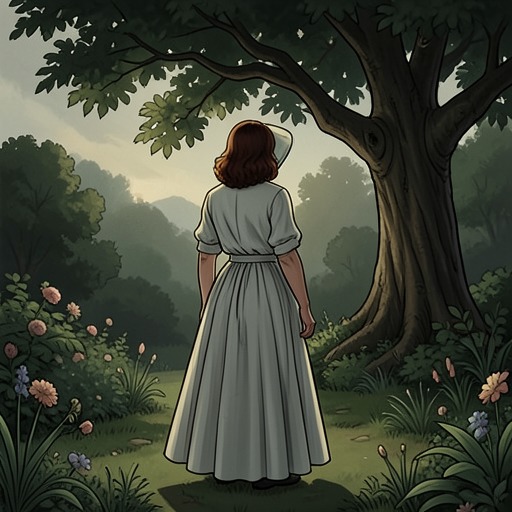
Nature and beauty as a comfort in suffering
Diary of Anne FrankNature and beauty become more than consolation in Anne Frank’s diary: they are a way of preserving inward freedom when persecution and confinement narrow the life available to her. A view of the sky, the bare chestnut tree, or the world beyond a window cannot undo suffering, but it can restore attention, happiness, and a sense of what remains human. The diary traces this refuge from family rituals and private grief to a considered conviction that beauty can sustain people even in misfortune.
Early Forms of Consolation
The motif first appears amid a life increasingly governed by restrictions. After the German occupation of the Netherlands, anti-Jewish decrees limited where Jews could go, when they could shop, and what they could do; the diary records the cumulative effect as a daily narrowing of freedom. Against that pressure, family memories retain their emotional force. Anne recalls that her grandmother died in January 1942 and that a later birthday celebration was intended to make up for earlier birthdays that had passed without much celebration. Her grandmother’s candle was lit with the others. The small observance does not remove grief, but it lets affection persist in a concrete, shared act.
Religious practice supplies another early, though uncertain, setting for reflection. When Anne’s mother gives her a prayer book, Anne reads a few prayers in German because they sound beautiful, while admitting that their meaning scarcely reaches her and questioning why she is expected to act devout. That reservation matters: the diary does not present comfort as the automatic result of religious observance. In a different register, the family’s Hanukkah celebration consists of a few small gifts and candles lit for only ten minutes because candles are scarce; Mr. van Daan makes a wooden menorah. The modest ritual joins beauty to material constraint: the light is brief, but singing and gathering make the observance meaningful.
The Attic View and a Change in Feeling
On February 23, 1944, a fine spell of weather changes the course of an ordinary morning in the attic. Anne goes there to get stale air out of her lungs and finds Peter cleaning. After he finishes, they sit together and look out at the blue sky, the bare chestnut tree glistening with dew, and birds wheeling in the air above Amsterdam. They remain silent, moved by the view; later, as Peter chops wood in the loft, Anne looks through the open window across the rooftops toward a pale strip of horizon. The scene gives nature its own presence: not merely a backdrop to their relationship, but an object of shared attention that briefly quiets speech and the enclosed routine.
The view also marks a change in Anne’s mood. She writes that as long as the sunshine and cloudless sky exist and can still be enjoyed, sadness need not have the final word. Her response is not a denial of the conditions around her. She and Peter have lost freedom and fresh air for a long time, and she distinguishes those losses from external comforts, which she says they have in adequate measure. The inward compensation she describes is not equivalent to liberty; it is the capacity to recover happiness through attention to nature, health, and what remains within a person.
Anne turns the morning into advice for Peter. When loneliness or sadness comes, she suggests going to the loft on a beautiful day and looking beyond the houses and rooftops toward the sky. The direction of attention matters: the roofs register the city and its limits, while the sky offers a wider field of vision. Looking at it fearlessly becomes, in her formulation, a way to recognize inner purity and find happiness again. The diary thus makes a particular place in the Annex—the attic and its window—an opening onto a world the hidden residents cannot freely enter.
Beauty as an Ethical and Spiritual Practice
Anne generalizes the experience into a belief that nature can console those who suffer. Going outside, somewhere one can be alone with the sky, nature, and God, is described as a remedy for fear, loneliness, and unhappiness. She believes that in such solitude a person can feel that things are as they should be and that God wants people to be happy amid nature’s beauty and simplicity. This is an assertion of faith grounded in looking, not an abstract claim that suffering is deserved or easily explained. The world’s beauty provides solace without explaining away the violence that makes solace necessary.
Her diary repeatedly draws a contrast between what can be taken and what can endure. Riches and prestige can be lost; happiness in the heart can be dimmed, but, while a person lives, it remains available to make happiness possible again. Nature is central to this account because it renews access to that inward resource. The claim is neither that the Annex’s losses are trivial nor that the residents are free: Anne explicitly longs, as Peter does, for freedom and fresh air. Instead, she insists that deprivation does not exhaust the self. The natural world can help a person recover a happiness that circumstances obscure but cannot wholly erase.
That conviction becomes clearest in Anne’s disagreement with her mother. After ending her prayers with thanks for what is good, dear, and beautiful, Anne says she thinks not of all the misery but of the beauty that remains. Her mother’s counsel is to think of the suffering in the world and be thankful not to share it; Anne’s is to go outside, enjoy the sun and nature, and seek happiness both within oneself and in one’s surroundings. She questions the security of her mother’s advice: if a person becomes part of the suffering, such a practice could leave that person lost. For Anne, attention to beauty is not complacency about other people’s pain. It is a means of keeping one’s balance when pain becomes one’s own.
From Private Refuge to Collective Hope
The motif carries a moral consequence as well as a personal one. Anne argues that a happy person can make others happy, and that a person with courage and faith will not die in misery. Her formulation links inward steadiness to responsibility toward others: finding consolation is not an escape from human bonds but a condition for sustaining them. Earlier, when she thinks of Hanneli and the danger and suffering her friend may be facing, Anne is overcome by the contrast between her own relative safety and Hanneli’s fate. She regrets having misjudged and neglected her friend, and longs to make amends if Hanneli survives the war. Beauty cannot rescue Hanneli in that moment; Anne’s reflection instead exposes the painful limits of private comfort and deepens her sense of obligation.
The diary also places this inward resilience alongside Jewish identity and collective endurance. In a moment of danger, Anne writes of Jews as people deprived of rights and confined to one spot, while insisting that the time will come when they will be people again and not only Jews. She asks why the Jewish people have been set apart and made to suffer, and places hope in the belief that God may lift them up again. Her faith that Jews have survived centuries of suffering and may grow stronger is not the same as the quiet happiness she finds looking at the sky, but the two convictions share a refusal to let persecution define the limits of the future. Nature offers solace to the individual; faith and communal memory extend hope toward a people under threat.
Across these passages, beauty remains a practice of noticing rather than a guarantee of safety. A candle burns briefly; the attic window opens only onto a view; the sky does not end the war. Yet these limited encounters allow Anne to affirm that happiness can return and that the world still contains something beyond suffering. Her diary gives that affirmation its force by holding it beside deprivation, guilt, fear, and uncertainty. Consolation is not presented as the disappearance of misery, but as the continuing possibility of seeing what misery has not destroyed.