Wartime scarcity and rationing
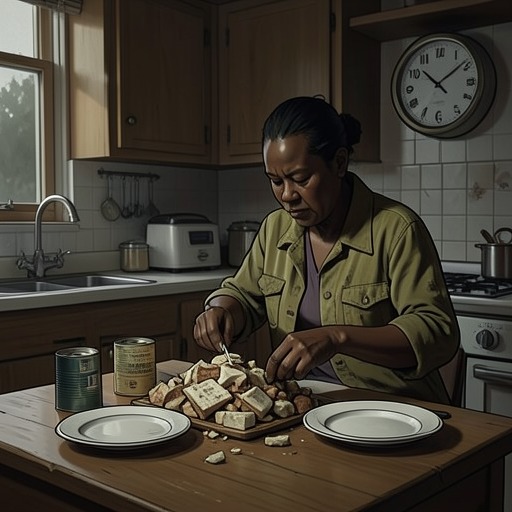
Diary of Anne FrankWartime scarcity and rationing are a continuing condition of life in the Secret Annex, governing meals, household work, clothing, hygiene, and the distribution of even small comforts. Anne’s diary records both the residents’ practical efforts to secure supplies and the gradual narrowing of what those supplies can provide: a cache of hundreds of food cans and three hundred pounds of beans exists alongside canceled bread, deteriorating produce, unequal portions, and prices that spiral beyond ordinary reach. The record makes deprivation tangible in objects and routines, while showing how shortage presses on relationships and on the residents’ sense of what a normal life might mean.
Supplies, Rations, and the Black Market
Food reaches the Annex through several imperfect channels. A friendly baker delivers bread daily, though in smaller quantities than the family had enjoyed at home. The residents also buy ration books on the black market. Their price rises from 27 to 33 guilders, and the books are only printed sheets: costly access to the right to obtain food, rather than food itself. The contrast between official entitlement and clandestine purchasing becomes especially sharp at Christmas. The residents are pleased to receive an extra quarter pound of butter, but the newspaper’s half-pound allowance applies to those fortunate enough to get ration books through the government. Jews in hiding can afford only four books instead of eight, so the public measure of entitlement does not describe their actual provision.
The residents try to make scarcity manageable by storing food for the long term. Alongside a reserve of one hundred cans, they buy three hundred pounds of beans, enough for the hidden group and the office staff. The sacks are first hung on hooks in the hallway just inside the secret entrance, then moved to the attic when their seams begin to split under the weight. Peter carries them upstairs; five arrive intact, but the sixth bursts, scattering about fifty pounds of beans down the stairs with a crash loud enough to alarm people below. The accident turns a stockpile into a laborious cleanup, and the beans continue to appear in corners and holes. The residents bend to collect them on later trips upstairs, saving handfuls to present to Mrs. van Daan. A provision acquired against future want thus becomes both a practical reserve and an ongoing household task.
The scarcity economy also reaches beyond food. Anne reports that the prices circulating outside the Annex have become almost unbelievable: half a pound of tea costs 350 guilders, coffee 80 guilders, butter 35 guilders a pound, and a single egg 1.45 guilders. Bulgarian tobacco sells for 14 guilders an ounce. Goods move through improvised exchanges: the bakery delivery boy offers darning thread, the milkman can obtain ration books, and an undertaker delivers cheese. The list conveys how ordinary errands and occupations have become entangled with the search for scarce supplies. It also places the Annex’s private shortages within a wider world where black-market trading is pervasive and the cost of basic goods has become a measure of wartime disruption.
Work, Portions, and Domestic Fairness
Shortage creates work as well as hunger. At one point, the residents fill packages with powdered gravy made by Gies & Co. Mr. Kugler cannot find anyone else to do the job, and having them perform it is cheaper. Anne compares it to prison work: repetitive, dull labor that makes the workers dizzy and giggly. It is an uneasy addition to domestic life in hiding, connecting the residents’ small household routines to the business operating below them while turning their time into a means of saving money.
The division of food is itself a source of conflict. When butter and margarine are apportioned, each person is supposed to receive a portion on an individual plate. Anne judges the allocation unfair: the van Daans, who prepare breakfast for everyone, give themselves one and a half times as much as they give her family. Her parents are too afraid of an argument to object. The episode makes rationing more than a question of quantity. Under pressure, the rules for sharing become a test of fairness, while the fear of worsening relations can leave a perceived imbalance unchallenged.
By March, the repeated reliance on beans has become difficult to bear. Anne says she can no longer stand to look at either brown or navy beans, and even thinking about them makes her feel sick. The household’s evening bread serving is canceled as well. These changes mark a tightening of the daily diet: a food bought in bulk as protection against future shortage becomes repellent through repetition, while a familiar portion disappears. Anne notices her father’s sadness in this setting, linking the visible emotional weight of scarcity to the diminishing meal.
The Worn Household
The strain extends from food into clothing, linens, and the implements of ordinary housekeeping. Anne compares life in the Annex with the relative comfort the residents had known before the war and wonders how they could hope to regain their former position when nearly everything they own has grown old and worn. An oilcloth has covered the dining table for the whole period in hiding. Cleaning it is difficult because the dishcloth, bought before they went into hiding, has more holes than cloth. The van Daans have slept through the winter on the same flannel sheet, which cannot be washed because detergent is rationed and scarce; its poor quality makes it nearly useless even apart from the difficulty of laundering it.
The worn objects register deprivation in each member’s circumstances. Anne’s father wears frayed trousers and a tie showing wear. Her mother’s corset snaps and cannot be repaired; Margot’s bra is two sizes too small. Mother and Margot have shared the same three undershorts throughout the winter, while Anne’s own are so small they do not cover her stomach. Anne insists that these troubles can be overcome, but the question that follows is larger: how can people whose possessions, down to a shaving brush, have become so depleted expect to recover the lives they had before the war? The smallness of each item makes the broader loss more legible without making it less consequential.
Objects can preserve something other than comfort. When Anne and Margot pack in preparation for going into hiding, Anne puts the diary into her schoolbag along with curlers, handkerchiefs, schoolbooks, a comb, and old letters. She knows she has packed some things indiscriminately, but she is not sorry: memories matter more to her than dresses. In the Annex, her father brings her postcard and movie-star collection, and she uses a brush and glue to cover the formerly bare bedroom walls with pictures. The room becomes more cheerful through objects carried or saved from the earlier life, even as the residents make do with worn clothing and scarce household supplies. The contrast distinguishes material abundance from material attachment: some objects serve basic needs, while others keep personal memory present.
Escalation and the Limits of Self-Sufficiency
The residents’ stocks and economies never remove their dependence on precarious supply. By the time Anne writes that the people who provide their food coupons have been arrested, the household has only five black-market ration books and no coupons, fats, or oils. With Miep and Mr. Kleiman sick again, Bep cannot manage the shopping. Anne uses a handkerchief scented with prewar perfume to cover her nose and mouth at the van Daans’ oilcloth-covered table, where the meal is mashed potatoes and pickled kale. The household expects to run out of fat, butter, and margarine the next day; fried potatoes, previously eaten for breakfast to save bread, must give way to hot cereal. A change in the suppliers’ circumstances and the loss of help with errands therefore alters both what can be bought and what can be cooked.
The ingredients themselves are deteriorating. The old pickled kale gives off a powerful odor, and the kitchen smells of spoiled plums, rotten eggs, and brine. The potatoes develop strange diseases; about one bucket in every two ends up in the garbage. The residents entertain themselves by guessing whether the potatoes have cancer, smallpox, or measles, making a grotesque game of a real loss of usable food. The humor does not cancel the deprivation: it is one way of passing time in a household whose meals are increasingly determined by what can still be salvaged.
Scarcity also exposes the limits of keeping the Annex functioning as a household. When the drains clog again, the residents cannot run water except as a trickle and cannot flush the toilet. They resort to a toilet brush and store dirty water in a large earthenware jar. They can manage for the day, but Anne worries about what will happen if the plumber cannot repair the problem before the Sanitation Department can come on Tuesday. Miep sends raisin bread inscribed with a greeting for Pentecost; the gift arrives amid conditions that make its cheerful message feel painfully out of step with the residents’ mood. The blockage, the jar, and the bread bring the material crisis down to essentials: water, sanitation, food, and the uncertain reach of help.
Across these episodes, rationing is not a single rule but a chain of constraints: limited access to coupons, black-market prices, reduced portions, extra labor, deteriorating goods, and worn possessions. Anne records the chain through particular things—the costly ration-book sheets, the scattered beans, the missing evening bread, the unwashed sheet, the spoiled kale, and the jar of dirty water. Their recurrence shows how shortage reshapes both practical arrangements and judgments about fairness, while the diary’s preservation of old letters, pictures, and other valued belongings keeps memory in view as material life contracts.