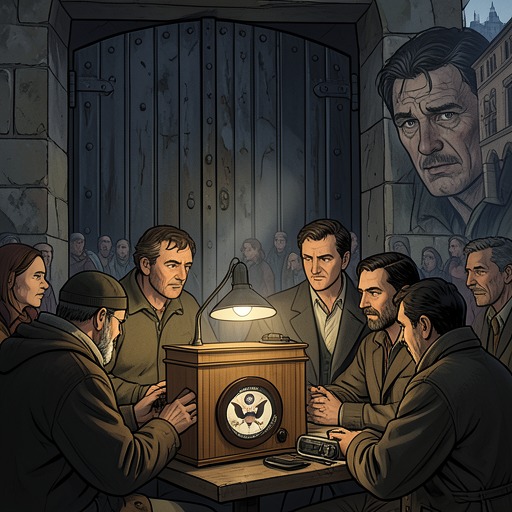
the Annex radio
Diary of Anne FrankThe Annex radio connected the residents of the Secret Annex to the war beyond their walls, turning distant broadcasts into shared news, argument, fear, and hope. Its importance lay not only in what it transmitted, but in the perilous conditions of listening: broadcasts had to be weighed against the danger of being heard, and the large set was eventually surrendered under the authorities’ order even as a smaller replacement was arranged.
Access and Security
The rules for the residents’ private radio made listening a regulated activity. It was available to them after 6 p.m., with German stations permitted only for classical music; German news bulletins were forbidden, whether transmitted from Germany or elsewhere, and residents were not to pass them on. The rules placed listening alongside other routines—rest hours and restrictions on movement—as part of the discipline required to keep the hiding place safe.
That danger was immediate from the beginning. During one early group listening session, the four residents went down to the private office to hear England. Anne was so afraid that someone outside might hear the broadcast that she begged Otto to take her back upstairs; Edith recognized her anxiety and accompanied her. The episode shows the radio’s double character: it offered access to the outside world while making the listeners acutely conscious of the walls that had to conceal them.
A Shared Source of News
Listening could bring the residents together. At a regular midday gathering, helpers and residents clustered around the radio to listen to the BBC. For that interval, even the household’s usual interruptions and arguments stopped: Hermann, who might otherwise argue, could not contend with the speaker. The broadcast created a common focus within a crowded and divided household.
The radio also carried news that gave shape to distant events. On September 8, 1943, the residents heard an announcement that Italy had capitulated. The Dutch broadcast from England followed, and its program included “God Save the King,” the American national anthem, and the “Internationale.” The sequence made political news audible as both report and public ceremony, while the diary notes the program’s effort to encourage listeners without becoming overly optimistic.
By June 6, 1944, the BBC’s announcement of D-Day brought the invasion into the Annex in a rush of bulletins. Reports described the bombing of French coastal cities, General Dwight Eisenhower’s address, and the scale of the operation: 11,000 aircraft and 4,000 landing craft and small boats. The residents’ excitement turned quickly into cautious hope. The broadcasts could announce that liberation might have begun, but they could not promise when it would reach them or what further suffering remained.
Surrender, Replacement, and Continued Listening
The large Philips radio had to be given up under an order requiring people to hand in their sets. The residents regarded it as a valuable source of morale, but could not risk drawing the authorities’ attention. Victor arranged for a small hidden set at his home to replace it, and the diary describes the planned exchange as a practical compromise: the conspicuous cabinet radio would go, while a small clandestine receiver would serve the people in hiding.
The loss of the large set did not end the radio’s role. Later entries describe broadcasts and special air-raid announcements being heard repeatedly from morning until late at night. The adults took turns listening to programs that included “Music While You Work,” Frank Phillips, and Queen Wilhelmina, as well as news from the BBC. Anne found the near-constant listening tedious, but her complaint also records how thoroughly radio had entered the Annex’s daily rhythm: it supplied both a stream of information and a recurring subject of conversation.
Information, Fear, and the Diary
Radio reports formed only one part of what the residents knew about persecution. Miep brought accounts of people deported to Westerbork, while Mr. Dussel described roundups in which families were taken from their homes and people were marched away under guard. The diary distinguishes such accounts from the residents’ own experience: news reached them through helpers, visitors, and broadcasts, and its emotional force grew from the knowledge that friends and acquaintances were among those at risk.
The radio’s significance therefore exceeded its function as a receiver. It made events outside the Annex present within it, sometimes offering encouragement and sometimes deepening dread. In the diary, the contrast between anxious listening, shared attention, unwanted repetition, and moments of public celebration records how a fragile communication link could help the residents orient themselves to the war while reminding them that they remained hidden, dependent, and exposed.