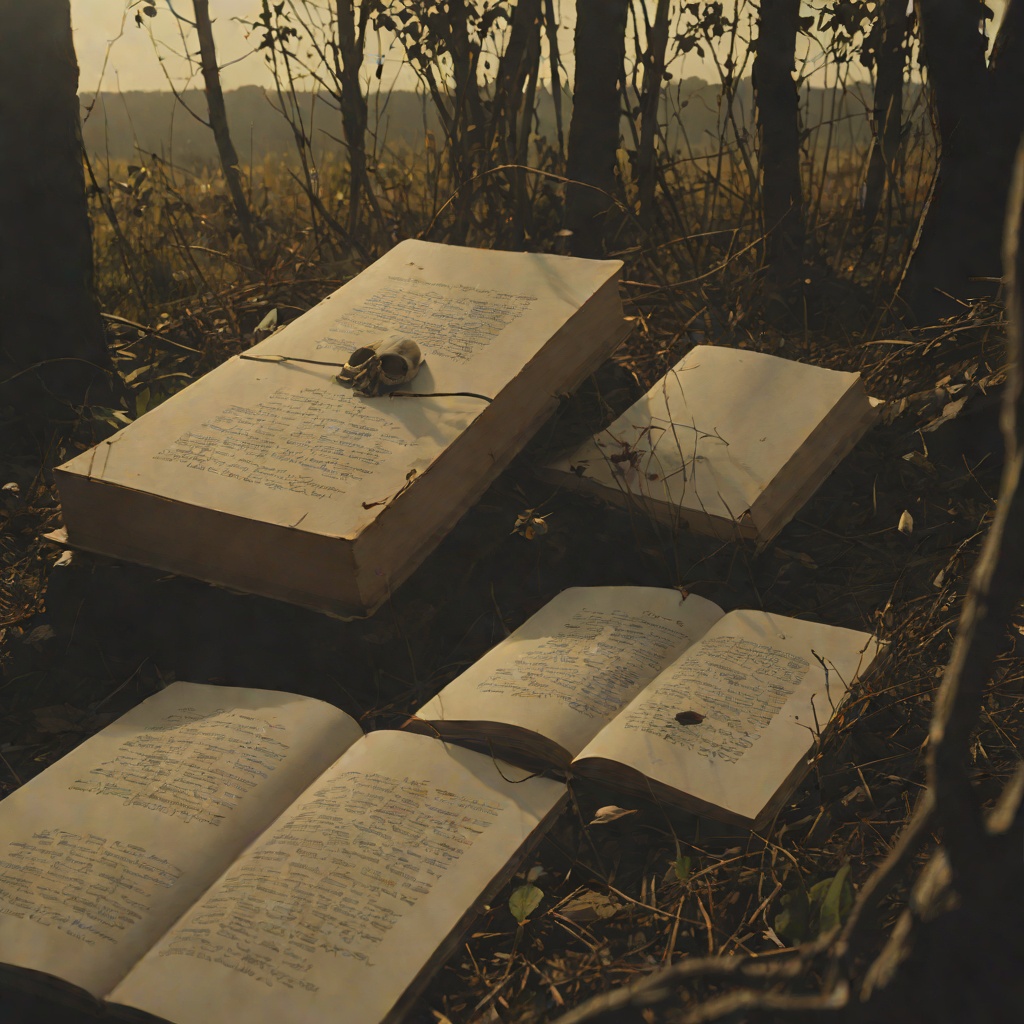
Death
Die, My LoveDeath functions in the narrative as both an inescapable physical reality and an atmosphere that reorganizes the living. It is present in the family home after the Father-in-Law’s death, in the public crowd gathered to watch a boy’s possible end, in the Narrator’s violent and erotic self-description, and in a landscape where animals and isolated people disappear before they can reproduce. Rather than remaining confined to graves or corpses, Death becomes a language for grief, alienation, desire, and the collapse of distinctions between ordinary life and catastrophe.
Death in the Family Home
The Narrator first experiences Death as an intrusion into the household after the Father-in-Law has died in his sleep. Night, the newborn child, and the family meal are all drawn into the same field of dread. While the others eat Christmas leftovers and gather around the fire, the Narrator remains outside in a wicker chair, counting fireflies and animal cries because she fears the harm she might cause the baby. Her fear is not presented as a clear diagnosis: she does not know whether she is losing her mind, and neither her Husband nor any doctor can establish what is happening. The uncertainty allows Death to spread beyond the fact of the Father-in-Law’s death into the unstable consciousness of the living.
The house itself becomes a mortuary environment. Death is perceived in the fire, carpet, curtains, old furniture, silverware, flowerless vase, and umbrellas piled near the door. The image is not merely decorative. It shows how bereavement alters perception: ordinary objects retain their practical identities while becoming saturated with the knowledge that someone has vanished. The Narrator repeatedly lies down and gets up, loses track of when each action occurred, and imagines the baby disappearing among the sheets like a tiny fish. The family’s future is consequently pictured through funeral imagery, with everyone, including the children, wearing black.
The Father-in-Law’s last remark, that his grandson would follow in his footsteps, was intended as a broad platitude, yet it becomes ominous after his death. Standing before the grave, the Narrator remembers the dead man’s teeth, especially his habit of complaining about them or picking food from between them while speaking. This sharply physical memory resists the abstraction of respectful mourning. He is not reduced entirely to a symbol of mortality; he remains a body with pain, habits, and an unappealing intimacy that memory preserves.
Death also changes the imagined future of the Mother-in-Law. The Narrator pictures her airing the house, discarding her husband’s spectacles, smelling him in the backrest of his rocking chair, cooking with the pans used for his fried eggs and porridge, and giving his socks to neighbours with the same size feet. These details make widowhood a sequence of practical substitutions rather than a single solemn instant. Yet the dead man continues to occupy the house through remembered speech, coughing, snoring, clothing, furniture, and bodily routines. The Mother-in-Law says that he squeezed her hand just before dying, although the doctor explained that the movement was only a reflex. The Narrator feels close to her for the first time at precisely this point, when the disputed gesture becomes a fragile boundary between intention and involuntary bodily action.
Death as Public Spectacle
Death becomes collective and theatrical during the family’s Sunday outing near the suspension bridge. The Husband drives, the Mother-in-Law follows with a sore back, and the baby crawls about while families gather to watch the sunset. The setting is populated by grandparents away from the nursing home, children and grandchildren, depressed pregnant women hiding cigarettes, and a recovering heroin addict. The apparent normality of a family excursion is already shadowed by illness, dependency, and concealed distress.
The arrival of police cars and fire-fighters transforms the outing into a public gathering. A thirteen-year-old gay boy has announced his farewell on Twitter and come to the bridge to throw himself off it, thanking his followers beforehand. Police tape is erected but cannot keep the crowd away; even the baby is allowed to look. The event therefore exposes a disturbing social impulse: spectators assemble around another person’s threatened death as though attending a fireworks display. The emergency response and the crowd’s curiosity become part of the same scene, each claiming to manage the crisis while remaining drawn toward its spectacle.
The Narrator refuses the consoling separation between spectators and victim. She does not want to waste time watching a corpse float on the water, yet her attention is fixed on the possibility that the corpse will become indistinguishable from the living. She imagines a lorry driver unable to tell the difference between a man resting beside the road and one who has recently been run over, or between someone lounging in the sun and someone who has suffered a stroke. Death here is not defined by a spectacular final gesture but by a barely perceptible alteration in bodily status. The ordinary Sunday outing ends with the bitter suggestion that a lovely day was shared by all, even beside a possible suicide.
Death, Desire, and the Narrator’s Body
Death is also the Narrator’s vocabulary for erotic and emotional upheaval. After the encounter at the fence, desire is rendered through images of lightning, white sand, a suddenly transformed town, and a horse brushing against the body. The surrounding world becomes arousing because longing gives insignificant things an excessive charge. Yet this awakening is immediately joined to anticipated sickness: the Narrator knows that she will go into the woods and vomit. Pleasure and repulsion are not separate stages but simultaneous effects of an experience that makes the familiar world unstable.
The Husband’s jealousy converts the affair into bodily violence and an assault on language. He demands to know whether the Narrator is sleeping with another man, while she cannot find an adequate answer to the force of what has happened. Her own imagery describes the lover’s entry into her body through predatory animal comparisons and the image of a machete making space. She experiences the encounter as a kind of internal death, saying that from within her darkened body he killed her. The statement does not describe a literal killing; it names the destruction of the identity maintained by marriage, domestic routine, and the expectation of emotional coherence.
The conflict ends in the first collision with the glass. The Narrator runs outside, bleeding, and crosses the pastures as though they were a park, trampling rabbits and barn owls while wondering whether the animals were trampling her instead. She lies in her kennel, a cave among pruned trees, with wet socks and dried blood on her body, then spends the long night looking at graves until sunrise. The sequence links violence, flight, animality, burial, and dawn. Her wounded body becomes a surface on which the boundary between human subject and creature, home and wilderness, life and death is repeatedly tested.
The Narrator subsequently turns every intimate act into an imagined disturbance of the dead. Sex becomes a celebration of the birthdays of the departed; falling in love becomes scattering earth onto a coffin; masturbation becomes desecrating crypts; rocking the baby becomes saying amen; smiling becomes unplugging an iron lung. These startling substitutions show that Death has colonized the symbolic meaning of ordinary gestures. The passage culminates in the recognition that she has felt dead throughout her Husband’s jealous shouting, even before the kiss and before birth. Emotional death therefore precedes, accompanies, and outlasts any clearly identifiable physical death.
Repetition, Loss, and the Natural World
The narrative extends Death beyond the family and the self into a broader geography of extinction. The Narrator remembers an island of men who search for beauty within confinement, contrasting it with a present in which there is no other, no soul, and no stable beloved to return to. A former lover once promised to mark a fatal sign on her womb and take her to fertile lands, but that night has become impossibly remote and the lover has disappeared. The memory survives as a series of sensory impressions—hands in twilight, the skin of a back, a bewitched throat—after the people associated with them are gone.
Around her, human and animal deaths form a bleak local pattern. A neighbour dies of a heroin overdose while holding a baby; a woman in a house with boarded-up windows suffocates in the smoke of her own fire; animals die before reproducing. The Narrator presents these incidents as what Death looks like in that place: not one exceptional catastrophe, but interrupted continuities, extinguished households, and life prevented from renewing itself. Against this landscape she sets memories of sun-soaked nights on the island, sexual reawakening, furious kisses, and stimulating conversation. The contrast makes the past seem less like a recoverable refuge than a lost intensity whose disappearance sharpens her antipathy toward the world.
Even the animals respond to this atmosphere as though it were a ritual scene. They form a circle around the Narrator and watch her with their jaws practically unhinged, while she falls to her knees before them. She imagines that a local person gathering mushrooms and berries would interpret the scene as a pagan ritual. Death thus produces a temporary reversal of human hierarchy: the Narrator is observed by animals, placed outside familiar social meaning, and made into an object within a ceremony she cannot control.
Meaning and Narrative Function
Death’s decisive narrative function is to dissolve stable categories. The living and the dead can become indistinguishable to a passing driver; a reflex can be mistaken for a final gesture of love; a family outing can become an audience for suicide; erotic fulfillment can be narrated as murder; and maternal tenderness can coexist with images of coffins, graves, and iron lungs. The book does not treat Death as a distant conclusion that gives life a clean moral shape. It treats it as a pressure already operating inside domestic affection, public behaviour, sexuality, memory, and language.
The Narrator’s fragmented declarations make Death both subject and method. Her repetitions and improbable transformations do not resolve grief into an orderly account; they show a consciousness returning compulsively to disappearance from different angles. The dead Father-in-Law remains present through objects and sounds, the bridge victim is imagined through the crowd’s inability to distinguish bodies, and the Narrator defines her own emotional condition by claiming to have been dead all along. In this structure, narration becomes a form of witness that cannot restore what has been lost but can expose how thoroughly loss has entered the living world.
Death finally carries a tragic and ironic force at once. It is terrifying when attached to the newborn, the suicide, the overdose, the fire, or the body lying bloodied in the field; it is grotesquely comic when ordinary acts are translated into funerary ceremonies. That oscillation prevents mortality from becoming a solemn abstraction. Death is instead a material, social, and imaginative condition, one that makes the Narrator’s family life unbearable while also providing the imagery through which she can say what ordinary language cannot contain.