Final separation
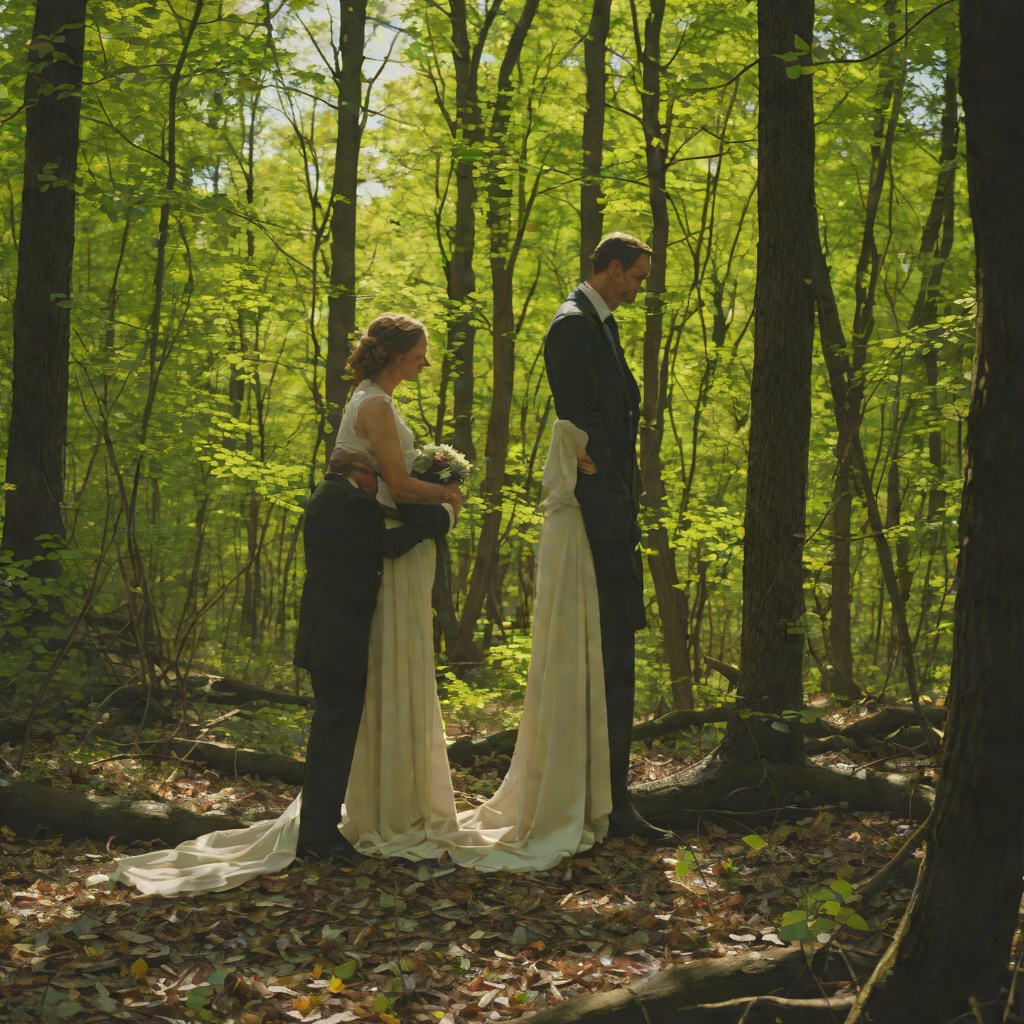
Die, My LoveThe Final separation is the novel's climactic break-up, the moment when The Narrator and The Husband part for good in the woods after the two men—The Husband and The Radiologist—have reached an agreement about her future. It is the book's decisive act of closure, a scene that converts the long-threatened dissolution of their marriage into a concrete, irreversible event. The separation is not a violent rupture but a quiet, almost bureaucratic transaction, conducted in a car parked among the trees, and it ends with The Narrator walking alone into the undergrowth, her life having been decided by others while she remained a passive, trembling witness.
The Agreement and the Question
The scene begins in the aftermath of the confrontation between The Husband and The Radiologist, who have been seen squaring up like duelists before the tension dissipates and they settle into something like two long-lost brothers reminiscing about their childhood and discussing how to settle their dead parents' debts. As they talk, The Narrator watches from a distance, her life coming and going before her eyes, unable to hear what is said but reading their understanding in the way they step aside and nod. One of them yawns, the other laughs, and they reach an agreement. The Narrator trembles, wondering which of them will be her "black-market buyer," what will become of her life, in which home she will live, and what she will be called. When one of the men coughs, she knows it is The Husband, "the most loyal of the two," who comes toward her. They walk to the open-top car in silence, a silence more complete than all those that had come before it.
The Drive into the Woods
As they drive home in the rain, The Narrator notices a row of cypresses and asks if they are new; The Husband replies that they have always been there. He does not stop at the front door, and she can tell the party is over because a few blue balloons are drifting over the garden, which she calls a minefield. She asks if the baby is asleep inside, and he answers that the child is not a baby any more—but what she understands is that he is not her baby any more. They drive into the woods, the wheels leaving tracks in the earth, with few animals awake. The stag does not appear, but The Narrator is there instead. He turns off the engine and relaxes, letting out a breath he has been holding in for too long, and asks, "So what do you want to do?" The question is the last thing she expected; she had thought the outcome would be positive or negative, that he would tell her how much time she had left in weeks or days, that he would cry. Instead, he asks a question, and she cannot say a word. He says, "Poor thing," and her whole life becomes a shrill whistle piercing his silence. The trees in the wood are like tigers in heat. He tells her, "I won't be able to forget," and for the first time he is serious. Another silence follows, more stifling than the last, and the buzzing in her ears plummets to the ground like a dead bird. There is nothing to say after the look he gives her.
The Twins and the Last Laugh
When he sees she is not going to put up a fight, The Husband lights a cigarette and adds, "Besides, they're expecting a child. Two, actually. They're having two tiny twins." Although they try to stay serious, they cannot help but laugh, about what she does not know—perhaps the sound of the words "two tiny twins." He asks, "And what if we have one? Another child?" The question gives him a coughing fit, and then they are in hysterics again. "Another child, us!" The two of them sit there laughing together for the very last time like a happily married couple. The laughter is a grotesque counterpoint to the gravity of the moment, a shared joke that seals their separation even as it mocks the idea of their continuing together. It is the final expression of their intimacy, and it is immediately followed by its dissolution.
The Walk into the Undergrowth and the Mourning
The Narrator gets out of the car without opening the door, noting that the convertible happens to be a very practical model for break-ups, and The Husband turns and sees her disappear into the undergrowth. At first, she feels nothing but pain, the kind of pain a person does not share, not even with herself. She is in mourning for a long time, but there comes a moment when, like the widow who unlocks her front door for the first time, who eats dinner in silence for the first time, who gets into bed alone for the first time, she feels a sadness that is exhilarating, wild. The separation is thus framed not as an ending but as a kind of rebirth, a release into a new and frightening freedom. The widow imagery transforms her grief into a form of agency, suggesting that the loss of the marriage is also the beginning of a solitary, unscripted life. The final separation is the novel's true conclusion, the point at which The Narrator's long passivity gives way to a single, decisive act of walking away, and the wild sadness she discovers is the emotional residue of a life finally her own.