Madness
Die, My LoveMadness is not presented as a detached diagnosis but as a shifting condition that reorganizes the Narrator’s body, perception, speech, and relationships. It begins in fear of what she might do to The Son, intensifies through self-harm, rage, sexual alienation, and withdrawal from domestic life, and culminates in The Husband’s decision to place her in The institution. Yet the treatment does not simply restore her. It produces a temporary calm and a new social identity, while the old images of violence, the stag, the glass door, and the family return with altered force.
Definition and First Manifestations
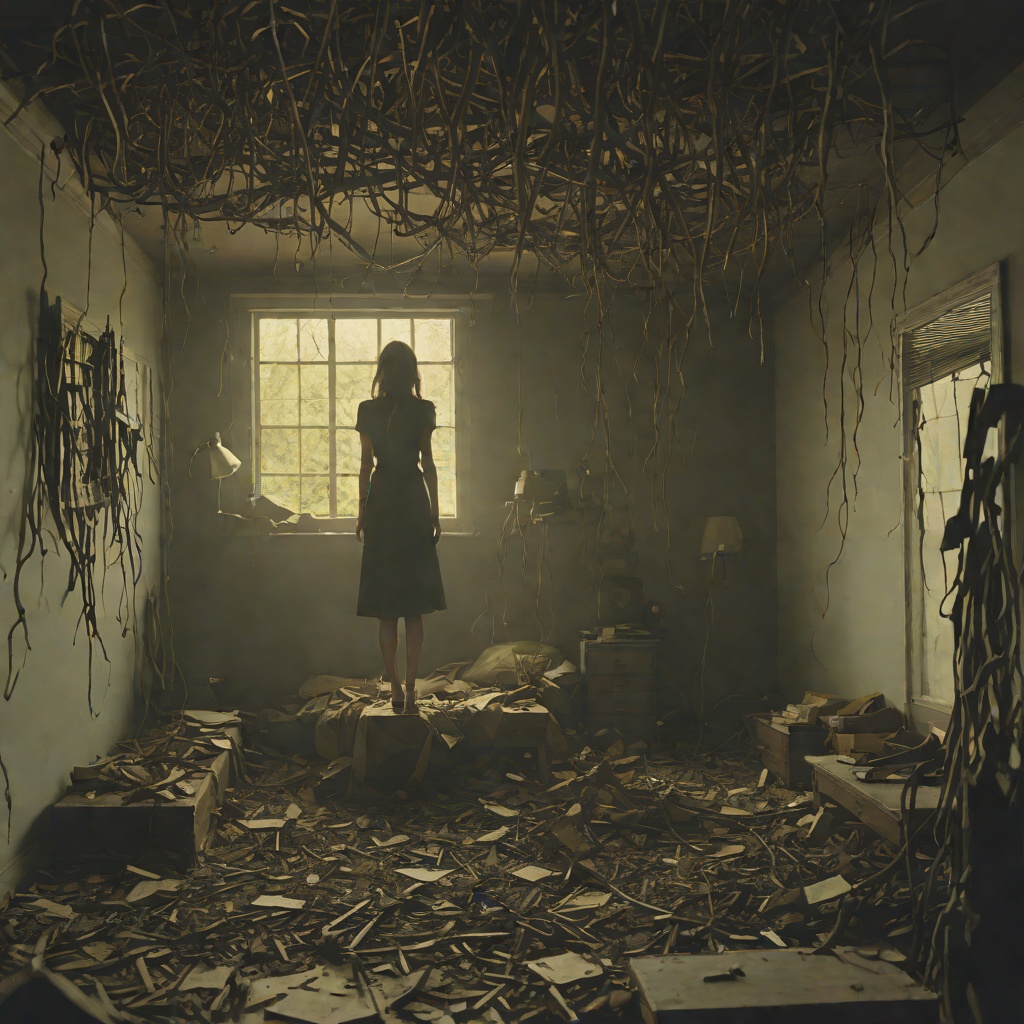
Madness first appears as an atmosphere of apprehension rather than a clear medical condition. Sitting hidden in the underbrush near the house, the Narrator imagines using the sun on her palm like a knife to bleed herself through the jugular. Behind her, The Son and The Husband are naked in a paddling pool, absorbed in ordinary domestic play, while she experiences herself as a weak and perverse woman who may be unfit to be either mother or wife. She does not kill them: she drops the knife, hangs their socks and shirts on the line, and returns to the kitchen as though nothing has happened. The contrast between murderous fantasy and successful laundry establishes one of the novel’s governing tensions. Madness does not remove her from routine; it forces her to perform routine while catastrophe continues internally.
The domestic setting repeatedly makes that division more severe. In The Son’s room, the Narrator watches him nurse, hears The Husband smoking outside at regular intervals, and describes milk, burping, breath, nappies, and swaddling as a chain of bodily pressures. She repeatedly imagines crashing through the glass and cutting herself, but stops before impact and slides the door open instead. The impulse is therefore both destructive and interrupted: the same boundary that promises injury also marks the point at which she returns to the household. The family’s ordinary gestures do not reassure her. They make her feel trapped inside a role whose surface continuity conceals psychic disintegration.
After The Father-in-Law’s death, the condition becomes more openly associated with anxiety and altered perception. The Narrator sits apart from the family table on the porch, counting fireflies and animal cries while imagining that the night marks a decline into an altered state. She cannot tell whether she is losing her mind, and neither, she says, can anyone else—not even a doctor. Death seems to seep from the fire, carpet, curtains, furniture, silverware, flowerless vase, and umbrellas near the door. The funeral and the surviving family’s gestures are perceived through this saturation: The Mother-in-Law’s grief, the child’s smile at the grave, and the dead man’s imagined presence all become part of a world where the living and the dead press against one another.
Bodily Crisis and Escalation
Madness is expressed through the body before it can be stabilized in language. The Narrator is brought to The hospital unconscious after being lost to the world in a field. Nurses treat small cuts scattered across her shoulder blades, chest, belly, and neck, removing shards, splinters, crystal, mirrors, petals, and slivers of glass. The wounds are literal, but they also repeat the novel’s image of the broken boundary: the glass that she once wanted to cross has entered her body in fragments. Staff warn her not to pick at the scabs, while each new nurse pauses to stare at her injuries. Their scrutiny turns suffering into a spectacle and places her between patient, suspect, and object of observation.
The return home does not resolve the crisis. The Narrator pulls grass from the lawn until worms, soil, and green and yellow blades blend in her hand, then throws a wooden chair at a mirror, tears a wardrobe door away, and rips shutters from the window. Blood in her underwear becomes difficult even for her to interpret: she considers whether it might be a miscarriage, then rejects that explanation and calls it the remains of her body. The scene makes bodily knowledge unreliable while making destruction precise. The Husband cuts wood beside The Son, and the child watches both the timber breaking and his mother breaking down, smiling at the airborne fragments as if they were dark snow. The image of the normal mother is thus maintained only from the child’s limited perspective; the Narrator knows how far she has moved from it.
Her agitation also takes the form of impossible physical intensity. She runs through wet fields, imagines a body that will remain undiscovered for years and become forensic evidence, and describes her breath as powerful enough to fog castle windows and suffocate everyone else. The Husband responds with cushions and then with red boxing gloves from his adolescence, trying to convert her distress into a manageable physical activity. She rejects the gloves, the boxing ring, and the chest guard. What she wants is not controlled release but a vision of her hands reduced to bones and firing in every direction. Sexual contact follows, but the encounter offers no restoration: desire is described as absent from her cries, and her fantasy turns instead toward a white room, sea air, salt, and someone who might heal her eyes and retrain her gaze.
Domestic Normality and Medical Authority
The Narrator’s madness is defined against the phrase normal family. She sees herself as an educated woman, a university graduate, yet judges herself more animal than dying foxes. She imagines a stateless version of The Son, without a date of birth, last name, or social status, born in the darkest corner of the woods rather than registered in a delivery room. This fantasy rejects the administrative and familial systems that make a child legible, but it also reveals how motherhood has become an institutional demand rather than a secure identity. The stag’s golden eye, rather than The Husband’s love or The Son’s love, is what she says saves her, suggesting that an animal presence offers a form of recognition outside domestic language.
The crisis becomes a marital and medical dispute when The Husband asks her to sit down and introduces the word treatment. His phrase signals that he now sees her as a woman who must be calmed, reduced, and made manageable. She imagines the psychiatric setting through its sheets, white walls, pills, capsules, craft workshops, juice, and illustrated books, anticipating a regime that will return her to society once she has become sufficiently quiet. Before that future can arrive, she vomits the couple’s ten years over the table, chair, and sofa. The bodily expulsion turns the marriage itself into material that can be discharged, while The Husband must decide whether to clean, embrace her, call an ambulance, or have her committed. The Son watches from beneath the table, apparently understanding the scene with an adult’s clarity.
The confinement is therefore presented as The Husband’s response to a domestic emergency as much as as a clinical intervention. He drives her toward The institution with The Son in the car, describing the journey as a cure that is approaching. The Narrator imagines the destination as a new home where she will eat toast with plum jam made by disturbed inpatients, work in a vegetable garden, attend craft workshops, and sleep on a narrow mattress among patients’ nightmares. The fantasy is grotesquely cheerful and self-conscious: she treats institutional life as both punishment and honeymoon, a place where morbid sexual anxiety might finally disappear. On arrival, however, no tour or family transition occurs. Staff seize her arms, The Husband and The Son wave goodbye, and the car leaves while she is forced down a hallway of closed doors and shut away.
Confinement and Altered Perception
Inside The institution, Madness becomes a problem of social classification. The first doctor tells her that she is free to leave whenever she wishes and describes the establishment as merely calmer than other places, but the reassurance conflicts with the circumstances of her arrival. She initially experiences the clean, comfortable facility almost like a hotel and goes to the dining hall feeling alive, greeting patients, kissing cheeks, shaking hands, and offering encouragement. The apparent recovery is not a simple return to ordinary behavior; it is another sudden transformation in her relation to other people.
The institution’s environment also exposes the gendered limits of the care offered to her. A high wall divides the grounds from a villa and German shepherds, while cumbia lyrics, newspapers, smoking, coughs, deep voices, and testosterone surround her. She realizes that The Husband has placed her among men, with only two females whom she does not consider to belong fully to that category. The patients appear as shaved-headed walnuts, and the staff’s gestures carry sexual as well as disciplinary menace. At a card table, a teammate signals for a card while looking at her with eyes that communicate sexual appetite. At night, barking crosses the wall from another life, and an unidentified man’s jawbone appears in her mouth and his eyes on her body. She wants to make him disappear, yet lets desire carry her away and does not think about The Son. The scene refuses to separate illness from sexuality, coercion from attraction, or recovery from the persistence of forbidden desire.
Perception in confinement remains unstable and bodily. When the Narrator wakes believing she is inside the woods, she notices that she no longer feels love for The Son. She searches for The Stag and finds nurses instead. Staff blindfold her, spin her around, and place something like a needle in her hand as other people guide her through a piñata game. The scene turns therapeutic or celebratory ritual into disorientation: cold, warmth, and heat are transmitted as shouted directions, while the blindfold becomes more comforting than sight. When it is removed, streamers, signs, gifts, cards, good-luck charms, and confetti announce her departure. The institution stages discharge as a new life, but the Narrator experiences it as both ending and beginning, with gloom and pessimism waiting outside rather than safely contained within the building.
Return, Recurrence, and Significance
The return to the family is framed as a ceremonial reintegration. The Husband appears dressed up and The Son wears a football kit; they hold hands and embrace the Narrator as though she has graduated and is ready to resume life. The Son is now walking, has more teeth and hair, and speaks more, so the period of separation has materially altered the child she left behind. The Husband jokes that her release will allow the family to live in peace, a remark that converts confinement into a solution for everyone else’s domestic disorder as well as for her distress.
Back at the house, the signs of order are conspicuously new: a microwave with a flashing time, a flower-patterned tablecloth, and a cordless phone with a notepad. The scene resembles a repaired normality, but the Narrator’s hand again contains the reflection of the first knife she ever dreamed of. She imagines that a genuine mental asylum, rather than a place merely intended to rest her, might have prevented this return of the weapon. She moves toward the repaired glass door, now fitted with mosquito mesh, and runs outside searching for The Stag’s antlers. The recurrence of knife, glass, and stag shows that treatment has changed the setting without eliminating the psychic structures through which she experiences herself.
Madness consequently functions as both state and contested label. The Narrator’s self-harm, suicidal fantasies, rage, hallucination-like images, sexual compulsion, and loss of maternal feeling are concrete experiences, but the novel never grants The Husband or the doctors complete authority to explain them. The condition is entangled with grief, pregnancy and its aftermath, motherhood, marital jealousy, domestic labor, and the demand to appear normal. Its narrative form is fragmented and repetitive: a knife is imagined, dropped, and later reappears; glass is feared, crossed, broken, and repaired; the woods return as an internal landscape; and the stag’s gaze survives where family love fails. Madness is therefore not merely the Narrator’s deviation from reality. It is the pressure generated when the roles meant to make life coherent—wife, mother, patient, and member of a normal family—become unbearable, and when the language of treatment promises peace by concealing the violence that produced the crisis.