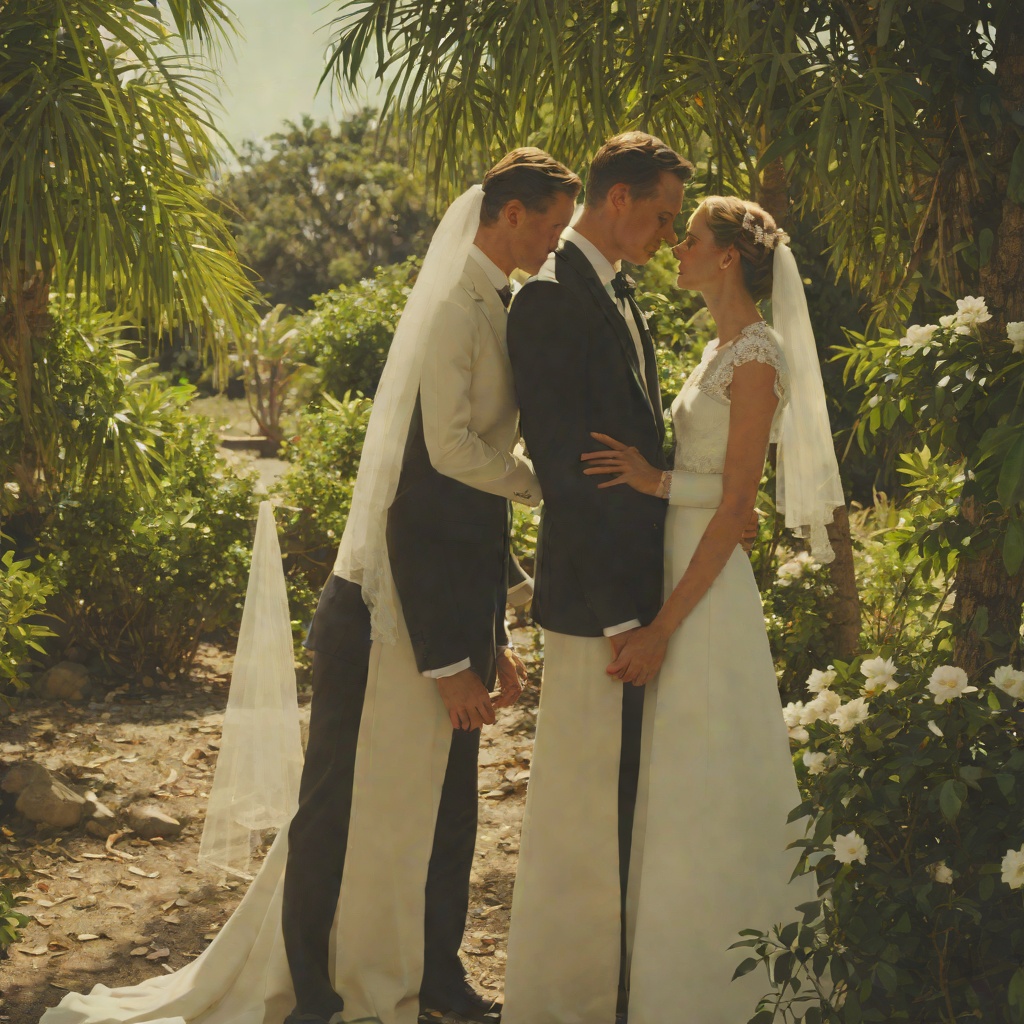
Marriage vows
Die, My LoveMarriage vows are the central verbal instrument of the wedding ceremony: they transform a private pair into a publicly recognized husband and wife by combining religious authority, mutual promises, witnesses, joined hands, and a final declaration. In the narrator’s experience, however, this language does not produce emotional unity. Its solemn assurances of love, fidelity, care, and lifelong obligation are spoken over a mind that has already begun to flee, making the vows an exact measure of the distance between social form and inner reality.
Ritual Form and Public Authority
The ceremony takes place in a makeshift chapel before a parish priest who is described as even less religious than the narrator. The priest nevertheless recites the established formula before God and the witnesses, asking whether the man will take the woman whose hand he holds as his lawfully wedded wife and whether he will love, honour, and cherish her while forsaking all others. The wording presents marriage as a complete moral arrangement: affection is joined to duty, exclusivity, and obedience to a public religious order.
The corresponding question is then put to the narrator. The symmetry of the exchange gives the ceremony its apparent fairness, since each partner is required to make a parallel commitment. Yet the scene also shows how ritual can impose a shared meaning on individuals whose experiences are not shared. The guests watch the narrator as the main attraction, while the words intended to create mutual consent become part of a spectacle in which her inward response is difficult to perceive.
Promises and the Narrator’s Divided Consciousness
The narrator answers the first question with consent, but she cannot actually hear the ceremony clearly. The priest’s speech dissolves into babbling and buzzing, suggesting that the formal language has lost its communicative force even as it continues to operate institutionally. The vow is spoken, but its meaning does not settle inside her as conviction. This separation between audible formula and subjective comprehension makes the marriage promise an instance of language acting despite the failure of language to provide genuine understanding.
The phrase concerning a husband’s duties and a wife’s duties carries a particular pressure. It defines marriage not only as feeling but as a prescribed system of obligations, and the narrator’s response registers that system as something from which her body and imagination are already attempting to escape. While the ceremony promises a lawful and exclusive union, she imagines her legs running down the road toward a parallel life. The marriage vow thus contains its own contradiction: the words demand a singular future at the very moment her consciousness produces another one.
Her inner imagery intensifies the contradiction. Before she reaches her own consent, she sees herself covered in grass and retains the strength and will to sink a knife into the flesh of a cow. These images do not belong to the orderly language of the chapel. They bring animality, bodily force, and possible violence into collision with the polished moral vocabulary of matrimony. The result is not a simple refusal spoken aloud, but a ceremony haunted by impulses that the ceremony cannot absorb.
Death, Permanence, and the Problem of Separation
The priest presents the marriage bond as lasting until death parts the couple. The formula is meant to establish permanence by making death the only legitimate limit of union. The narrator immediately turns that promise into an uncertainty about corpses, burial, and survival: she wonders which of them will see the other’s corpse and which will bury whom. The vow’s confidence is therefore answered by a question about mortality that it cannot resolve.
This response changes the value of the phrase “till death do you part.” Instead of reassuring the narrator, it makes marriage inseparable from the prospect of death. The words that are supposed to secure the future expose the future’s unknowability, while the promise of permanence becomes a reminder that the bond may be completed only through loss. The ceremony’s sacred language remains intact at the level of public performance, but its emotional effect turns from certainty toward dread and instability.
Declaration, Consequence, and Collective Celebration
After the couple has consented and joined hands, the priest declares them husband and wife and invokes the injunction that those joined by God must not be put asunder. This is the decisive performative moment: the declaration does not merely describe a relationship but officially brings its public status into existence. The words conclude the questioning and convert the couple’s responses into a social fact recognized by the assembled company.
The guests respond with whoops compared to the cries of jackals and hyenas. Their celebration demonstrates the vow’s collective afterlife: once spoken, it belongs not only to the couple but also to the witnesses who acclaim, repeat, and enforce its meaning. The newlyweds are lifted in chairs, spun around, and hailed with cries of “Hurrah!”, “Long live the newly-weds!”, and “Hallelujah!” Rice is thrown over them, lodging in the narrator’s pores, and the ritual’s physical signs of blessing become intrusive rather than comforting.
The ceremony then breaks into grotesque disorder. Lumpy lips kiss the narrator in sequence, while hunting dogs with reptile tails whirl through the room, upsetting the tablecloth and smashing glasses, bottles, and flowers. Dogs also run in circles in her mind, or perhaps foals do. The marriage vows have produced the intended public transformation, but the celebration that follows cannot stabilize it. The language of sacred union is surrounded by animal imagery, confusion, broken vessels, and mental disorientation.
The Vows as a Failed Contract of Intimacy
The vows promise that the couple will love and honour one another, forsake all others, and perform the duties attached to marriage. Their structure resembles a contract of mutual recognition, but the narrator’s experience reveals no corresponding inward settlement. She is watched, displayed, physically handled, and celebrated, while her own consciousness moves toward escape, violence, and the search for figures outside the marital script. The ceremony therefore makes a distinction between legal or religious enactment and emotional truth.
The vows also sharpen the story’s larger contrast between normal family structures and unruly desire. The wording attempts to close the couple into a stable social unit, yet the narrator searches for her stag and for her little son, who is hiding, rather than finding completion in the newly declared marital bond. Marriage becomes a public name imposed amid competing attachments and impulses. Its solemn formulas do not disappear; instead, their very persistence makes the surrounding fracture more visible.
At the end of the scene, the narrator is no longer simply a bride participating in a conventional ritual. She sees herself as an empress, a bearded lady, and Madame Zingare, figures of spectacle and transformation rather than domestic composure. When she touches her lips, she expects to feel a smile but instead feels something murky, tepid, and viscous dribbling from the corners of her mouth. The vows have succeeded in making the wedding official, but they have not made the narrator whole. Their decisive significance lies in that failure: the strongest language of marital permanence becomes the frame around a consciousness already escaping its promised life.