Release from the Institution
Die, My LoveRelease from the Institution is not presented as a simple medical recovery or a secure return home. For the Narrator, discharge becomes a ceremony of forced transition: nurses and fellow patients turn her departure into a game and a celebration, while her own consciousness remains fixed on the disturbing fact that she no longer feels love for her son. The journey out of the institution then appears to promise reunion, but its brightness is unstable. Family welcome, technological novelty, and domestic order gradually give way to the Narrator’s return to the glass door, the knife, and her desperate search for the Stag.
The Discharge Ritual
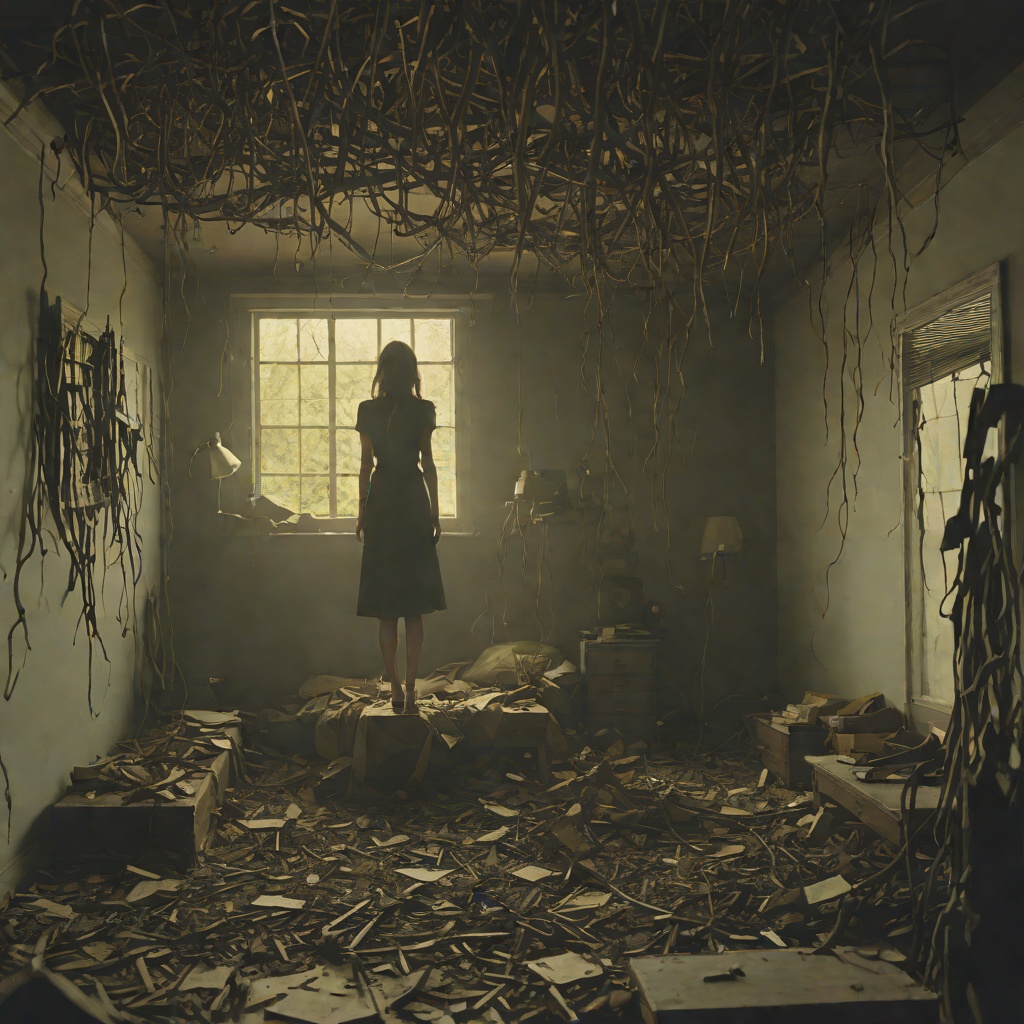
The event begins after the Narrator wakes inside her woods and recognizes that maternal feeling has vanished. She leaves the humid bedroom seeking clarity, yet the rain outside, the quiet cries of animals, and the intensified sensation of being in a wood deepen rather than resolve her estrangement. Expecting that the Stag’s gaze might help her, she goes looking for him, but finds nurses instead of antlers. The institutional building is therefore encountered through displaced animal imagery: the place of treatment becomes another version of the woods, and the promised clarity of release remains entangled with confusion.
The nurses lead the Narrator through the building until she collides with a door and a staircase, then sit her down and blindfold her. She does not understand why she has been seated or why her eyes have been covered, but the explanation seems less important than the continuing fire within her and the absence of love for her baby. Someone spins her around while counting, and something resembling a needle is left in her hand. The procedure is conducted like a children’s party game rather than a transparent medical process, making the institution’s authority appear both coercive and absurd.
Still blindfolded, the Narrator is guided by the others’ exultant instructions: cold, warmer, hot, burning. Her needle apparently strikes the piñata, which explodes as the group applauds. The scene turns discharge into a grotesque initiation. The Narrator’s hand, the needle, the hidden target, and the cheering crowd create a bodily ritual whose meaning she cannot grasp, while the institution treats her departure as an achievement already completed. When the others grow impatient and remove the blindfold, she would prefer the pleasant darkness to continue. Her reluctance establishes that release is not yet experienced as freedom; darkness offers more coherence than the visible world waiting outside.
Welcome and the Promise of a New Life
The revealed scene is covered in streamers, colourful signs, gifts, and confetti. Cards and good-luck charms accompany the message that she is beginning a new life, and the staff lead her away. The language and decorations imply graduation, celebration, and successful reintegration, but the Narrator experiences the moment as an ending that somehow becomes a beginning. Her statement that gloom and pessimism lie outside reverses the expected geography of recovery: the institution has been frightening and opaque, yet the world beyond its doors is not automatically reassuring.
At the main entrance, the Husband and the Son wait together. The Husband is dressed up, the Son wears his football kit, and the two hold hands. They move toward the Narrator as though she has passed an examination and is now ready to resume ordinary life. The reunion is physically affectionate: the three embrace, and the Husband welcomes her with the image of his “bitter sweetheart” and “little leapfrog.” His playful language attempts to absorb the crisis into family intimacy, but it also places the Narrator back into a role whose emotional terms she has already lost.
The Son is no longer the baby she remembers. He is walking, has more teeth and hair, and speaks with an expanded vocabulary that includes “coing coing” and “taca taca.” These concrete changes expose the time and experience that have passed beyond the Narrator during her confinement. The family reunion thus contains an irrecoverable interval: the Husband and the Son return to her as familiar figures, but the child has developed without her continuous presence, and she encounters motherhood as something already altered.
The Journey Home
The Husband jokes that now she is finally out, the family will be able to live in peace. The remark presents discharge as the restoration of domestic order, yet its tone makes peace sound like a condition imposed on the Narrator rather than a shared achievement. Soon he stops the car beside a river she has never seen and tells her to close her eyes. Once again, she stops seeing. The command repeats the earlier blindfolding and links the institutional ritual to the family journey: outside the institution, her perception remains controlled by others.
The Son responds to the journey with frantic happiness. He raises his hands to feel the air, throws stones into the river, and ignores the Narrator’s warning that the wind might carry him away. When she complains to the Husband, he does nothing. The scene places the Narrator in the position of anxious caretaker, but her warning has no authority within the family. The child’s exuberance, the open roof, the rushing air, and the river produce a sense of movement that is exhilarating for the family and threatening to the Narrator.
The convertible’s roof opens like a peacock’s feathers, and the family continues along the road while the Son enjoys the wind. The car carries them across the miles separating the Narrator’s countryside house from the institutional world that has already fallen into the apathy of things past. The Husband and Son ask how she has been, whether she has made friends, and whether she has brought presents. Their questions assume a conventional story of social recovery, but the Narrator’s head is already flying backward. The Husband accelerates to make the journey more exciting, intensifying the gap between the family’s celebration and her unstable perception.
When they enter their town, tractors, sheds, and neighbours smoking in doorways reappear as though the family were being escorted through the streets to an altar. The return is given the shape of a public ceremony, but the ordinary rural landscape has become theatrical. The Narrator does not simply arrive home; she is displayed as someone restored to the community. This apparent reintegration carries the same ceremonial pressure as the institutional celebration, replacing one organized audience with another.
The House and the Return of Danger
Inside the house, everything shines, although changes mark the passage of time: a microwave flashes its time, a tablecloth bears embroidered large flowers, and a new cordless phone sits beside a notepad. These objects promise domestic continuity and modernization, but they also make the house unfamiliar. The home has remained a place of return while becoming materially different, so the Narrator’s re-entry is not a restoration of the past but an encounter with a rearranged environment.
She sits on the sofa facing the fireplace, and the movements of the Husband and the Son appear as halos of light. The visual field is softened and estranged, as if ordinary family activity cannot be perceived directly. At the same time, the reflection of the first knife she ever dreamed of appears in her hand again. The knife reconnects the returned Narrator to an earlier history of violence and mental disturbance, interrupting the official narrative that discharge has completed her recovery.
The Narrator imagines that a genuine mental asylum, rather than a place where she was merely punished, might have left her without the dagger. Her distinction between punishment and medical care exposes the institution’s ambiguous function: it has released her, but it has not supplied a stable account of what happened to her or what treatment achieved. The object in her hand becomes the material proof that the danger has not disappeared simply because the family has welcomed her back.
Terrified, she moves toward the glass door through which she once crashed. The door now has a mosquito mesh, a small practical alteration that both repairs and memorializes the earlier breach. She opens it and runs outside, not toward the Husband or the Son but toward the Stag. Her purpose is to see the tips of his antlers, and her appeal to the Stag as her beloved and only one reveals where her strongest attachment now lies. The release that was supposed to return her to family life instead ends with her fleeing the house in search of the animal figure who remains, for her, a source of recognition and desire.
Narrative Significance
The event is narrated through the Narrator’s unstable first-person perception, in a frame that may be read as dreamlike or institutionally disordered rather than as a straightforward report of discharge. A clinical transition is rendered through party games, confetti, gifts, a football kit, a peacock-like car roof, and halos of light. This collision between bureaucratic recovery and festive imagery makes the familiar process of coming home strange. The reader is never allowed to settle comfortably into the social script according to which treatment ends, the family reunites, and ordinary life resumes.
The release also reverses the expected direction of emotional recovery. The Narrator does not emerge with renewed love for the Son; she wakes without it and carries that absence through the ceremony, the reunion, the drive, and the house. The Husband and the Son act as if she has graduated into readiness, while her own experience remains organized by blindness, fire, backward motion, and the search for antlers. The institutional and domestic worlds mirror one another in their attempts to define her condition from the outside.
Most decisively, the final movement from the knife and repaired glass door toward the Stag prevents discharge from becoming closure. The house contains signs of normal family life, but it also contains the object and threshold associated with earlier rupture. By running outside, the Narrator converts release into another departure: she has left the institution, yet she has not been reintegrated into the identity of wife and mother that awaits her. The event’s significance lies in that unresolved transfer from confinement to domestic space, where apparent freedom remains inseparable from alienation, danger, and the Narrator’s longing for a nonhuman counterpart.