Self-harm
Die, My LoveSelf-harm is the novel's most persistent and physically concrete expression of the narrator's inner collapse. It is not a single act but a recurring, escalating pattern that runs from fantasy to reality, from a dreamed knife to actual cuts, from private rage to a public, bloody spectacle. The narrator's self-destructive impulses are woven into the very texture of her daily life as a mother and wife, surfacing in moments of domestic banality and exploding in moments of crisis. Her body becomes the battlefield where her ambivalence about motherhood, her rage at her husband, and her despair at her own entrapment are fought out, leaving literal wounds that the narrative refuses to let heal or be ignored.
The Knife in the Grass: Fantasy as Prelude
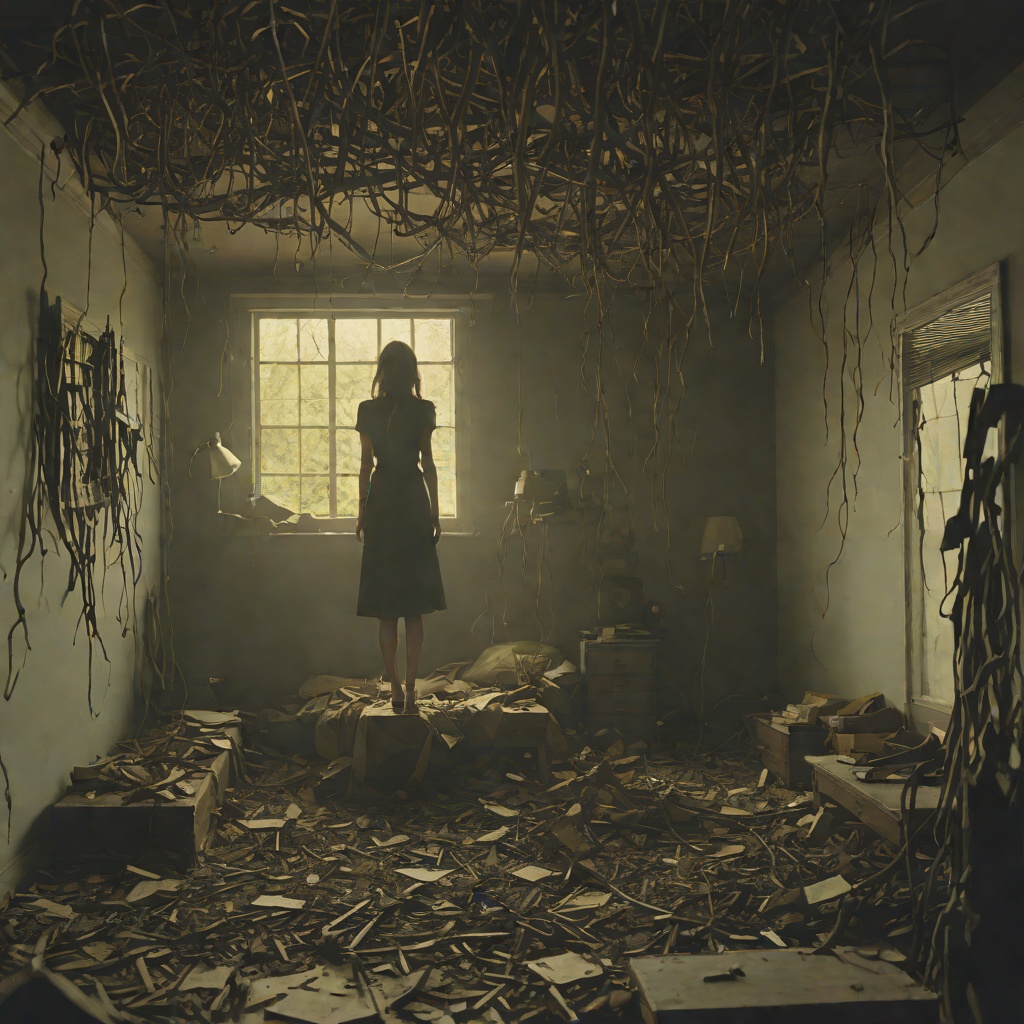
The narrator's self-harm first appears as a fantasy of violence that she immediately disowns. Lying in the grass among fallen trees, with the sun on her palm feeling "like a knife I could use to bleed myself dry with one swift cut to the jugular," she spies on her naked son and husband splashing in a blue paddling pool. The image is startling in its precision: the sun itself becomes a weapon, and her own body the target. She asks herself how a "weak, perverse woman" who dreams of a knife in her hand could be the mother and wife of those two individuals, and her answer is to burrow deeper into the ground, hiding her body. The fantasy is immediately followed by its negation — "I wasn't going to kill them. I dropped the knife and went to hang out the washing like nothing had happened" — but the sequence establishes the pattern: violent impulse, suppression, and a return to domestic performance. The knife is dropped, but it is never truly put away; it reappears throughout the novel in different forms.
The Glass Door: From Thought to Act
The transition from fantasy to actual self-harm occurs in the aftermath of a violent confrontation with her husband over her suspected affair with the radiologist. Accused of being a "two-faced liar" and subjected to kicks, blows, and the epithets "idiot, piece of shit, crazy bitch," she runs outside and, "for the very first time," crashes straight through the glass. The act is both a breaking out and a breaking in: she escapes the house but only by shattering the barrier that separates her from it, and the glass cuts her body as she passes through. The description of her flight is surreal and self-alienating — "Red all over, I crossed the pastures as though they were a park, trampling on rabbits and barn owls as I went. Or were they trampling on me?" — as if she cannot tell whether she is the agent or the victim of the violence. She lies down in a "kennel" among pruned trees, her socks wet, cold dried blood stuck to her body, and spends the long night looking at graves until sunrise. The crash through the glass is the novel's central image of self-harm: it is simultaneously an escape attempt, a self-inflicted wound, and a public exposure of her private agony.
The Hospital: The Body as Evidence
The consequences of the crash are physical and institutional. The narrator is brought to the hospital straight from the field, unconscious — the first time she has fainted and been lost to the world. For days, nurses treat her cuts, which cover her shoulder blades, chest, belly, and neck. The medical staff's response is marked by a silent, staring judgment: "Every time a new nurse comes in, they stand still for thirty seconds and stare at me, making sure I notice." Her protest — "It's not what you think" — is met with indifference. The removal of glass from her body is described in strangely beautiful, almost mineral terms: "Pieces of crystal, tiny mirrors, petals and slivers of glass come out of my body. First a small ulcer, and the next day, or the day after, a tiny sparkle appears." The body is treated as a site of extraction, its wounds yielding up tiny treasures of shattered material. She is told to walk slowly, avoid running, and keep her feet raised; she imagines she will have "the instep of a zebra." The hospital sequence transforms her self-harm into a spectacle for medical scrutiny, and her body into a document of her crisis. Her husband's visit is a study in avoidance: he hides behind flowers, kisses her while avoiding the gashes on her face, and deflects her questions about the condoms she found, countering with his own accusation about her trips to McDonald's. His hand falls "exactly, precisely, on the cut along my neck" — a gesture that is either cruel coincidence or unconscious aggression.
The Lawn and the Mirror: Rage Without Release
After her release, the self-harm mutates into a broader pattern of destructive behavior that is no longer directed only at her own body. Lying on the lawn, she yanks out clumps of grass "over and over, green and yellow, worms and soil all blending together in my hand," frantic but uncalmed. She runs inside and throws an old wooden chair at the mirror, wrenches the door off the wardrobe, and tears the shutters off the window. The violence is diffuse, aimed at objects rather than herself, but it is accompanied by a bodily symptom: a blood clot in her knickers that runs down her legs. She considers whether it is a miscarriage, then rejects the idea — "it's the remains of my body." The distinction is crucial: her body is producing blood not as a sign of new life or its loss, but as a material trace of her own disintegration. Her husband's attempts to help are absurdly inadequate — he brings her a cushion, then a pair of red boxing gloves from his teenage years. She throws two wild punches at his nose and takes them off, rejecting the mediation of gloves and rings: "I want to see my hands made of bones firing in every direction." Her scream — "Fuck me already!" — is a demand for contact that is also a demand for annihilation, and what she really wants is to eat poisonous flowers, poisonous mushrooms, stones. The scene ends with sex that is described as a violation — "his piece of flesh entered my hole (if that's what making love is)" — while she longs for a white room with a sea breeze, salt stinging the cuts on her shredded tongue.
The Road: The Body as Obstacle
The final form of self-harm is a passive, almost suicidal exposure. Standing in the middle of the road with a straw hat and a suitcase, the narrator becomes an obstacle that cars, bikes, and lorries must dodge. She imagines her own death in graphic detail: "Me getting run over on the side of the road is the least of their worries. Me winding up covered in brown blood, my twisted body sprawled out on the ground between the septic tank and the chicken coop. Or flying through the air and shattering against the corrugated metal of a garage door." The fantasy of her own corpse is elaborated with a kind of grim satisfaction, and she notes that no one would grieve for "the wretched woman with scarred arms who was consumed by the misery of life" — only for the little boy left motherless. The scarred arms are mentioned as a matter of fact, a visible record of her self-harm that has become part of how she imagines others seeing her. She walks barefoot on the tarmac, liking the way her feet turn grey, waiting for a call that never comes. The scene is a form of self-harm by exposure: she places her body in harm's way not to die but to be seen, to force the world to reckon with her presence. Her husband eventually comes to fetch her, whistling a tune of victory, and she follows him home, but the image of her standing in the road, an insect with antennae raised, a scarecrow, remains as the novel's final statement on her condition.
The Pattern and Its Meaning
Across these scenes, self-harm functions as a complex and contradictory language. It is a form of punishment — the narrator turns against her own body the violence she cannot direct at her husband or her child. It is a form of communication — the cuts and the blood are visible evidence of an inner state that words have failed to express, and the hospital sequence shows how her body becomes a text that others read, however imperfectly. It is also a form of agency: in a life where she is defined by her roles as mother and wife, where her desires are denied and her voice is ignored, the act of cutting herself is the one thing she can do to her own body, the one assertion of control over her own flesh. The novel refuses to offer a cure or a resolution; the self-harm is not overcome but transformed, from the knife in the grass to the crash through the glass to the long wait in the road. The narrator's body, scarred and bleeding, becomes the permanent record of her refusal to be a "normal" mother, and the price she pays for that refusal is written on her skin.