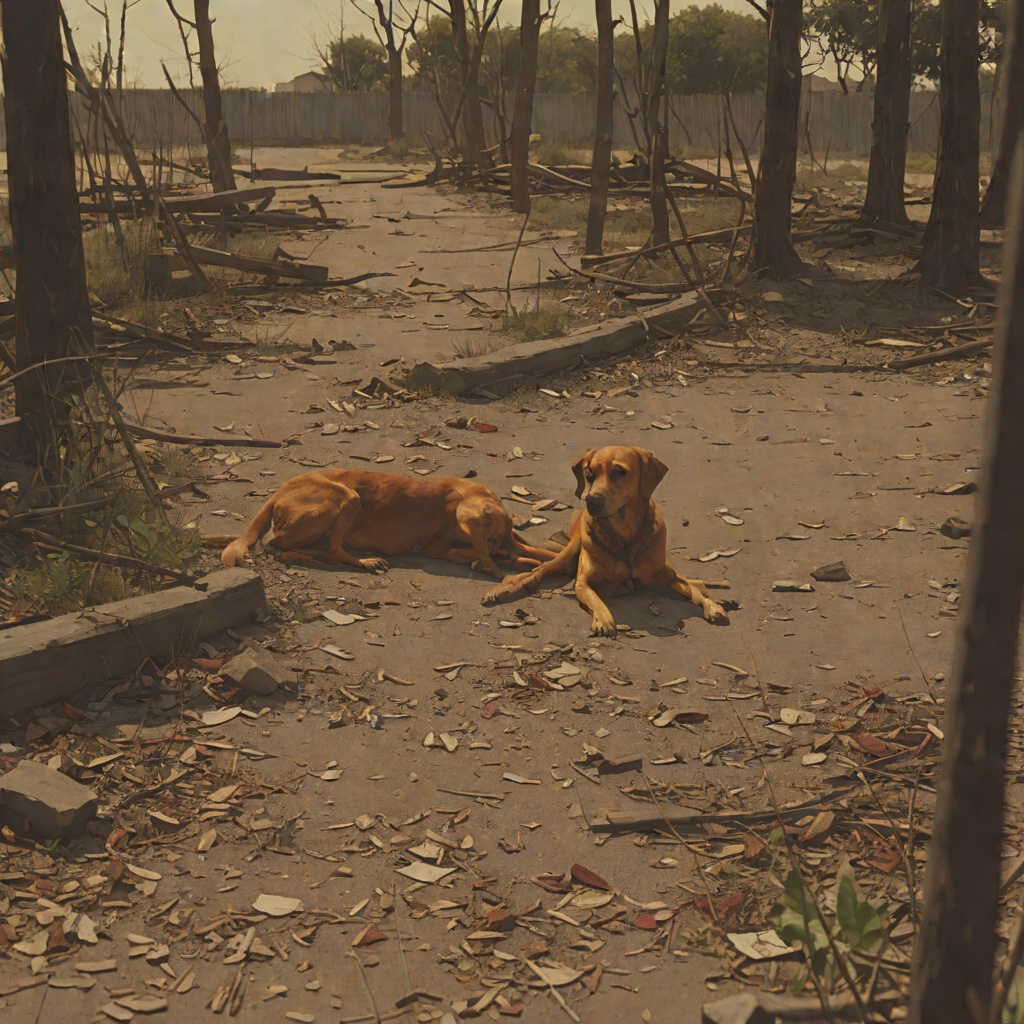
Shooting Bloody
Die, My LoveShooting Bloody is the novel's central act of violence, the moment when The Narrator crosses from witnessing suffering to inflicting death. The dog, christened Bloody after being struck by the couple's car, has been reduced to a writhing, whimpering wreck of pain, and The Narrator, unable to endure its cries any longer, takes her dead father-in-law's shotgun and fires for the first time in her life. The killing is not a clean mercy but a messy, ambivalent act that haunts the rest of the narrative, surfacing again at The Son's second birthday party when the dog's unburied corpse becomes the focal point of her unraveling.
The Dog's Suffering and the Failed Mercy
The shooting is the culmination of a night of escalating torment. After the collision that left the dog broken and bleeding, The Narrator and The Husband brought it home, wrapped it in whatever they could find, and fastened it into the back of the car with a seatbelt. At home, the dog's cry, a high-pitched "eeeeee, eeeeeee," echoed throughout the house, driving The Narrator crazy. She got up, grabbed a small torch from the tool drawer, and went into the garage, rummaging through layers of filth on pieces of wood, unused furniture, and swivel chairs, finding only the telescope clean, sheathed in clear plastic. The dog followed The Husband around with a pained look, its eyes watering, its leg dragging, its body writhing as it made holes in the ground. The Husband's response was to promise they would call the vet tomorrow, a deferral that The Narrator found intolerable.
The Nighttime Search for the Gun
Unable to leave it at that, The Narrator went outside, leaving the front door open so the cold air would chill the house, and walked in wellies and half-naked to her mother-in-law's place. She found the rabbit-paw keyring hidden in the flowerpot next to the front door and let herself in, noting that if her father-in-law had been alive, he'd have fired, no matter the direction, just for the pleasure of pulling the trigger. Inside, the pile of ironed shirts and the books organised on the shelves gave no impression that someone had recently died. She went up the suspended staircase, holding onto the ropes on either side, and found her mother-in-law asleep, doped up, a plank of a woman with a flat-chested, sexless body like a table wrapped up in sheets, her eyes covered by a mask and two pieces of cotton-wool in her ears. Next to her were a piano and a Japanese drawing of a small island. The Narrator lit a candle and looked at the piano again, feeling an urge to play a note, then searched. Some people need to be able to see the ocean, she reflected, but she needed to be able to see a firearm, even if it was motionless, dirty, and unloaded.
The Confrontation with The Husband
Returning with the shotgun, The Narrator found The Husband with one eye open and aimed at him. He was so scared he couldn't say a word. "Kill him," she said. When he asked who, she clarified: the dog. "Because he's suffering," she explained. The Husband refused, telling her to leave him alone, and rolled over onto his side, his arse facing her, letting out a snore almost as loud as Bloody's whimpers. The Narrator stayed there, watching him sleep, astonished by his relentless cowardice. His refusal to act, his retreat into sleep, and his empty promise to call the vet in the morning all confirmed for her that the mercy would have to come from her own hands.
The First Trigger Pull
Shotgun in hand, The Narrator went from room to room until she reached the corner of the kitchen where, all twisted on a filthy rag, Bloody was sobbing with pain. She aimed. Her brain went blank. She felt like an Israeli soldier and suddenly, in her mind, she heard the order: "Fire! Fire, you bastard!" And there, for the first time in her life, she pulled the trigger. The killing is framed not as a moment of clarity but as a dissociation, a blanking of the mind in which she becomes a soldier following an internal command. The dog, which had licked its beaten body after the collision and had done the dirty work of licking the remains off the bonnet, is reduced to a corpse with a bullet in it, left unburied through the night.
The Return of the Dead at the Birthday Party
The shooting's consequences erupt at The Son's second birthday party. As The Narrator walked through the party, her chest anointed, drinking the dregs of yesterday's wine and then another bottle, her gaze fell on a mound of earth in the garden. At first she didn't understand, looking at it the way one might look at images of events that took place millions of years ago. Then she felt the dog leap up onto her lap and sink a tooth into her. Of course. Poor Bloody was down there, where she and The Husband had put the dog, but only at noon, by which time its eyes were full of flies. It had been there the whole night with a bullet in it, unburied, entrails all over the place, so dead that it didn't even let out a last howl. As she was looking at its remains, she heard the gun go off. The kids were skipping over the makeshift grave, singing and laughing and holding hands. Something made her rush inside and shut herself in her bedroom, slamming the door behind her, and she wished them all dead, every last one of them. The buried dog, the unacknowledged corpse, becomes the literal ground of the family's celebration, and its return in her perception triggers her final break from the party and from the family itself.
The Act's Narrative Significance
The shooting of Bloody is the novel's hinge point, the moment The Narrator's internal violence becomes external and irreversible. It is an act of mercy that reads as murder, a killing justified by compassion that leaves her isolated and guilty. The dog, an animal she and The Husband rescued and named, becomes the first life she takes, and the act prefigures the larger violences and abandonments that follow: her flight from the birthday party in the convertible, her shouted offer to give away her son, and her eventual separation from the family. The event also crystallizes the novel's central tensions: the failure of language and communication, the mechanized love of a family that cannot see or respond to suffering, and the animality that both connects and separates The Narrator from the world around her. In killing the dog, she becomes the one who acts, but the act leaves her more alone than ever, a perpetrator whose crime is buried but never forgotten.