Suicidal ideation
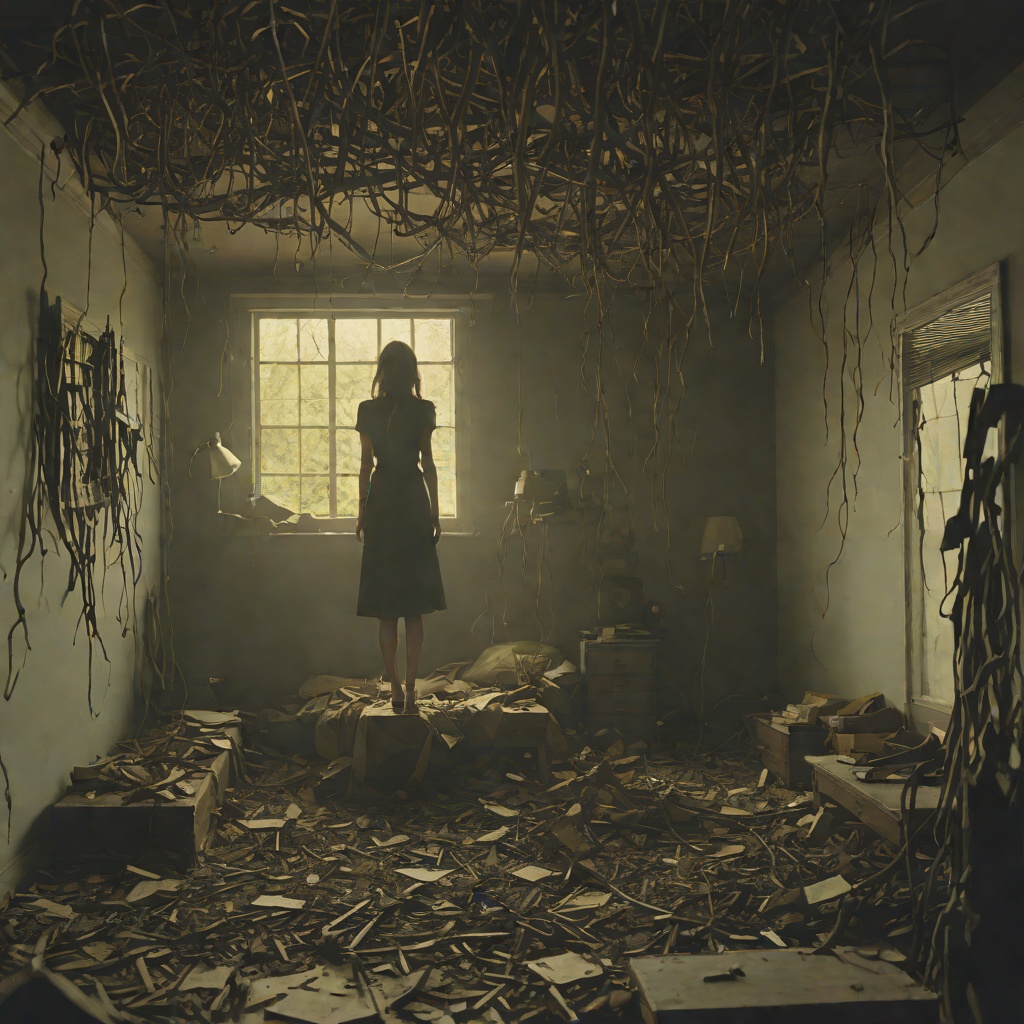
Die, My LoveSuicidal ideation is a recurring, embodied state in the Narrator’s life, where the wish to die presses against the routines of marriage, motherhood, pregnancy, and institutional care. It appears through concrete instruments and thresholds—the knife in the grass, the glass door, the window, and the gun—while never becoming a single, completed act. The state’s force lies in that oscillation: death is imagined with frightening precision, but domestic obligations, bodily sensation, and language repeatedly interrupt its execution.
Definition and First Manifestation
The Narrator’s suicidal ideation first emerges in a pastoral domestic scene that has been stripped of pastoral comfort. Lying among fallen trees with sunlight on her palm, she experiences the sun’s warmth as resembling a knife capable of opening her jugular. Behind her, The Husband and The Son are naked in a blue paddling pool whose water is thirty-five degrees, while the Narrator hides in underbrush and spies on them. The scene joins familial intimacy to violent estrangement: she is physically close to the family portrait but psychologically outside it, asking how a woman who dreams of a knife can be the mother and wife of these two people.
The knife remains an object of contemplated possibility rather than completed violence. The Narrator burrows deeper into the ground and says she is not going to kill them; then she drops the knife and goes to hang out the washing. Pegging The Son’s and The Husband’s socks, underwear, and shirts to the line becomes an act of camouflage, a performance of ordinary domestic competence carried out immediately after the fantasy of bloodshed. The contrast does not resolve the crisis. She returns to the tree trunks, still identifying herself as more animal than the foxes she describes, and the movement between household labor and violent thought establishes suicidal ideation as a condition that coexists with routine rather than replacing it.
Domestic Life, Pregnancy, and the Wish to Die
The Narrator’s sense of entrapment intensifies through the demands attached to motherhood. She describes herself as an educated woman and university graduate, yet sees herself as a country bumpkin hanging laundry, a foreigner, a woman whose reading life has collapsed. The birth of The Son does not produce the expected maternal declaration that life without a child is unimaginable. Instead, she treats the child’s six-month milestone as an obligation involving a bakery cake, candles, and comparisons with other mothers. She links the child’s existence to a sexual memory of The Husband ejaculating inside her, imagining that closing her legs or stopping him would have prevented the present duty.
At the family celebration, suicidal ideation remains hidden beneath the rituals of normality. The Narrator drinks beer with The Husband, places a finger in The Son’s mouth, and watches him bite her with his gums. The Husband proposes planting a tree for the child’s long life, a gesture of continuity that the Narrator receives with a foolish smile while wishing she were dead. The family portrait therefore carries an internal contradiction: the adults toast the baby’s happiness, but the mother experiences the celebration as evidence of the life from which she wants escape. Their use of the word love is similarly mechanized; the phrase continues to circulate even when the couple despise each other.
Pregnancy makes the suicidal state more visible to the extended family without making it comprehensible to them. At Christmas, The Narrator’s stomach churns and the baby moves at abnormal speed while relatives silently hope that a hospital trip will not interrupt their turkey-and-apple dinner. She has been containing her desperation in an increasingly intense swaying motion, but the family responds with a seat, cool water, and a green-and-white pill. Their practical gestures are intended as care, yet the Narrator experiences them as intolerable reductions of a desire to die to a problem supposedly solved by hydration and medication. She later throws the pill into the fire because she dislikes its side effects and antidepressants, choosing instead to hug her womb and wait.
Thresholds, Images, and Repetition
The state repeatedly gathers around thresholds through which the Narrator imagines passing. In The Son’s room, after breastfeeding him and watching him become a heavy, sleeping body, she wraps him in her scarf and walks toward the patio doors. She says she always toys with the idea of going straight through the glass and cutting every inch of her body. The glass is both barrier and imagined instrument: it separates her from the outside world while offering a surface through which self-destruction could become immediate and total.
The window returns in the Narrator’s reflection on a literary character. While sitting in a car near the woods, she hears a radio discussion of Mrs Dalloway and recognizes that Septimus, the traumatised war hero, really does throw himself out of the window. She considers the palliative effects that writing, or throwing herself out of a window, might have on her life. The literary allusion does not distance suicidal ideation; it gives the impulse another form and places it inside a chain of representation. Writing can offer relief, but the represented suicide also supplies a model of action. Her laughter is nervous, and the thought is followed by the practical gesture of grabbing the handbrake, showing how contemplation and self-preservation occupy the same sequence.
The passage turns suicidal ideation into a problem of language as well as action. The Narrator longs for the intellectual world implied by discussions of literature and the word interconnectivity, yet also treats literary interpretation as absurd beside the physical immediacy of the window, the car, and the woods. She tries to hear birds speaking Greek, repeats what would it be like, and kicks the steering wheel before falling asleep with her legs marking the glass. The episode delays a decisive act through repetition, nervous laughter, mechanical details, and sleep. Its narrative form makes the impulse recur without allowing it to settle into a final explanation.
Crisis, Gun, and Institutional Consequences
The most dangerous development occurs after The Husband leaves and takes The Son with him. The Narrator looks across the institution’s grounds as though they were a cliff and feels that she has ruined everything. A breath of irrationality has, in her account, set fire to her existence, and she finds herself trying to preserve appearances while holding a loaded gun. The wish to pull the trigger is now attached to an actual weapon, not merely to an imagined knife or remembered window.
The gun changes the social meaning of the crisis. As birds make what she considers unbearable noise and other residents leave the dining hall with fruit and binoculars to watch migration, the Narrator walks down the hallway with the gun raised. She experiences herself as voluptuous and victorious, with her breasts above her shirt collar and a smile on her face, while the people who first smile at her recognize the danger and hurry away. The grotesque theatricality of the scene does not make the threat unreal; it shows suicidal ideation becoming performance, spectacle, and confrontation with witnesses.
The professional follows her through the glass doors and asks her to enter his office. When she shapes her hand like a revolver and mimes pulling the trigger, he steps back before locking the door. His intervention exposes the gulf between clinical speech and the Narrator’s lived crisis. He tells her that The Husband feels powerless before an unknown man, that the air in the house is turning foul, and that The Husband would prefer her to remain another week. The Narrator understands these decisions as being made behind her back: she has been grounded, confined, and denied the release of returning home to face the animals.
The crisis ends provisionally rather than conclusively. In the office, the Narrator says that she feels responsible, will rethink her role as wife and mother, and would benefit from staying another week. She allows her hand to return from the shape of a gun to its ordinary five-fingered form. The gesture is a minute reversal, but not a cure. She then runs to her bedroom, blinded by shower steam, and calls The Husband, only to encounter the household’s recorded message. The institutional aftermath therefore preserves the same pattern established earlier: suicidal ideation is contained by procedure, separation, speech, and delay, while the underlying contradiction remains active.
Narrative and Thematic Significance
Suicidal ideation exposes the failure of the normal family to absorb the Narrator’s experience. The family’s gestures—water, a pill, a birthday cake, a tree planted for long life, a family portrait—promise continuity, but each is shadowed by the Narrator’s conviction that she has been placed inside a life she did not freely choose. The more insistently the household performs health and order, the more violently her thoughts register the excluded possibility of death.
The state is also bound to maternal ambivalence and to the failure of language. The Narrator can nurse The Son, burp him, discard his heavy nappy, and return to domestic work, yet she cannot make the culturally expected maternal feeling appear. She speaks in abrupt images, obscene associations, ironic reversals, and repetitions rather than in a stable psychological explanation. Her language does not simply report suicidal ideation; it enacts its fragmentation, moving from knife to laundry, from cake to conception, from glass to literature, and from a mimed revolver to a clinical interview.
At the same time, the repeated deferral of action creates a form of survival that is neither reassurance nor resolution. The Narrator drops the knife, takes hold of the handbrake, sleeps in the car, refuses the pill, and changes the gun-hand back into a human hand. These gestures do not disprove the desire to die. They show instead how the desire is repeatedly interrupted by responsibility, bodily attachment, fear, habit, and the stubborn continuation of narration. Suicidal ideation becomes one of the book’s central structures of tension: a wish for disappearance that keeps returning precisely because the Narrator remains caught in the visible, ordinary world she finds unbearable.