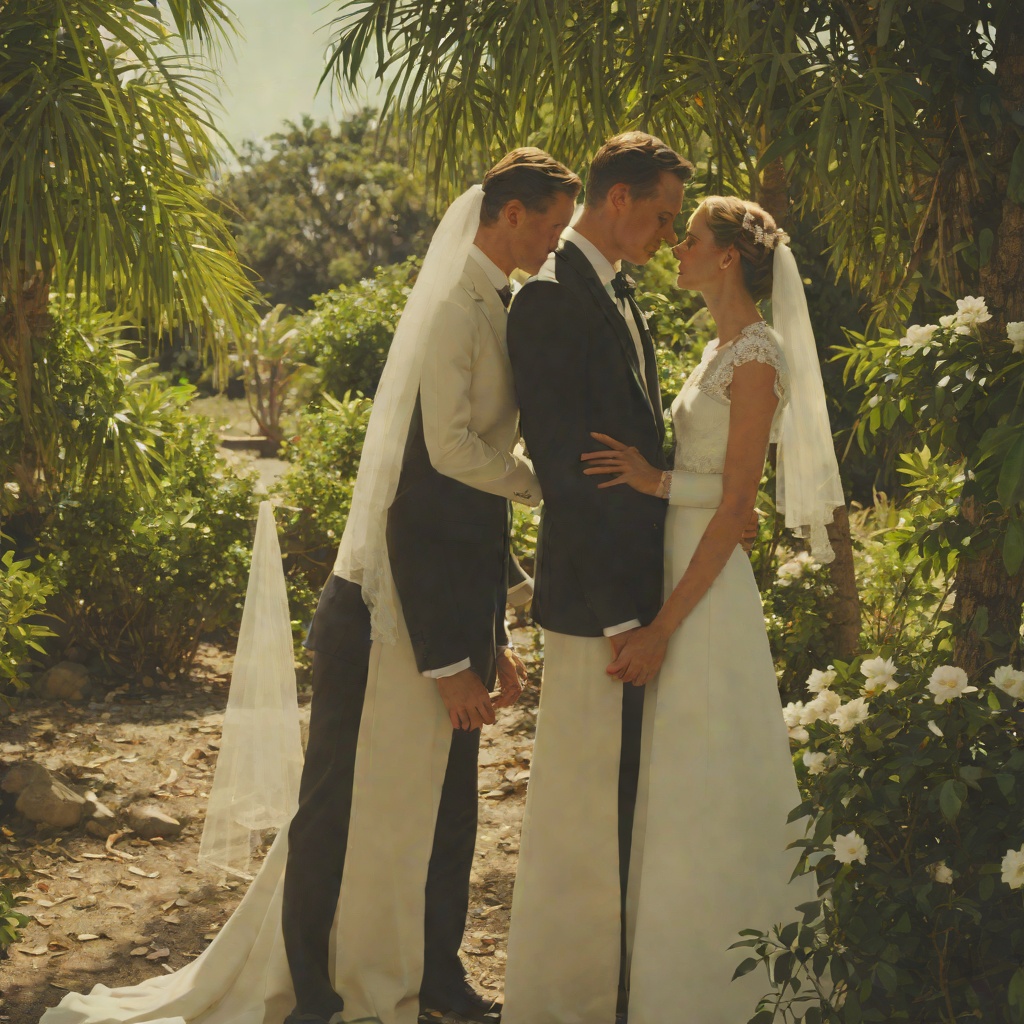
The Abandoned Wedding Night
Die, My LoveThe Abandoned Wedding Night is one of the most visceral and disorienting episodes in the narrator's fragmented testimony, a scene that collapses the boundary between bridal fantasy and abject desperation. Dressed in nothing but a white dress with ruffles, fitted at the waist and completely soaked, the narrator waits alone in a hotel room with a ceiling fan for the groom who has promised to arrive early for their night of passion. The scene unfolds as a private theater of thwarted desire, in which the bride becomes her own audience, her own tormentor, and finally her own accuser, all while the promised consummation never arrives.
The Bride in the Hotel Room
The episode opens with the narrator reduced to a single, saturated garment: a white dress with ruffles, fitted at the waist and completely soaked in that room with a ceiling fan. The wet fabric weighs her down, and she struggles to free herself from what she describes as a tangle of seaweed, from the fabric of the slip that is gripping her throat. The room itself is a pressure chamber of stalled time: the fan rotates more and more slowly, advancing upon her threateningly; the phone is silent; the mattress is a puddle; the jute curtains rustle slowly. She has been waiting so long that after opening and closing her legs so many times, they are beginning to go numb. The promise that anchors the scene is explicit: he had promised to arrive early for their night of passion, to drop the child off at the widow's place and come straight over. That promise, and its failure, is the wound around which the entire episode turns.
The Frenzy of Waiting
What follows is a frantic, escalating catalogue of attempts to summon desire, to occupy her own body, to become someone else. Her hand wanders between her legs, but that is not what she needs; she scrubs away down there for a bit, but nothing. She squeezes herself, hits her hand until it becomes the hand of the other. She rips off her garters with her teeth, pulls out the stitching with her nails, puts a hand on her heart, wets the nape of her neck and splashes herself with perfume, undressing over and over. She changes her knickers, tries to smell herself but fails even though she stretches her neck almost to the point of breaking it. She wants to sleep face down, face sideways, face up, but none of these positions offers relief. In a gesture that will echo through the book's larger preoccupation with doubling and self-fragmentation, she grabs the scissors with a swipe of her hand, cuts off her fringe and leaves it on the pillow, announcing: now there are two of us. The severed fringe becomes a physical token of a self split in two, one waiting, one already gone.
The Performance of Desire
The waiting mutates into performance. She jumps up, hurt by not having a bra on, paces around on the bed, gets down on all fours. She laughs, wrapped up in tulle, as she sees herself in the tacky, peeling mirror, casting herself as a Hollywood actress, charming and tragic. She gets in the bath and splashes about, but still does not have what she needs; nothing is calming her down. She does a somersault, ties herself up, unties herself. If he does not come, she declares, she will begin on her own, the appetiser, the pre-drinks, the warm-up. There is a smell of raw meat in the hotel and she inhales it. She wets a finger with saliva knowing it will not be enough, that it will never have the brute force she needs. She is indifferent, too naked in her body, and what she wants is violence: to be punched, to be shaken hard, to have something thrusting at her. The desire for the groom has curdled into a desire for impact, for force, for anything that might break through the unbearable stillness of the room.
The Concierge and the Striptease
In a grotesque parody of bridal service, she calls the concierge and wakes him up; he talks like his eyes are glued shut. She orders a martini and specifies that she would like it without olives but with two ice cubes and a slice of lemon. He turns on music for love-making, his voice sounds sympathetic, and he offers to bring her a soft drink, trying to cheer her up. She hangs up. What follows is her high-voltage striptease, performed on top of the toilet: she sways, shimmies, grinds, sticks out her tongue, struts around the room in her heels, her own horny audience in the medicine cabinet's reflection. When it ends, she flushes the toilet. The groom still has not arrived. The performance, like the waiting, produces nothing but its own exhaustion.
The Child's Fault and the Meaning of the Scene
The episode closes with a single, devastating attribution of blame: this must all be the child's doing. The groom's absence is not read as abandonment or betrayal but as the interference of the child, the third figure whose existence has already, in the narrator's account, poisoned the marriage from its first night. The scene thus becomes a compressed origin myth for the narrator's maternal ambivalence: the child is present even in his absence, the invisible cause of the groom's failure to arrive, the reason the bride is left alone in a soaked white dress with a severed fringe on the pillow. The abandoned wedding night is not merely a memory of disappointment; it is the template for a marriage in which the child always comes between the couple, and in which the narrator's desire is always deferred, always redirected, always left to perform itself into exhaustion before an audience of one.