The Narrator
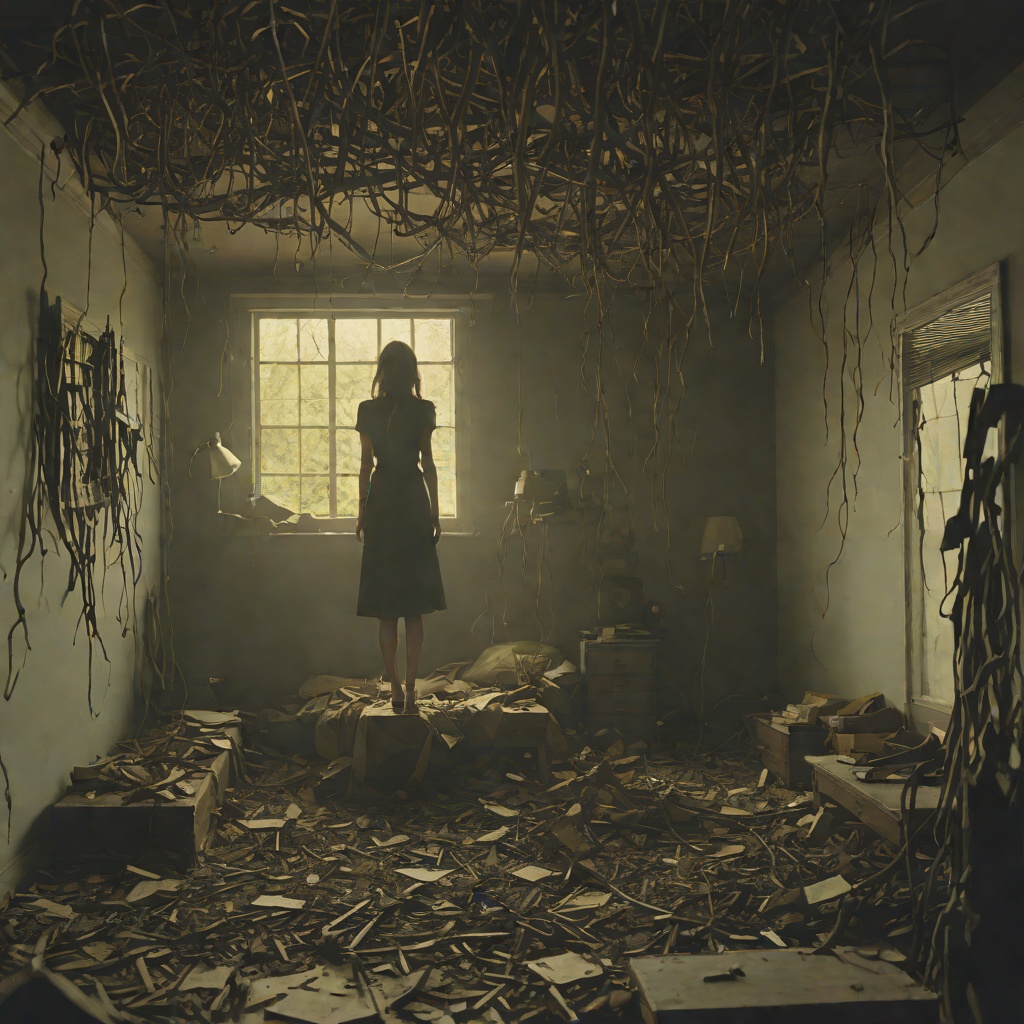
Die, My LoveThe Narrator is the unnamed mother, wife, foreigner, and protagonist whose consciousness gives the novel its most volatile shape. She inhabits a domestic world of a husband, a young son, rural routines, family portraits, birthdays, funerals, and medical treatment, yet experiences that world as an enclosure pressing against the limits of her body and mind. Her decisive significance lies in the contradiction she refuses to resolve: she can perform the ordinary roles of mother and wife, but she cannot make herself feel ordinary within them.
Identity and Domestic Position
The Narrator is an educated woman and university graduate who sees herself, with both contempt and irony, as a foreigner and a country bumpkin in her adopted rural environment. She is married to The Husband and has a son, with the possibility of another pregnancy haunting the account. Her self-description is deliberately self-divided: she imagines herself as an ignorant woman hanging out laundry in a red polka-dot skirt, then as an educated person who is more animal than the foxes around her. The gap between these identities is not a stable psychological opposition but a recurring condition of her narration.
Her household is organized around the rituals of normal family life. On the Sunday before a bank holiday, she hides in underbrush while The Husband and The Son play naked in a blue paddling pool heated to thirty-five degrees. She hangs their socks and shirts on the line, buys a cream or chocolate cake for The Son’s six-month celebration, drinks beer beneath the pergola, and participates in a family portrait. Yet each apparently harmless act is contaminated by thoughts of injury, sex, resentment, or death. The family’s normality is therefore not an achieved refuge but a performance she can reproduce while remaining radically outside it.
Maternal Body and Mental Crisis
The Narrator’s relation to The Son is physically intimate but emotionally unstable. In his room, under faint blue light, she breastfeeds him and watches her nipple satisfy him with every swallow. She burps him, wraps him in her scarf, and lays him down, but the tenderness of care is inseparable from images of heaviness, trapped air, nappies, bodily waste, and exhaustion. She hears the child’s repetitive sounds through the night and answers the social expectation of maternal devotion with a refusal to claim that her life became unimaginable without him. Her motherhood is experienced as labor, invasion, obligation, and self-loss rather than as a simple emotional conversion.
This conflict becomes most visible in her violent fantasies. Lying among fallen trees, she imagines the sunlight on her palm as a knife with which she could bleed herself through the jugular. She briefly holds the knife, then drops it and hangs out the washing as though nothing has happened. The action matters because it shows both danger and inhibition: the murderous thought is real within her consciousness, but the immediate act is a return to domestic procedure. Her fantasies repeatedly approach self-harm or harm to others, while her body remains caught in the repetitive tasks that supposedly prove her fitness as a mother and wife.
The maternal body also becomes a site of abjection and uncertainty. She feels trapped between pregnancy, menstruation, sexual penetration, miscarriage, and the remains of a body she no longer recognizes as hers. During one violent episode, blood appears in her underwear and runs down her legs; she first suspects another miscarriage, then rejects that explanation and calls it the remains of her body. The distinction is crucial: what appears to be reproductive loss becomes a broader collapse of bodily identity. Her body does not merely suffer; it turns into evidence against the coherent person she is expected to be.
Desire, Violence, and the Lover
The Narrator’s desire is directed away from the stable household and toward an unnamed man later revealed through another perspective to be The Radiologist. His presence at the fence transforms the rural landscape: the gate, pond, fallen fruit, and swamp become erotically charged. She sees him and anticipates both sexual release and animal transformation, imagining herself with a beak, feathers, and talons. Her desire is therefore not presented as a calm alternative romance. It is a force that unsettles species, identity, and language.
The first kiss at the fence occurs while The Husband sleeps and The Son is in danger of falling from bed. The scene binds adultery to domestic neglect, but it also makes desire appear as a sudden rupture in an already damaged life. The Narrator does not describe the kiss as a solution. Instead, she knows that afterward she will go into the woods and vomit. Attraction and disgust arrive together, as if the body can register the truth of desire before the mind can give it a socially acceptable name.
The affair becomes the hidden pressure behind the conflict over the condoms found in the car’s glove compartment. The Husband questions her about them, links them to alleged sexual activity at McDonald’s, and demands to know who the neighbor is. She repeatedly denies what is happening, recognizing that denial is a defensive tactic even when evidence is present. The narration withholds and displaces the truth at the same time: it gives the reader images of penetration and bodily invasion while refusing to offer The Husband an explicit confession. Her silence is not innocence, but neither is it simple calculation; it is a sign of a self that cannot translate its experience into a stable account.
The confrontation escalates into accusations, insults, kicks, and blows. The Narrator’s response is physical escape rather than explanation. She runs through the sliding glass door for the first time, crossing the pasture with blood covering her body and later lying in her kennel-like refuge among the pruned trees. Afterward, she describes sex, falling in love, masturbation, rocking The Son, and smiling through images of the dead: celebrating the birthdays of the departed, scattering earth onto a coffin, desecrating crypts, saying amen, and unplugging an iron lung. These associations make erotic and maternal gestures resemble rituals performed among corpses. She concludes that she has been dead throughout the period in which The Husband has been shouting in jealous rage, turning jealousy into not only a marital conflict but also a condition of psychic extinction.
Family, Death, and Containment
The Narrator’s crisis is intensified by the death of The Father-in-Law. Before the death, she sits outside while the family eats and gathers by the fire, afraid of the harm she might cause the newborn. She does not join them, even when the meal consists of leftovers from Christmas. Inside the house she imagines death inhabiting the fire, carpet, curtains, old furniture, silverware, flowerless vase, and umbrellas near the door. The house becomes a mortuary atmosphere before the funeral has finished defining the loss.
Her response to The Father-in-Law’s death is both detached and intensely visual. At the grave she remembers his teeth, his complaints about them, and the food he picked from between them. She imagines The Mother-in-Law airing the house, giving away his socks, cooking with the pans used for his fried eggs and porridge, and continuing to hear his cough and snore. The Narrator’s identification with The Mother-in-Law emerges through the widow’s vulnerable body and gestures: a nightgown, dark purple nipples, swollen ankles, a hand covering the mouth, and a grip on the bedpan. The death does not simply produce grief; it gives the Narrator a new way to recognize a shared condition of bodily dependence and abandonment.
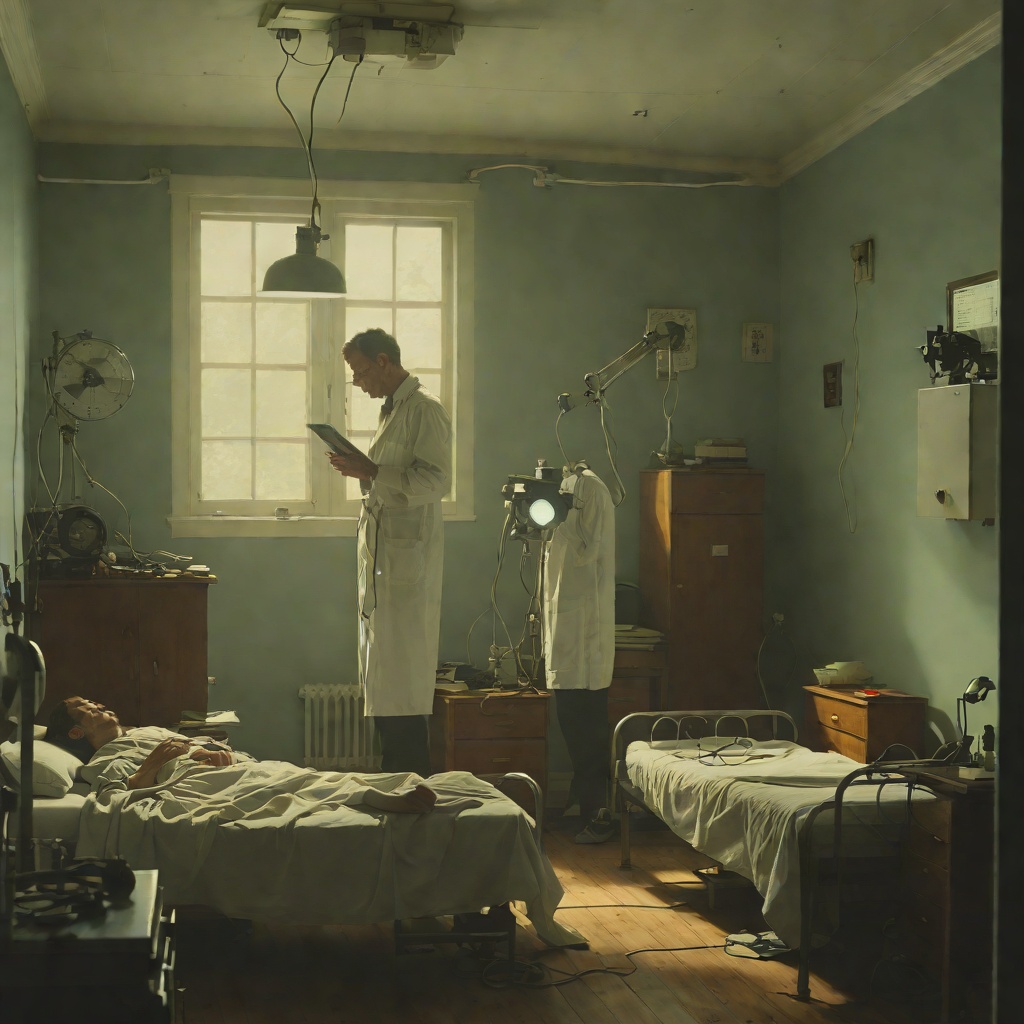
The Narrator’s treatment is likewise represented as a conflict between containment and erasure. After crashing through the glass, she is taken unconscious to The Hospital, where nurses treat cuts across her shoulder blades, chest, belly, and neck. Tiny shards, splinters, crystal, mirrors, petals, and slivers of glass are removed from her body. She is told to walk slowly, avoid running, keep her feet raised, and refrain from pulling open her scabs. The medical scene translates her crisis into wounds that can be disinfected and medicated, but the imagery resists a complete cure: her body is imagined as acquiring the striped instep of a zebra, another transformation rather than a return to normality.
Abandonment and Narrative Reconfiguration
The family eventually takes The Narrator to The Institution. In the back of the car she holds a suitcase, wears yellow shorts and unlaced shoes, and practices faces that might appear normal before suddenly freezing into vacancy. She imagines herself as Zelda Fitzgerald traveling toward Switzerland, not for its chocolate or watches, and treats the journey as the opening of a novel in which a woman is carried somewhere far away. The scene makes her removal both an institutional procedure and a literary transformation: she becomes a character who can observe the mechanics of her own abandonment.
At the institution, she imagines toast with plum jam made by disturbed inpatients, work in a vegetable garden, craft workshops, narrow mattresses, nightmares, and half-smoked cigarettes. The imagined details are concrete enough to make confinement feel like a new domestic order, but the underlying promise is not restoration. She expects to wake the dead, make them jump over the fence like sheep, and rid herself of morbid sexual anxiety through activity. The Husband and The Son wave goodbye almost immediately after she arrives, calling her beautiful and Mummy, so that familial affection becomes part of the speed and efficiency of separation.
When she is released, the return is staged as a family reunion and then destabilized by her renewed perception. The Son is older, walking, speaking more words, and possessing more teeth and hair; The Husband jokes that they can finally live in peace. During the drive home, the convertible roof opens like a peacock’s feathers, The Son throws stones into the river, and The Husband accelerates to heighten the excitement. At home, a microwave, embroidered tablecloth, cordless phone, and notepad mark the passage of time and the family’s attempt to resume ordinary life.
Yet the return does not restore The Narrator to her earlier role. Facing the fireplace, she sees the reflection of the first knife she ever dreamed of in her hand. She approaches the sliding glass door that she once crashed through, now protected by mosquito mesh, and runs outside searching for The Stag. Her final impulse is not toward domestic reconciliation but toward the animal figure she calls her own, seeking the tips of his antlers. The movement from institution back to house thus ends in another movement outward, toward the woods and toward a self that may be less human, less marital, and less containable than the family can accept.
Narrative Function and Significance
The Narrator’s voice makes the novel’s central oppositions unstable. She is simultaneously mother and threat, wife and adulterer, patient and observer, victim and aggressor, cultivated graduate and self-described animal. Her account is unreliable in the precise sense that its statements cannot always be reconciled with the scenes it presents: she says she was not going to kill her family, repeatedly denies the affair, wonders whether events are really happening, and converts physical episodes into metaphors so extreme that factual and imagined violence overlap. This unreliability does not empty her testimony of value. It exposes the pressure exerted by social explanations such as normal family, maternal instinct, marital duty, and medical correction.
Her language repeatedly returns to animals, wounds, glass, corpses, and bodily fluids. The repetitions form a structure of compulsion: the knife is dropped but remains available, glass is crossed and later approached again, death enters both the funeral and ordinary domestic space, and the body continually becomes something foreign. Physical intensity often precedes explanation. Tingling between the legs, milk, blood, trapped air, vomit, shaking, cuts, and breath carry meanings that the Narrator cannot or will not stabilize in speech. The failure of language is therefore not a lack of eloquence; it is the formal sign of a life in which experience exceeds the identities offered by family and institution.
The Narrator’s deepest conflict is with the demand that motherhood and marriage appear natural, grateful, and emotionally complete. She can wash clothes, buy cake, breastfeed, attend funerals, sit for photographs, and return to the family home, but each ritual produces another image of exclusion. The novel does not present her as simply escaping oppression into freedom. Her escape leads through violence, hospitalization, institutional confinement, renewed separation, and an animal-oriented search for The Stag. Her significance lies in that unresolved trajectory: she makes visible the psychic and bodily cost of being required to inhabit a normal family while feeling, at every level, that normality has already made her strange.