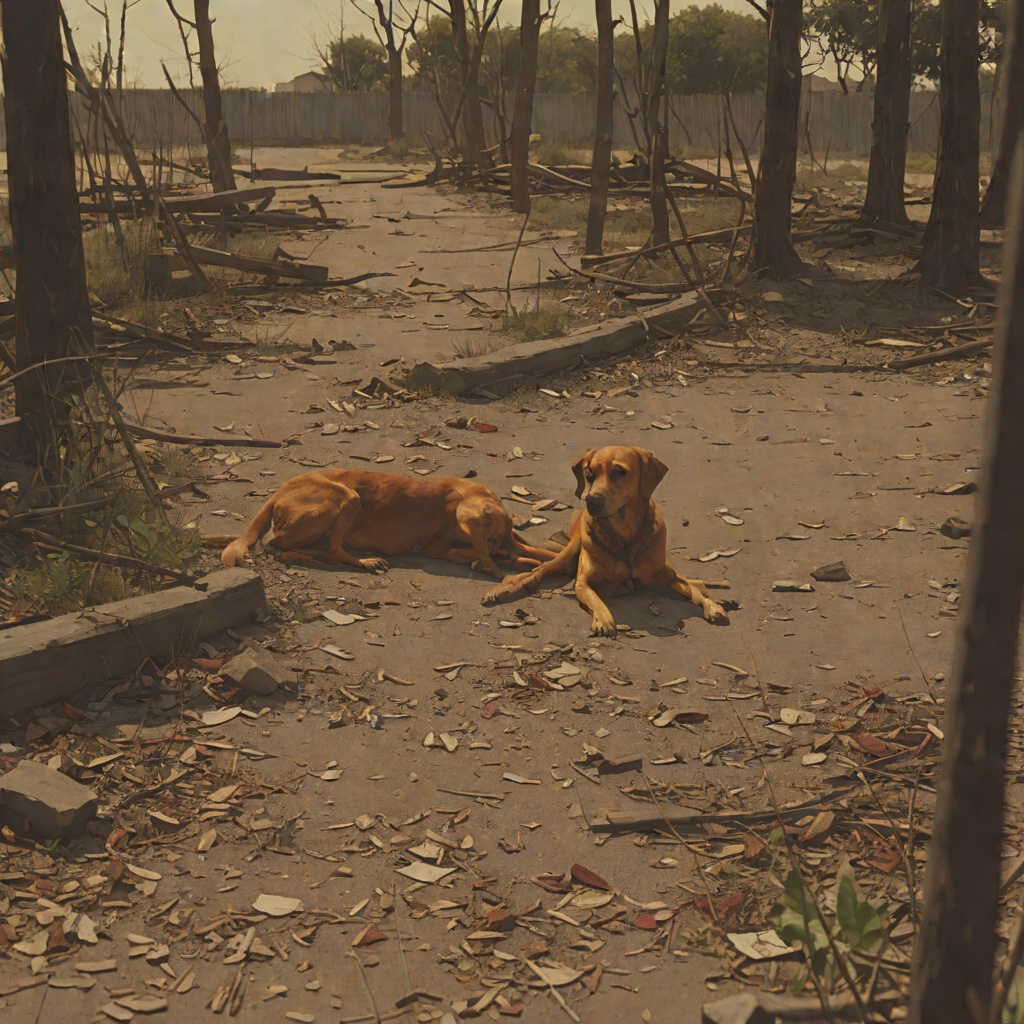
The Narrator and Bloody (Dog)
Die, My LoveThe relationship between The Narrator and Bloody (Dog) is one of the most charged and revealing threads in the novel, tracing a brutal arc from reluctant adoption to violent killing. The dog enters the family not through any desire of the narrator's but through her husband's pity, and it becomes the object onto which she projects her rage, her disgust, and finally her own unbearable pain. The bond is defined less by affection than by a series of violent, almost ritualistic acts — the naming, the killing, the burial — that mark the narrator's progressive unraveling and her estrangement from the norms of family life. Bloody is not merely a pet; it is a witness, a victim, and a mirror of the narrator's own condition, and its death becomes one of the novel's most harrowing set pieces.
Adoption and Naming
The narrator makes clear from the start that she never wanted the dog. It was her husband who took pity on the animal when they saw it lying in the middle of the road on the way back from the supermarket. The narrator's resistance is immediate and visceral: when the dog tugs at the tablecloth and breaks her glass, when it pisses on the floor, she refuses to clean it up, watching the puddle spread to the door and underneath it. Her contempt is expressed in a stream of bitter epithets — "obsequious boot-licking dog," "indoctrinated dog" — that reveal her view of the animal as a servile, degraded creature. The naming itself becomes a site of conflict. The narrator would have no problem calling it simply Dog, but her husband insists on giving it a proper name and making it part of the family. The name they settle on, Blood, in English, is soon corrupted to Bloody, a word that carries both the animal's bloodied snout and the narrator's own violent impulses. The christening happens in the aftermath of a car accident, when the stag collides with the windscreen and the dog licks the remains off the bonnet, shaking its head once the job is done. The name is thus born from blood and death, an omen of what is to come.
The Killing
The killing of Bloody is the climax of the relationship and one of the most disturbing scenes in the novel. The dog, injured in the stag collision, is in visible agony, its leg dragging, its body writhing as it makes holes in the ground, its cry — "eeeeee, eeeeee" — echoing throughout the house. The narrator, driven mad by the sound, gets up in the night, grabs a small torch from the tool drawer, and goes into the garage. She searches through layers of filth until she finds the father-in-law's shotgun, and then, in wellies and half-naked, she goes to her mother-in-law's house, letting herself in with the rabbit-paw keyring hidden in the flowerpot. She finds her mother-in-law asleep, doped up, a "plank" wrapped in sheets, and she searches until she finds the firearm. Back home, she aims the gun at her sleeping husband and says, "Kill him." When he asks who, she says, "Kill the dog. Because he's suffering." Her husband refuses, rolls over, and snores. The narrator, astonished by his "relentless cowardice," takes the shotgun and goes from room to room until she reaches the corner of the kitchen where Bloody is sobbing with pain on a filthy rag. She aims. Her brain goes blank. She feels like an Israeli soldier and hears an order in her mind: "Fire! Fire, you bastard!" And there, for the first time in her life, she pulls the trigger. The scene is rendered with a chilling detachment that underscores the narrator's dissociation from her own act.
The Burial and the Birthday Party
The aftermath of the killing is as disturbing as the act itself. The narrator and her husband bury the dog in the garden, but they do so only at noon, by which time its eyes are full of flies. It had been there the whole night with a bullet in it, unburied, entrails all over the place, so dead that it didn't even let out a last howl. The makeshift grave becomes a grotesque centerpiece of the son's second birthday party, which the narrator has organized with great care — banners with little bumper cars, mini plates of finger food, a party bag for each guest. As she walks through the party, drinking the dregs of yesterday's wine, her gaze falls on the mound of earth in the garden. At first she doesn't understand; she keeps looking at it the way one might look at images of events that took place millions of years ago. Then she feels the dog leap up onto her lap and sink a tooth into her — a hallucinatory return of the dead animal. The children skip over the makeshift grave, singing and laughing and holding hands. Something — the sight of the remains, the rancid wine, the mouths smeared with banana — makes her rush inside and shut herself in her bedroom, slamming the door. She hopes they all die, every last one of them. When her husband comes knocking, calling her "darling, honey, sugar, sweetheart, my bunny rabbit, my love," she says nothing, and finally tells him to leave her alone and die. She then pushes past the guests, gets into the convertible, and drives off without a license, shouting that she will hand over their son to him, gift-wrapped. The dog's death is thus not an isolated act of cruelty but the pivot on which the narrator's final break with family life turns.
Thematic Significance
The relationship between The Narrator and Bloody is a dense knot of the novel's central themes. The dog is an animal, and the narrator's treatment of it — her casual killing of spiders, flies, bees, ants, worms, and slugs throughout the novel — places her within a world of pervasive animality, where life and death are cheap and the boundary between human and beast is porous. The narrator's identification with the suffering animal is implicit: she, too, is trapped, in pain, and crying out. Her refusal to wipe up the dog's piss, her insistence on wearing her trousers unbuttoned, her demand that her husband kill the dog to end its suffering — all these acts are expressions of a maternal ambivalence that extends beyond her human child to all dependent creatures. The killing of Bloody is also a failure of language: the narrator cannot articulate her own pain, so she acts it out in violence. The dog's name, Bloody, is a curse word, an expletive, a marker of the narrator's own profane relation to the world. And the dog's unburied corpse, with flies in its eyes, becomes a symbol of the narrator's own unburied grief and rage, a thing that will not stay buried, that returns to haunt her at the birthday party and drives her to abandon her family. In this sense, Bloody is not just a pet the narrator kills; it is the embodiment of everything she cannot say and cannot escape.