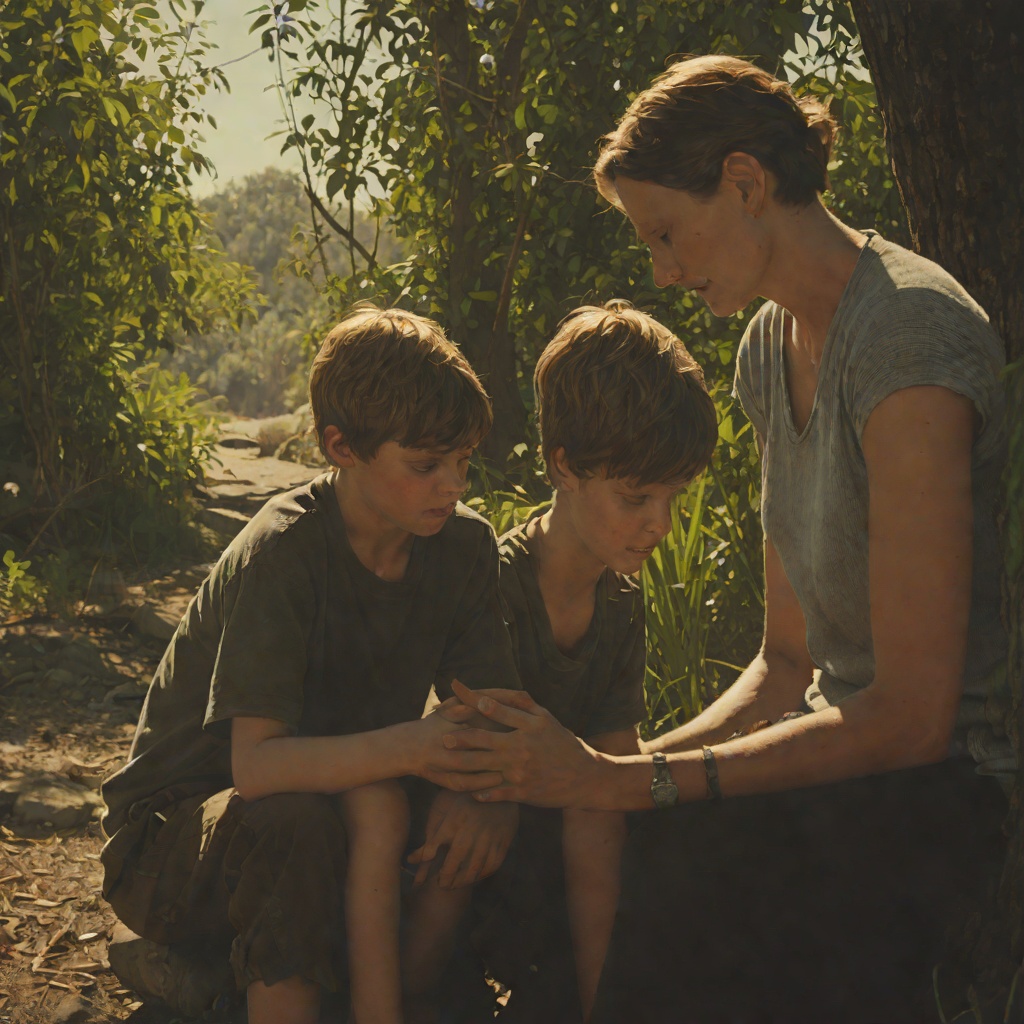
The Narrator and Her Son (Mother-Son)
Die, My LoveThe relationship between The Narrator and her son is the novel's emotional and thematic core, the site where its most extreme contradictions collide. It is at once a bond of fierce, almost feral attachment and a source of unrelenting rage, disgust, and regret. The narrator's own testimony frames the paradox from the start: she is "a weak, perverse woman" who dreams of a knife in her hand, yet she is "the mother and wife of those two individuals." She is the person in charge of her son's education, and she is also the woman who, lying hidden in the underbrush on a Sunday before a bank holiday, spies on her naked husband and son splashing in a blue paddling pool and wonders what she is going to do. The relationship is defined by this oscillation between devotion and the desire to escape, between protective instinct and the fantasy of violence.
Identity and Introduction
The narrator introduces her son primarily as "the baby," an object of bewildering otherness rather than a fully realized person. Her first memory of him outside her body is from the porch of her house at nightfall, when she sits in a wicker chair counting fireflies because she is afraid of the harm she could cause the newborn. She does not join the others at the table, does not share the bed, the table, or the bathroom. The baby is so small he gets lost among the sheets, "like a tiny fish." Even her hopes for him are refracted through her own alienation: she wants his first word to be "magnolia" or "compassion" or "dalliance," not "Mum" or "Dad," not "water." She would rather he did not speak at all than speak the ordinary words of the family she cannot inhabit. The child is thus introduced not as a person with his own interiority but as a mirror of the narrator's own fractured subjectivity, a creature whose existence forces her to confront what she has become.
Arc Through the Plot
The relationship develops through a series of escalating crises. In the son's room, lit by a faint blue light, the narrator watches her nipple satisfy him with every slurp, then leans him against her chest to burp him, ridding him of air from her milk, her chest, her insides. After he burps he becomes a dead weight, his arms hanging, his eyelids thickening. She lays him down wrapped in her scarf and thinks of Isadora Duncan, of who gets which life, of what body one ends up in. The thought of the glass patio doors cutting every inch of her body is never far. When the baby is six months old, she reflects that if she had closed her legs, if she had grabbed her husband's dick, she would not have to go to the bakery for cream cake or chocolate cake and candles. The moment of his birth is inseparable in her mind from the moment of his conception, her husband behind her, about to ejaculate on her back, turning her over suddenly and coming inside her. The child is thus perpetually bound to the sexual act that produced him, and to her own failure to prevent it.
Key Actions and Objectives
The narrator's actions toward her son swing between extremes of care and abandonment. She devotes a wintery Sunday morning to swearing at him, filling him with one insult after another, hoping he does not recognize any of the dirty words and go around saying "fucking hell" in front of everyone. When he says "Mum, pee," she tells him to go and pee on his own, and to feed himself while he is at it. She is fed up with the fact that "it's not okay to bad-mouth your own baby or walk around firing a gun." Yet the same woman, when she loses sight of him in the woods, begins to run with arms flailing, her heart beating so fast she thinks she will see him covered in mud among the fallen leaves. She finds him lying on branches higher than she would have climbed, and scrambles up to sit holding on to him. She gives him swamp water from the pond to taste, petals from the most colorful flowers to eat, leaves to chew for their sap. She mimics the calls of the animals with him, becoming part of them. She dunks him in icy water and baptizes him by mistake, and when he seems too pale to be real, she shakes him and wraps him in her red flesh until he comes to at midnight. The objective that emerges is not coherent motherhood but survival, both his and hers, through a series of improvised, often dangerous acts.
Relationships and Conflict
The conflict between mother and son is the novel's most sustained and explicit antagonism. The narrator describes herself as "a mother on autopilot," lifting the child with a fake smile and clenched teeth. She needs the loo but cannot go because he cries and cries and cries, and she would rather shit herself than take him with her again. She calls her husband for reinforcements, begging him to come home, saying she will not last till tonight, but he pretends not to understand. She carries the baby to the door to see if there is anyone passing by she can give him to, but the neighbors are all bastards. She leaves him lying at her feet, and he twists, stretches, screams at her, takes off his nappy, unbuttons her shoes, chews on the leather straps. She looks at him the way a crab looks at a child. The conflict is not merely domestic but existential: the child's need is relentless, and the narrator's capacity to meet it is exhausted. Her regret is stated with brutal finality: "I'm a mother, full stop. And I regret it, but I can't even say that." She takes no responsibility for anything he might think of her. She brought him into this world, and that is plenty.
Change and Ending
The relationship's final transformation is the novel's most devastating turn. When the narrator wakes up inside her woods, she notices that she no longer feels any love for her son, as if discovering she is missing an arm or an eye. She goes looking for the stag, but instead of his antlers she finds nurses. After her release from the institution, she is greeted by her husband and son, the father all dressed up, the son wearing his football kit, the two of them holding hands. The baby is already walking, has more teeth, more hair, and an expanded vocabulary that includes "coing coing" and "taca taca." The three of them hug, and her husband tells a joke to lighten the mood: "Now you're finally out we'll be able to live in peace." They greet her as if she has graduated, as if it is time to get on with her life. But the detachment persists. At the son's second birthday party, she watches him spit out his chocolate banana cake and run away, chases him, rugby-tackles him, kisses him, breathes him in, and then he escapes again. She drinks the dregs of bottle after bottle and walks through the party like any host would. When her husband tells her, "He's not a baby any more," what she understands is, "he's not your baby any more." The relationship ends not in reconciliation but in a mutual, unspoken release, the mother and son separated by the very institution that was meant to restore her to him.
Narrative Role and Evaluation
The mother-son relationship is the novel's primary vehicle for its critique of motherhood as a social institution. The narrator's ambivalence is not presented as a personal failing but as a structural condition: she is an educated woman, a university graduate, yet she finds herself more of an animal than the half-dead foxes with sticks propping their mouths open. The child is "a wild animal," and she is the beast who breathes slowly and heavily, leaving no air for anyone else. Her maternity is inseparable from abjection, from the bodily fluids and decay that surround the child's care, from the saliva and crumbs in her mouth, the tomato stuck to her arm, the viscous thing he sticks to her bellybutton. The relationship thus becomes the test case for the novel's larger claims about the failure of language, the impossibility of the normal family, and the indistinguishability of the living and the dead. The narrator's final detachment from her son is not a resolution but a confirmation of her deepest fear: that she has become incapable of the love she is supposed to feel, and that the institution, far from curing her, has only made the estrangement permanent.