The Narrator and the Husband's Marriage
Die, My LoveThe marriage between The Narrator and The Husband is the novel's central relationship, a union that unfolds as a chronicle of mutual incomprehension, mechanized affection, and slow, corrosive decay. From its inception, the relationship is framed not as a meeting of souls but as a collision of two people who are fundamentally wrong for each other. The narrator reflects that they are "one of those couples who mechanise the word 'love'," using it even when they despise each other, a phrase that becomes the defining paradox of their life together. This mechanization is evident in their daily rituals, such as the husband's habitual question, "Blonde or dark?" when offering a beer, a query that reduces choice and intimacy to a hollow, repeated formula. The narrator's response, "Whatever you're having, my love," is delivered with a foreign accent that marks her as an outsider, a "fraud of a country woman" who has let herself go, has a mouth full of cavities, and no longer reads. The marriage is thus established as a performance, a family portrait staged for an audience of three, where the narrator toasts the happiness of her baby while internally wishing she were dead.
The Architecture of Separate Lives
The physical and emotional geography of the marriage is one of separation. The couple sleeps in separate bedrooms, on separate mattresses, a spatial arrangement that mirrors their profound emotional distance. The narrator describes a grotesque intimacy born of this separation: she uses her sleeping husband's hand to touch herself while he dreams, and he uses her "dead hand" to touch himself while she is asleep. This image of mutual, unconscious use is a stark metaphor for their relationship—two people who are physically present but psychically absent, using each other's bodies without true connection. The narrator reflects that "there's been a mistake. We're not meant to be one," and that no one wants to be a Siamese twin, to have their organs stuck to someone else's. This aversion to fusion is the bedrock of their union. The house itself, once a dairy farm, becomes a symbol of their estrangement; the narrator has grown used to sleeping alone, stretched out diagonally across the bed, claiming the space that her husband has vacated. Their interactions are punctuated by violence and resentment: she swears at him, punches him on the shoulder and in the face, and gives him the finger as soon as she gets up, only to ask, "Morning, what do you want for breakfast?" This oscillation between aggression and mundane domesticity is the rhythm of their life together.
The Failure of Language and the Pasture Confrontation
The marriage is characterized by a profound failure of language. The husband is unable to ask a simple question like "how was your day yesterday?" and instead interrogates their son with "Who do you love more?" The narrator, in turn, is accused of verbal diarrhea, her speech compared to a car alarm that "goes on and on, it's unbearable." When she tries to explain herself, he tells her to control herself, to take a pronunciation course, to do a language exchange with a local. This dismissal of her very voice is a form of erasure. In a pivotal confrontation, he leads her into the pastures where the vegetation is taller than them, making her walk blindly as the grasses hit her face like thistles. He presses himself against her, but it goes nowhere, and he pushes her further in. When she begins to speak, he snaps at her and walks away, leaving her to press her fists into her eye sockets. She feels like "a startled deer, a sad, sensitive deer," reduced to "just another patch of grass." The scene is interrupted by the sight of cows separated from their calves, a moment of animal anguish that mirrors the couple's own disconnection and the narrator's fraught relationship with motherhood. The husband's most aggressive statement in seven years of marriage is "Go and get yourself checked out," a phrase that pathologizes her distress rather than addressing it, while the narrator's own threat, "You're a dead man," uttered during the first month of their relationship, foreshadows the emotional death that will define their years together.
The Treatment Talk and the Collapse
The marriage reaches its crisis point in a scene that begins with the husband's ominous words, "Come here, sit down." The narrator immediately understands this phrase as the end, a signal that their life together is over. It is not even eight in the morning, and she feels a stabbing pain in her sex as she drags herself towards the chair. The husband's proposal is not a discussion but a verdict: he sees her as a woman who needs "treatment," who needs to calm down and become an amoeba, to be placed in a place full of sheets and white walls, with pills, capsules, and tablets under her tongue. He envisions her in a psychiatric institution, attending craft workshops and reading illustrated hardback books until she is discharged. The narrator, overwhelmed by a need to heave, throws up "our ten years as a couple all over the table, the chair and the sofa." This visceral act is a physical rejection of their shared history. The husband, faced with the damage, does not know whether to mop up, hug her, or call an ambulance to have her committed. Their son looks at them from between the table legs, understanding it all like an adult. The narrator, having lost her home, goes out into the fields, rolling around in the weeds, feeling that nature itself is laughing at her. When she returns, her "boys" are watching a game show and eating hamburgers. In a desperate, ironic gesture, she says, "Let's get married," and one minute later, without taking his eyes off the TV, her man says, "Sure." This absurd proposal and acceptance is the marriage's final, hollow affirmation.
The Wedding as a Dance of Death
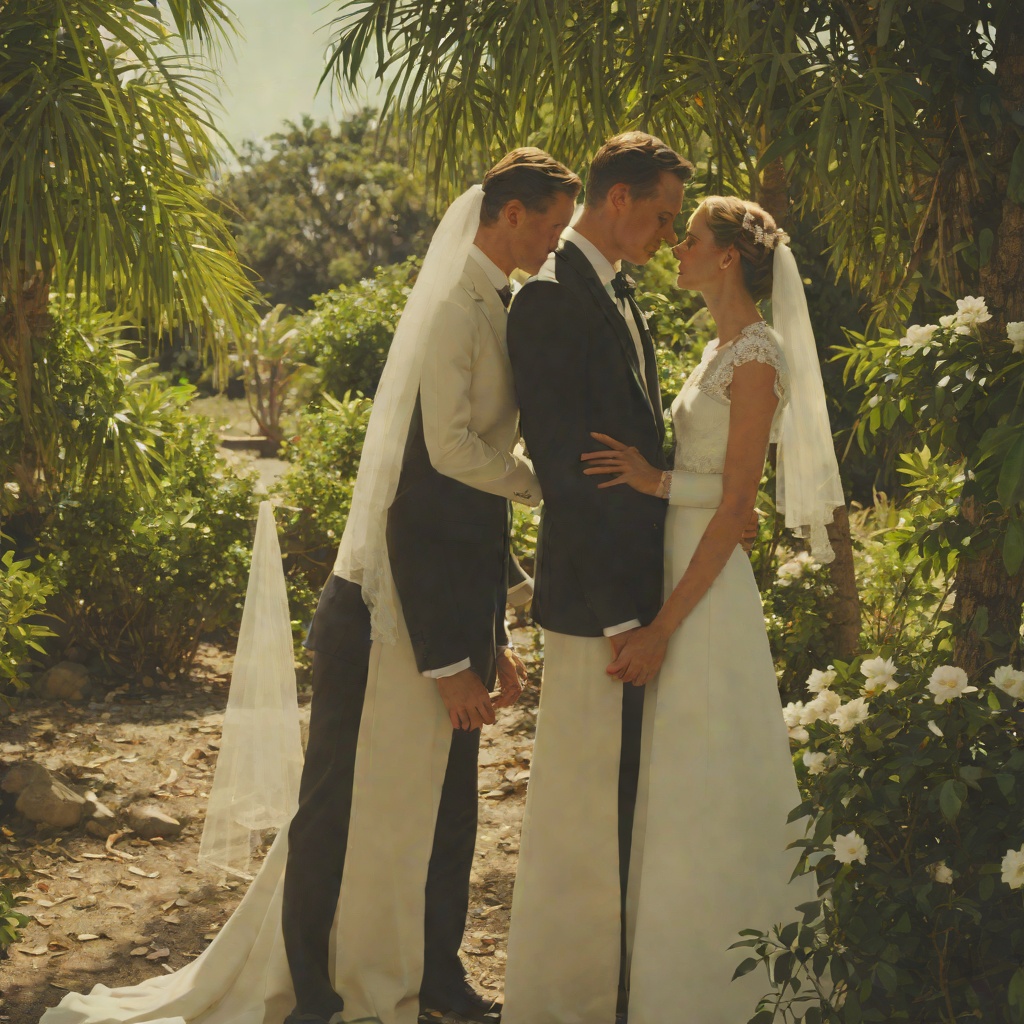
The wedding itself, which should be a celebration, is rendered as a grotesque, death-tinged ritual. The narrator wears high heels for the first time, has a waist she didn't know she had, and her hair shines, but her laughter doesn't seem believable to her. The guests dance wildly, and some of them fall down the slope into the woods and are never seen again; more guests have disappeared than remain. The parish priest, who is even less religious than the narrator, intones the traditional vows, asking the husband if he will love, honour, and cherish her, forsaking all others. The narrator, unable to hear a thing, only hears babbling and buzzing. As she says her "I do," her legs run down the road towards a parallel life in her mind, and she imagines sinking a knife into the flesh of a cow. The ceremony is a performance of commitment that she experiences as a form of death, a binding that she desperately wants to escape. The guests whoop like jackals and hyenas, and the narrator searches desperately for her stag, a symbol of her true, wild self, and for her son, who is hiding. The rice thrown at them gets lodged in the pores of her head, a physical intrusion that mirrors the invasive nature of the vows.
The Final Separation in the Woods
The marriage ends not with a dramatic confrontation but with a quiet, rain-soaked drive into the woods. After a conversation between the husband and the radiologist, the narrator's lover, the two men reach an agreement, and the husband comes to collect her. They drive home in the rain, and the narrator notices a row of cypresses, asking if they are new; he tells her they've always been there. He doesn't stop at the front door, and she sees a few blue balloons drifting over the garden, a sign that the party is over. When she asks if the baby is asleep inside, he says, "He's not a baby any more," which she understands as "he's not your baby any more." In the woods, he turns off the engine and asks, "So what do you want to do?" a question she never expected. He tells her, "I won't be able to forget," and then reveals that the radiologist and his wife are expecting a child—two, actually, "two tiny twins." The absurdity of the phrase makes them both laugh, and they sit together laughing for the very last time like a happily married couple. The narrator gets out of the convertible without opening the door, noting that it is a very practical model for break-ups, and disappears into the undergrowth. She feels nothing but pain, a mourning that lasts a long time, until she finally feels a sadness that is exhilarating and wild, like a widow unlocking her front door for the first time. The marriage, which began with a mechanized "I love you," ends with a shared, inexplicable laugh and a silent parting, leaving the narrator to mourn not the man, but the life she has finally escaped.