The Radiologist's Daughter
Die, My LoveThe Radiologist's Daughter is a profoundly disabled child whose silent, suffering presence becomes the novel's most potent symbol of the narrator's own entrapment, desire, and fractured humanity. She is the fixed point around which the affair between The Narrator and The Radiologist revolves, and her condition—a flat left brain, an inability to speak, walk, or even focus—mirrors the narrator's own sense of being a 'little fish with no scales,' lost and voiceless. Her existence is both the object of the radiologist's tender, desperate care and the catalyst for the narrator's most violent fantasies, ultimately binding the two lovers in a shared, unspoken understanding that transcends their physical affair.
Identity and Condition
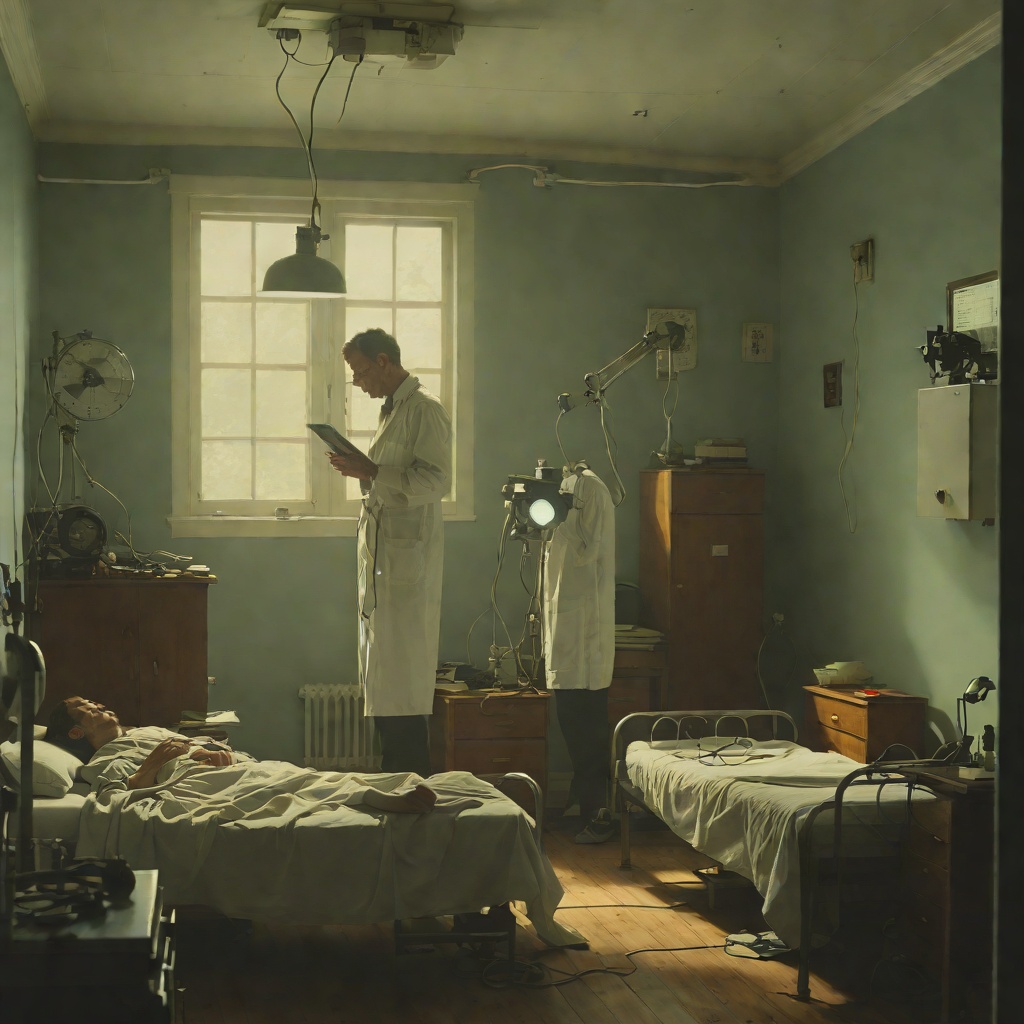
The Radiologist's Daughter is defined entirely by her profound disability, which the novel presents with clinical, almost brutal precision. She is described as a 'special-needs daughter,' a 'little fish with no scales,' and an 'empty-headed angel.' Her condition is starkly physical: the left side of her brain is flat, a detail the narrator notes she 'takes after her mother.' This neurological damage renders her unable to talk, walk, or sit up. She cannot cry, does not drink water, and cannot focus her gaze, 'can't even pretend to.' Her body is a prison of convulsions and spasms, which her father, The Radiologist, must constantly try to calm. The narrator observes him 'swaying from side to side, gripping her bones. Crushing her hips,' as he attempts to soothe her. The girl's eyes roll 'with wild delight at her father,' a gesture that suggests a flicker of connection within her otherwise unresponsive form. Her textureless brain, the narrator reflects, 'won't stop her body in its path towards putrefaction, or from menstruating or ceasing to menstruate,' a chilling reminder that her biological life continues even as her cognitive one is absent. She is a 'child in a state of senility,' a being trapped between infancy and decay.
The Father's Care and the Narrator's Voyeurism
The Radiologist's Daughter is the central figure in the narrator's voyeuristic spying on the radiologist's home. From her bicycle, hidden in the vegetation, the narrator watches the father's intimate, desperate care for his daughter. She sees him wrap the girl in a feather duvet, 'turning her into a pheasant with a ring of white plumage around her neck.' She observes him lulling her to sleep, stroking her ankles, and smothering her with kisses. This tender, almost suffocating care is what ignites the narrator's desire. Watching him, she feels a want so powerful she could 'put my fist through the window, climb in and rape him right then and there, with the infant breathing softly nearby.' The daughter's presence is not an obstacle to the narrator's fantasy but an integral part of it; the scene of paternal devotion is precisely what makes the radiologist so desirable. The narrator's observation is also a form of judgment, as she notes the father 'pinches her skin' and 'squeezes her too hard,' blurring the line between care and violence. The daughter's howl, heard through the window, punctuates the narrator's own fall into a ditch, a moment of physical and symbolic abjection that mirrors the girl's own helplessness.
The Abandoned Princess
Later in the novel, the Radiologist's Daughter becomes the focal point of a scene of apparent abandonment. After the narrator flees her son's birthday party in a convertible, she drives to the radiologist's house, only to find 'his princess was in the window, but there was no one else around. Neither him nor his wife. No trace of either of them.' The narrator is struck by the thought that they have 'abandoned their special daughter.' She enters the house, looking at the bed they sleep in, the bathroom, his toothbrush, 'at everything he looks at from the minute he gets up,' before collapsing into an embroidered armchair. Upstairs, the daughter moans, a sound that underscores the narrator's own sense of being lost and forgotten. This moment of perceived abandonment is crucial: it suggests that even the radiologist's devotion has its limits, and it positions the daughter as a figure of ultimate vulnerability, left alone while the adults pursue their own dramas. The narrator's intrusion into this private space is a violation, but it also reveals her identification with the girl—both are, in their own ways, left behind.
The Silent Witness to the Men's Agreement
The Radiologist's Daughter is present, though silent and unseen, during the climactic confrontation between The Husband and The Radiologist. As the two men walk off into the open fields to reach their agreement, the narrator sees 'Mother and daughter appeared at the window, one paler than the other.' The daughter, held or standing beside her mother, becomes a silent witness to the negotiation that will decide the narrator's fate. Her presence at the window, a pale figure against the glass, is a haunting image of the consequences of adult desire. She is the living embodiment of the radiologist's other life, the responsibility that anchors him even as he engages in this affair. The narrator, watching the men talk, feels her own life 'came and went,' and the daughter's silent observation from the window mirrors this sense of passive spectatorship. The girl is not a participant in the drama but its backdrop, a reminder of the world that exists beyond the narrator's obsessive love. Her presence at this moment underscores the novel's central irony: that the affair, which seems to offer escape, is ultimately bound to the very structures of family and obligation that the narrator seeks to flee.
Thematic Significance: A Mirror of Voicelessness
The Radiologist's Daughter functions as a profound thematic mirror for the narrator's own condition. Like the girl, the narrator is often voiceless, unable to articulate her rage, her desire, or her despair. The daughter's inability to speak or focus her gaze is an extreme version of the narrator's own 'failure of language,' her sense that words cannot capture her experience. The narrator's fantasy of being a 'little fish with no scales' directly echoes the description of the daughter, suggesting a deep, unconscious identification. The girl's body, with its convulsions and spasms, mirrors the narrator's own physical disintegration—her cuts, her rage, her sense of falling apart. The daughter is also a figure of pure, unmediated need, a being who demands care without the possibility of reciprocity. This is the very condition the narrator rebels against in her own motherhood. Where the narrator resents her son's demands, the radiologist embraces his daughter's, and this difference is central to his appeal. The daughter, in her helplessness, represents the absolute limit of the maternal and paternal ideal, a test of love that the narrator fails and the radiologist, at least in her eyes, passes. She is the silent, suffering proof that care can be an act of devotion rather than a trap, and her presence haunts the narrator's own struggle with motherhood, desire, and the meaning of a life lived in the shadow of another's needs.