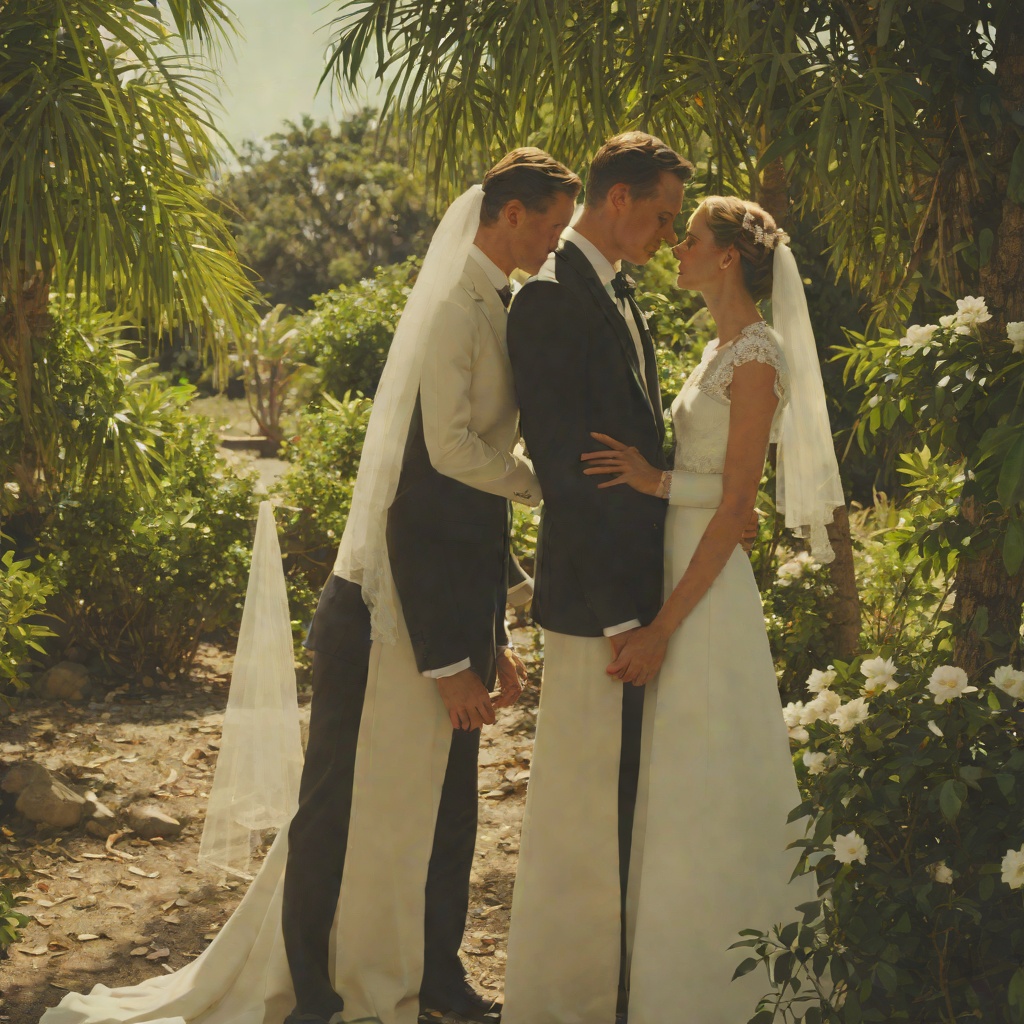
The Wedding
Die, My LoveThe Wedding is the novel's central ritual of bad faith, the ceremony that binds The Narrator to The Husband while her inner life is already running toward escape, violence, and the stag. It is the moment the marriage is publicly sealed and privately voided, a carnival of drunken guests, tongueless kisses, and a bride who cannot hear a word of her own vows. The event establishes the marriage as a performance from its first instant, and it plants the seeds of everything that follows: the affair with The Radiologist, the narrator's descent into madness, and the eventual collapse of the family. The wedding is not a beginning but a trap, and the narrator knows it even as she says "I do."
The Ceremony and Its Setting
The wedding takes place in a makeshift chapel, officiated by a parish priest who, the narrator notes, is "even less religious than I am." Champagne is drunk by the glass, and the narrator wears high heels for the first time, discovering "a waist I didn't know I had." Her hair shines, and outside, two squirrels swagger around. Everyone is inebriated — "Even the rocks." The scene is one of deliberate excess: a long table with rouge stains set off against white linen, guests dancing wildly, women rotating their swan necks three hundred and sixty degrees. Some of the guests fall down the slope into the woods and are never seen again; more guests have disappeared than remain. The neighbours are asleep or dead in their rickety beds. The air is dense and every so often it shimmers. This is not a celebration but a grotesque spectacle, a world already tipping toward dissolution.
The priest's words are the official liturgy of the marriage service, spoken in an affected voice: "We are gathered here today in the presence of God and these witnesses to celebrate before the Almighty and in the name of our holy religion, the marriage between this man and this woman." The narrator hears none of it — "Just babbling, buzzing." She is the main attraction, and everyone is watching her. The vows are recited in full: the promise to love, honour, and cherish, to forsake all others, to perform faithfully all the duties which a husband owes to a wife and a wife to a husband, "while God grants you life." The narrator's "I do" comes, but her mind is elsewhere. She cannot hear a thing.
The Bride's Inner Dissent
While the priest speaks of holy matrimony "till death do you part," the narrator's thoughts are running down a road towards a parallel life. She imagines her legs carrying her away from the ceremony. In her mind she still has the strength and the will to sink a knife into the flesh of a cow — a violent, almost sacrificial image that recurs in her imagination. Before her "I do," she sees herself covered in a coating of grass, as if she were already lying in the earth or in the weeds. She asks herself unanswerable questions: "But how will it part us? Which of us will see the other's corpse? Who will bury whom?" The marriage service promises a bond till death, but the narrator is already contemplating which of them will die first. The ceremony is supposed to be a beginning, but for her it is already an ending.
The narrator searches desperately for her stag during the ceremony, the animal that represents her true, non-human desire. She searches for her little son too, but he is hiding. There is "no one, no one and nothing that could stop me." The stag is absent, the son is hidden, and the narrator is alone in the crowd. The wedding is a moment of total isolation disguised as communion. The guests whoop like jackals, like hyenas, and the narrator is lifted up in a chair, twirled around in their arms, showered with "Hurrah!" and "Long live the newly-weds!" and "Hallelujah!" Rice is thrown at her and gets lodged in the pores of her head. She is kissed by a sequence of lumpy lips. A pack of hunting dogs with reptile tails spins around in a whirlpool, upsetting the tablecloth and smashing the glasses, bottles, and flowers. The chaos of the celebration mirrors the chaos in her mind.
The Carnivalesque Degradation
The wedding is a carnival in the fullest sense: a temporary inversion of order that reveals the grotesque body beneath the social surface. The narrator becomes "the empress, the bearded lady, Madame Zingare" — a figure of spectacle, both exalted and degraded. She puts a hand to her lips and instead of feeling a smile, she feels something murky, tepid, and viscous dribbling from the corners of her mouth. The bride's smile is not a smile; it is a leak, a bodily betrayal. The guests dance wildly, the women rotate their swan necks, and some fall down the slope into the woods, never to be seen again. The celebration is a dance of death, a phrase the narrator herself uses: "before the dances of death." The wedding is not a step toward life but a step toward the grave.
The narrator's laughter "doesn't seem believable" to her. She touches her smile with her fingers, as if checking whether it is really there. The performance of happiness is so alien that she cannot trust her own face. The Husband comes and goes, giving her "tongueless kisses" and stroking her shoulder — gestures of affection that are empty, mechanical, devoid of passion. Even the animals look at him with respect, the narrator notes, but his kisses carry no tongue, no life. The marriage is already a corpse, and the wedding is its funeral dressed in white.
The Aftermath in the Bridal Chamber
After the ceremony, the narrator finds herself in a room with a ceiling fan, wearing nothing but a white dress with ruffles, fitted at the waist and completely soaked. She is alone. Her hand wanders between her legs, but "that wasn't what I needed." She scrubs herself down there, but nothing. She squeezes herself, hits her hand until it becomes the hand of the other. She rips off her garters with her teeth, pulls out the stitching with her nails, puts a hand on her heart, wets the nape of her neck, and splashes herself with perfume, undressing over and over. She changes her knickers. She tries to smell herself but cannot, even though she stretches her neck almost to the point of breaking it. She wants to sleep face down, face sideways, face up — but no position offers rest. She grabs the scissors with a swipe of her hand, cuts off her fringe, and leaves it on the pillow. "Now there are two of us." The fan rotates more and more slowly, advancing upon her threateningly. The phone is there, a lifeline she does not yet take. The bridal chamber is not a place of consummation but of self-fragmentation, a room where the bride splits herself in two and waits for something — anything — to happen.
The Wedding's Narrative Significance
The wedding is the novel's founding lie, the moment that sets the narrator's entire trajectory in motion. It is the public seal on a marriage that is already dead, and the narrator's inner dissent during the ceremony foreshadows every subsequent act of rebellion: the affair with The Radiologist, the abandonment of her family, the commitment to the psychiatric institution. The ceremony is also the novel's first full display of its carnivalesque aesthetic — the grotesque bodies, the inverted order, the mingling of celebration and death. The guests who fall into the woods and vanish, the hunting dogs with reptile tails, the rice lodged in the narrator's pores — all of these images belong to a world where the sacred and the profane, the human and the animal, the living and the dead are indistinguishable. The wedding is not a beginning but a rupture, and the narrator steps into it with her eyes open, already planning her escape.