The visit to the radiologist's house and the two men's agreement
Die, My LoveThe visit to the radiologist's house and the two men's agreement is the climactic meeting that joins the narrator's illicit love, her marriage, and the future of her family in one charged sequence. She goes to the radiologist's house expecting to find him and his wife, but instead encounters an emptied home, a kiss that briefly arrests her sense of death, and an eventual pact between the two men. What appears at first to be a reunion with the lover becomes a transfer of authority: the narrator's life is silently discussed, chosen, and returned to her husband, while the possibility of a new family elsewhere closes around her.
The Empty House and the Return of Desire
The narrator reaches the radiologist's house after fleeing the birthday gathering in the convertible. The surrounding landscape is marked by repetition and desolation: sheep, chickens, abandoned windmills, boats sunk in lakes, chimneys pouring out black smoke, and animal pens pass before she stops. Inside, she finds the radiologist's disabled daughter still upstairs, moaning, while neither the radiologist nor his wife is present. The absence of the adults makes the house feel less like a refuge than an abandoned structure organized around the daughter's isolated suffering.
She searches the rooms with invasive attention, looking at the bed where the radiologist and his wife have sex, their bathroom, his toothbrush, and the objects that accompany him from waking onward. The search is both erotic and forensic. Rather than meeting the lover directly, she reconstructs his domestic life through its traces, collapsing the distance between adultery and ordinary household intimacy. Her collapse into an embroidered armchair, followed by sleep, permits a dream of the radiologist on his back, his hair against her skin, and the sweet, hollow sound of an antler. The dream joins sexual memory to the animal imagery that repeatedly surrounds the narrator's desires.
The radiologist and his wife eventually return from mushroom gathering, their baskets overflowing. The wife looks at the narrator with horror, while the radiologist sends her upstairs to the daughter and leads the narrator away from the house. At a distance, the lovers face one another without speaking. The narrator treats speech itself as repulsive, and the silence makes the kiss their operative language. She notices the marks left by the glass on the radiologist's face; her tongue against his tongue tastes of salty blood and functions as a painkiller. The kiss therefore restores desire while also exposing injury. It is not a simple romantic reunion but a bodily exchange in which pain, consolation, and the interruption of death become inseparable.
The Husband Arrives
The kiss is interrupted by the arrival of the Husband on the neighbour's motorcycle, a vehicle so small that it makes him look fourteen. The image strips him of conventional marital authority and places him beside the radiologist as one of the narrator's two animalized males: her bulls, stallions, or pawns. Yet the comparison also reveals her attempt to arrange the men as pieces in a private drama that has exceeded her control. The Husband's arrival converts the private scene between lovers into a confrontation among three people whose relationships can no longer remain compartmentalized.
The Husband and the radiologist walk together into the open fields, stopping beyond the narrator's hearing. No spoken exchange is available to her; she sees only their bodies in profile and the distance separating them. The scene makes withheld language central. The narrator has already declared speaking disgusting, but the men now take that refusal of language away from her as well: their agreement is produced outside her access, and she must interpret it through posture, gesture, and duration.
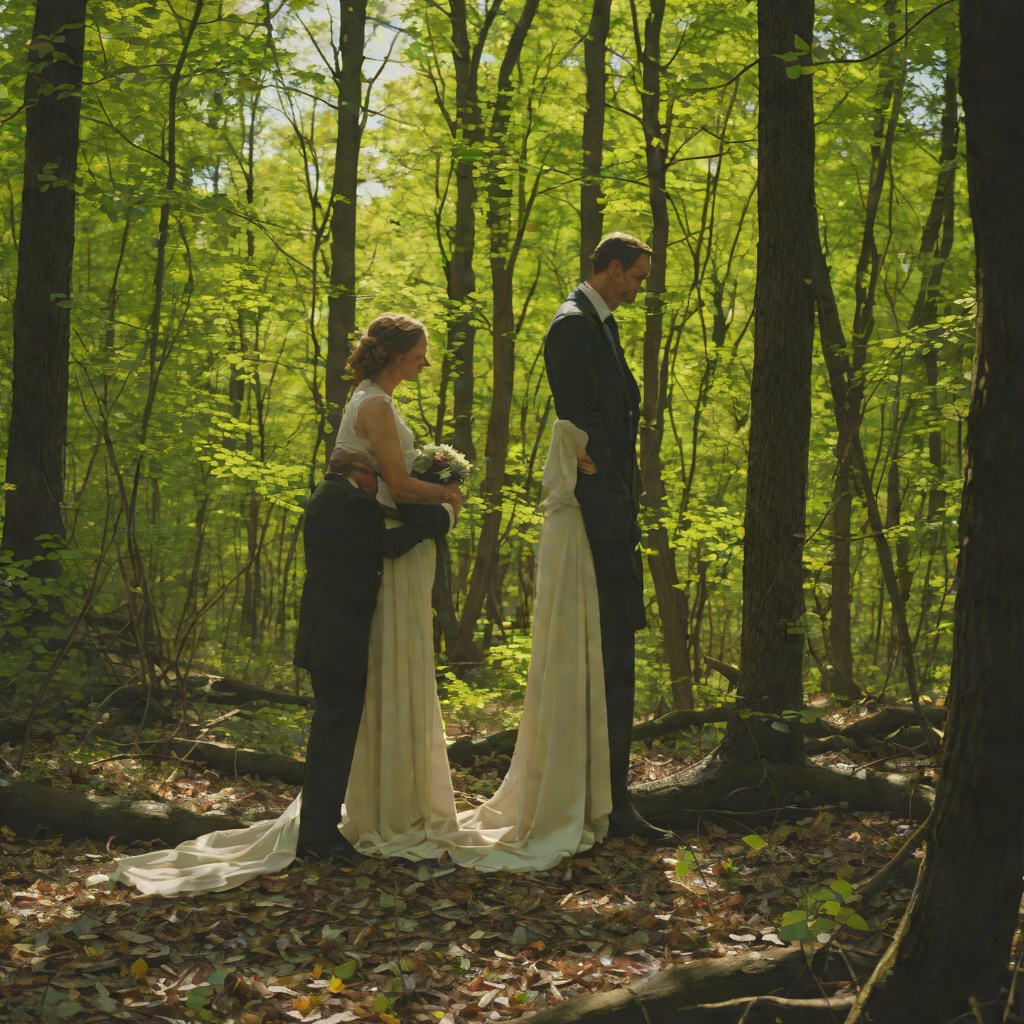
At the window, the radiologist's wife and daughter appear, one paler than the other. From inside the house, the encounter resembles a duel between the two men. The tension then dissipates, and the narrator imagines them as two long-lost brothers recalling childhood in the family home and discussing how to settle their dead parents' debts. This transformation from rivals to brothers does not erase conflict; it recasts erotic rivalry as an inherited domestic obligation. The sun sets over them, dusk tints their bodies, and steady rain falls while they continue their muted negotiation.
The Agreement and the Transfer of Choice
The narrator cannot know what the men say, but small gestures indicate that they have understood one another. They step slightly aside, nod, yawn, and laugh. Their physical restraint contrasts with the narrator's earlier flight, rage, kissing, and collapse. Where she experiences intimacy as violent intensity, they settle its consequences through a practical exchange whose terms remain hidden. The men become, in the narrator's image, Siamese twins who must eventually part; the metaphor suggests that husband and lover have been joined by the same woman, yet their bond is also a deforming constraint from which one must separate.
The radiologist approaches the narrator first, and her trembling expresses the scene's central uncertainty. She does not know which man will take her, whom she will belong to, or what name the chosen arrangement will give her life. She imagines herself as a black-market purchase, asking what home will receive her and what the buyer will call her. This commercial vocabulary turns romantic choice into ownership and exposes the violence beneath the supposed freedom of the triangle. The radiologist coughs, and she recognizes the Husband as the one coming toward her, the more loyal of the two.
The Husband and the narrator return to the convertible in silence. This silence is more complete than all the earlier silences because the agreement has already been made and no explanation can undo it. On the drive home, the narrator notices a row of cypresses and asks whether they are new; the Husband replies that they have always been there. The exchange gives the landscape the force of belated recognition. What seems newly planted has existed throughout, just as the structures governing the marriage may have been present before the narrator could see them.
The Child, the Woods, and the Final Separation
The Husband does not stop at the front door. Blue balloons drift over the garden, which the narrator perceives as a minefield, signaling that the birthday celebration has ended but that its damage remains. When she asks whether the child is asleep inside, the Husband says that he is no longer a baby. The narrator understands the deeper implication: the child is no longer her baby. Motherhood is thus withdrawn at the very moment the marriage is being reconstituted, and the family home becomes a place to which she can return physically but no longer belong in the same way.
They drive into the woods, leaving tracks in the earth while most animals remain asleep. The stag does not appear; instead, the narrator occupies the place of the absent animal presence. In the woods, the Husband turns off the engine and releases a breath held for too long. He asks what she wants to do, but she has expected a verdict rather than a question. She thought he would tell her whether the outcome was positive or negative and how many weeks or days remained, perhaps crying as he delivered the result. His question exposes the impossibility of reducing the marriage's crisis to a diagnosis or timetable.
The narrator cannot answer. The trees seem like tigers in heat, and the Husband says that he will not be able to forget. His seriousness produces another, more suffocating silence. He then reveals that the radiologist and his wife are expecting two children, tiny twins. The disclosure changes the emotional geometry of the visit: the lover is not simply available for escape, and his domestic future is expanding. The absurd phrase describing the unborn children provokes laughter, and the narrator and the Husband laugh together about the possibility of having another child themselves. Their laughter is hysterical and unexplained, but it is also their last shared performance as a happily married couple.
The narrator leaves the convertible without opening its door, using the vehicle's practical design as an emblem of the ease with which the relationship can now be exited. She disappears into the undergrowth, and the separation becomes physical rather than merely emotional. Pain comes first, followed by a long period of mourning. Eventually, however, grief becomes exhilarating and wild, like the first solitary acts of a widow who unlocks the front door, eats dinner, and gets into bed alone. The visit therefore ends neither in romantic fulfilment nor in reconciliation. Its agreement releases the narrator into an untamed form of loss, where the marriage, the affair, and the family all survive as altered arrangements rather than recoverable homes.
Narrative Significance
The sequence reverses the expected logic of a love triangle. The narrator's reunion with the radiologist brings a powerful bodily affirmation, but the lovers' kiss does not lead to union. Instead, the arrival of the Husband creates an alliance between the two men, and their silent negotiation decides the immediate fate of the narrator's relationships. The decisive action is thus not a declaration of love but a redistribution of intimacy, loyalty, and possession.
The event also turns language into a sign of failure and gesture into a substitute for speech. The narrator rejects speaking, the men conduct their agreement beyond her hearing, and the final domestic exchanges rely on ordinary words whose hidden meanings are more consequential than their literal content. The row of cypresses that have always been there, the child who is no longer a baby, and the lovers who are expecting twins all reveal realities that the narrator can only recognize after they have become irreversible.
At the level of value, the scene moves from desire toward separation, but not from vitality toward simple defeat. The kiss stops death for an instant; the agreement destroys the fantasy of possessing either man; the laughter in the woods turns impending loss into an experience shared one final time; and the narrator's mourning ultimately becomes wild freedom. The visit is therefore the hinge between clandestine attachment and final separation, a scene in which the normal family, erotic escape, and personal autonomy are shown not as stable alternatives but as competing forms of enclosure.