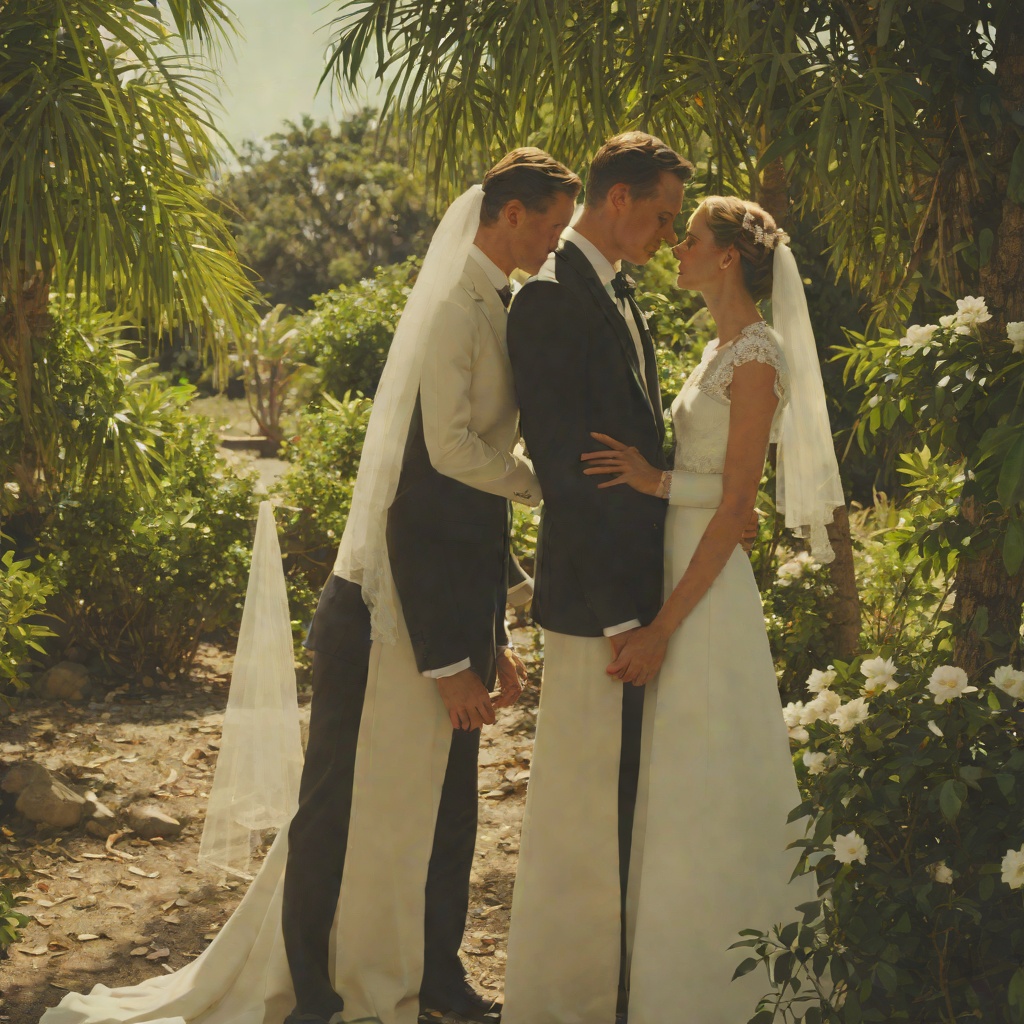
The wedding ceremony
Die, My LoveThe wedding ceremony is the novel's central performative catastrophe: a makeshift chapel wedding in which the Narrator says 'I do' while dissociating from her own body, envisioning herself covered in grass and running toward a parallel life, and searching desperately for her stag and her hidden son. The ceremony crystallizes the book's core tensions—the failure of language, mechanized love, the sinister normal family, and the narrator's animality—as the vows that should bind her instead expose her radical unfreedom. It is the moment the social script of marriage is spoken over her, and the moment she most completely fails to inhabit it.
The Setting and the Festive Atmosphere
The wedding unfolds in a world already tilted toward excess. Champagne is being drunk by the glass, and the Narrator wears high heels for the first time, discovering a waist she didn't know she had, her hair shining. Outside, two squirrels swagger around. Everyone is inebriated—'Even the rocks.' A long table is set with rouge stains set off against white linen. The guests dance wildly, the women rotating their swan necks three hundred and sixty degrees, and some of them fall down the slope into the woods and are never seen again. More guests have disappeared than remain. The neighbours are asleep or dead in their rickety beds. The air is dense and every so often it shimmers. The Husband comes and goes, giving her tongueless kisses and stroking her shoulder. Even the animals look at him with respect. This is not a celebration but a carnival of disappearance, a feast where the living and the dead blur together.
The Vows and the Dissociation
In a makeshift chapel, a parish priest who is even less religious than the Narrator speaks in an affected voice, intoning the traditional marriage liturgy: 'We are gathered here today in the presence of God and these witnesses to celebrate before the Almighty and in the name of our holy religion, the marriage between this man and this woman.' The priest asks the Husband whether he will love, honour and cherish her, forsaking all others for her alone, while God grants him life. He answers, 'I do.' But the Narrator couldn't hear a thing—just babbling, buzzing. Everyone is watching her; she is the main attraction. When the priest turns to her, asking whether she will love, honour and cherish him, forsaking all others for him alone, while God grants her life, her mind runs elsewhere: 'While God grants me life, and my legs run down the road towards a parallel life.' Even as she prepares to say her own 'I do,' she still has the strength and the will to sink a knife into the flesh of a cow. Before her 'I do,' she sees herself covered in a coating of grass. The vows that should unite her to her husband instead split her from herself.
The Pronouncement and the Crowd's Response
The priest continues the liturgy, declaring the marriage a seal of mutual faith and affection, 'a remembrance of this sacred service, and of the sacrosanct bonds of marriage, by which you are bound in holy matrimony till death do you part.' The Narrator's mind interrupts with a chilling question: 'But how will it part us? Which of us will see the other's corpse? Who will bury whom?' The priest pronounces them husband and wife, declaring that those whom God has joined together let not man put asunder. The crowd whoops like jackals, like hyenas. The Narrator searches desperately for her stag, and for her little son too, but he is hiding. There is no one and nothing that can stop her. The guests lift the couple up in chairs, twirl them around in their arms, shouting 'Hurrah!' 'Long live the newly-weds!' 'Hallelujah!' Then they throw rice at her, and it lodges in the pores of her head. She is kissed by a sequence of lumpy lips, and a pack of hunting dogs with reptile tails spins around in a whirlpool, upsetting the tablecloth and smashing the glasses, bottles and flowers. Dogs run around in circles in her mind as well—or are they foals?
The Bride's Transformation and the Aftermath
The Narrator sees people in the open fields exchanging whispers and looking at her in astonishment. She is the empress, the bearded lady, Madame Zingare. She puts a hand to her lips and instead of feeling a smile, she feels something murky, tepid and viscous dribbling from the corners of her mouth. The wedding has transformed her into a grotesque spectacle, a carnival exhibit rather than a bride. The scene continues into the wedding night, where she is nothing but a white dress with ruffles, fitted at the waist and completely soaked in a room with a ceiling fan. Her hand wanders between her legs, but that isn't what she needs. She scrubs herself, squeezes herself, hits her hand until it becomes the hand of the other. She rips off her garters with her teeth, pulls out the stitching with her nails, puts a hand on her heart, wets the nape of her neck and splashes herself with perfume, undressing over and over. She changes her knickers, tries to smell herself but fails, stretching her neck almost to the point of breaking it. She wants to sleep face down, face sideways, face up. She grabs the scissors, cuts off her fringe and leaves it on the pillow. 'Now there are two of us.' The fan rotates more and more slowly, advancing upon her threateningly.
The Ceremony's Significance
The wedding ceremony is the book's most concentrated demonstration of the failure of language and the mechanization of love. The vows are spoken, the pronouncement is made, the crowd celebrates—and none of it reaches the Narrator, who hears only babbling and buzzing. The performative speech acts that should create a marriage instead expose its emptiness. The ceremony is also the fullest expression of the sinister normal family: the ritual that is supposed to sanctify the family unit is revealed as a carnival of grotesquerie, where guests disappear into the woods and the bride feels viscous matter dribbling from her mouth. The Narrator's search for her stag and her hidden son during the ceremony reveals where her true loyalties lie—with the animal and the child, not with the husband. The wedding is the point of no return, the moment she is bound 'till death do you part' to a man she cannot hear, in a life she experiences as a parallel road her legs run down. It is the seal of her imprisonment, and the beginning of her long, failed escape.