animality
Die, My LoveAnimality is a central concept in the Narrator’s attempt to escape the supposedly stable categories of woman, mother, wife, and human subject. It is not simply an admiration for wildlife or a metaphor for savagery. It is a pressure within the body and the language of the novel: a recurrent sense that human domestic life is already animal, that the cultivated self is only a thin performance, and that animals may offer a form of recognition unavailable from other people. Yet the movement toward animality never becomes a pastoral liberation. It is bound to danger, bodily abjection, violence, and the fear that the Narrator’s instincts might destroy the family she is expected to protect.
Definition and Domestic Contrast
The concept first appears through a deliberate collapse of the distinction between civilized family life and animal existence. While the Narrator hides in undergrowth near the house, The Husband and The Son play naked in a heated paddling pool, an apparently ordinary family scene set against her fantasy of using the knife to bleed herself at the jugular. She calls herself a weak and perverse woman who dreams of a blade, then drops the knife and hangs out the washing as if nothing has happened. The domestic gesture becomes a disguise: pegging The Son’s socks and The Husband’s underwear to the line makes her look like an ignorant country woman, while the concealed violence remains unspoken beneath the performance of normality. The countryside reinforces rather than resolves this contradiction. People chop wood and prepare for Winter “like animals,” and the Narrator insists that nothing distinguishes human beings from them. Her education does not protect her from this recognition; as a university graduate, she judges herself more animal than the half-dead Foxes whose mouths are propped open by sticks and whose faces are stained red. Animality therefore functions as a rebuke to human exceptionalism. It does not place the Narrator outside society so much as reveal the animal violence already contained within its habits, family rituals, and ideas of respectable behavior.
The Maternal Body and Loss of Boundaries
Animality is also produced through the maternal body, where the boundary between self and other becomes physically unstable. In The Son’s room, the Narrator watches her nipple satisfy him as he drinks, then burps him and experiences the air in his stomach as air from her milk, chest, and insides. The child becomes a heavy, sleeping body after feeding, while she remains acutely aware that motherhood has made her body an access point between two beings. The scene gives material force to the claim that the human individual is not sealed off from other life: nourishment, breath, waste, exhaustion, and desire circulate across the boundary between mother and child. That circulation is accompanied by disgust and violent fantasy. The Narrator throws out the heavy nappy and repeatedly imagines passing through the glass to cut her body, while the baby’s sounds reduce language to fragments such as “Ma-ma, da-da, poo-poo” and “Co-co-na-na-ba-ba.” The infant’s prelinguistic vocality is not presented as a defective version of adult speech; it is part of a world in which bodily need precedes social meaning. At the same time, the Narrator feels trapped by being responsible for The Son’s education and by the demand that she embody an uncomplicated maternal identity. Animality names the truth that motherhood exposes and the social identity that tries to cover it. The same crisis returns when she tears up grass, worms, and soil, and when rage makes her imagine herself as a buffalo whose heavy breath leaves no air for anyone else. Her body becomes landscape, beast, and forensic remnant at once. The imagined corpse would remain undiscovered for years and become evidence, while her breath fogs windows and mirrors entire cities in narrow rivers. The image enlarges private distress into a material condition: the Narrator is not merely comparing herself with an animal but experiencing herself as a body with weight, appetite, waste, breath, and eventual decomposition. The human subject survives only as a temporary arrangement within these processes.
Becoming Animal in the Woods
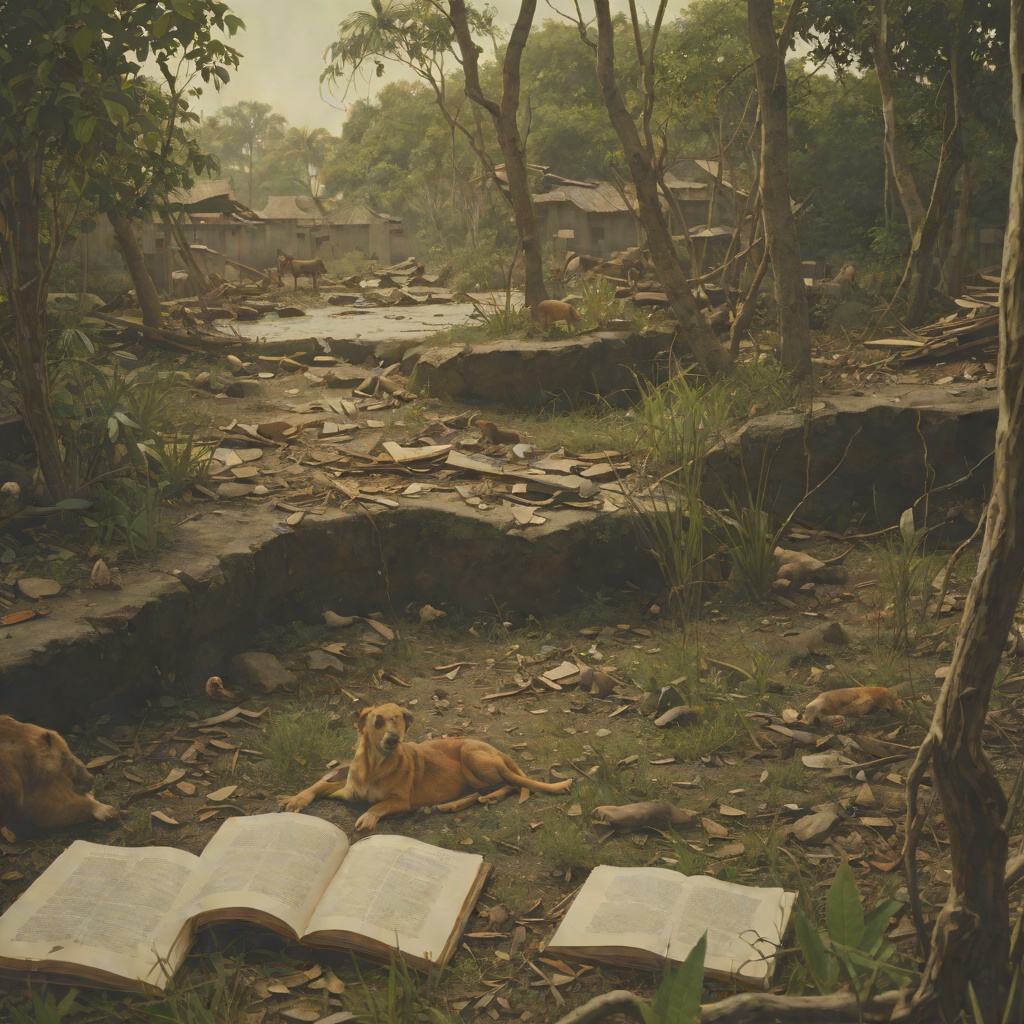
The woods provide the clearest space for animality to become an active mode of perception. With The Son’s buggy set aside, the Narrator lies down beneath falling acorns and leaves, describing the air as charged with invisible sexual tension. The movement of leaves, the golden light, and the nocturnal flutter of butterflies make the forest seem to possess its own sensual rhythm. She falls asleep beside The Son and, on waking, temporarily forgets that he came out of her. The child of the forest copies the motions of mating Capybaras with his tiny pelvis, and the Narrator recognizes him as “an animal like the rest.” The scene does not place human sexuality above animal reproduction; it puts them on the same continuum of movement, impulse, and imitation. The accidental baptism in the woods intensifies this identification. The Narrator gives The Son swamp water, flower petals, and leaves, teaches him to taste the environment, and imitates the calls of the surrounding animals with him. The forest’s birds answer, but their call changes from a peaceful vowel into a harsh and fearful sound, becoming two birds at once: sane and insane, tame and murderous. Animality thus contains contradiction rather than purity. It offers contact with a larger living world, but that world includes predation, death, fear, and mental disintegration. When The Son appears pale and almost unreal after being dunked in icy water, the Narrator shakes him and wraps him in her red flesh, as though trying to revive a stillborn animal. He eventually comes to at midnight, after the hours of the dog and the wolf have passed and the bats have taken over the night. The episode makes care inseparable from animal behavior: the mother does not rescue the child through orderly language or institutional expertise, but through shaking, warmth, flesh, and bodily persistence. Her maternal action is both frightening and protective, and the text refuses to separate those qualities cleanly.
The Stag and Nonhuman Recognition
The Stag becomes the most powerful figure of animality because the Narrator experiences him as a subject rather than as scenery or a mere emblem. After the searchers surround the wilderness with lanterns and human voices, The Stag stops motionless, with glass-like eyes. The Narrator calls him the man of her life, the one who can see into her infinite sadness, while the other men remain inadequate because their language falls short. This preference is not presented as a cute fantasy about wildlife. It is a rejection of the human social order represented by the neighbours and family members who arrive to pull her and The Son out of the woods. The contrast reaches its most explicit form when the Narrator says that her real man is not human and questions the value of wanting to be human at all. The Stag’s triangular ear and black snout are touched by The Son, but the animal does not laugh or perform affection for them. That refusal matters. The Stag is not entirely absorbed into the Narrator’s emotional symbolism: his stillness, opacity, and nonresponse preserve a degree of independence. He can be approached, imagined as a companion, and treated as a witness, but he cannot be made fully legible within human language. Even so, the Stag’s subjectivity remains filtered through the Narrator’s crisis. He becomes the figure of a form of masculine presence without domestic law, jealousy, paperwork, or failed speech. The animal appears to offer what human men do not, yet the scene also reveals how urgently the Narrator needs him to carry her unspoken sadness. Animality therefore resists the human-centered order without escaping representation altogether; the Stag is granted narrative gravity, but his meaning is still shaped by the human voice that seeks recognition from him.
Violence, Desire, and the Human Return
The novel does not equate animality with innocence. In the scene of sexual violence and rage, the Narrator describes desire through the bodies of a cow and a stag. When overcome by lust, she is a cow with a trapped head; when desire burns, she is a stag entering the woods as a bridegroom enters a church. These comparisons make sexuality instinctive and embodied, but they also expose constraint. The cow’s trapped head joins desire to captivity, while the stag’s entrance joins desire to ritual, danger, and surrender. Animality is not a pure opposite to social forms; it repeats and distorts them. The surrounding landscape also mirrors this tension. A peasant fires at a twisted tree, riddling its trunk without bringing it down, while The Husband pretends not to cry and another man presses his body against the Narrator’s. The tree staggers but remains standing, a nonhuman presence that absorbs violence without becoming a simple decorative symbol. Human erotic conflict, gunfire, wounded vegetation, and bodily pressure occupy the same field. The Narrator’s response is not a stable liberation but a desire to be shaken as profoundly as by a dying animal, an intensity beyond the orderly language of divorce, lawyers, signatures, and mutual consent. The concept finally remains inseparable from damage. The Narrator’s cuts are treated in The hospital, where nurses remove shards, mirrors, crystal, petals, and slivers of glass from her shoulder blades, chest, belly, and neck after she is brought in unconscious from the field. Her body becomes a hybrid surface of flesh and broken object, while medical care tries to restore the borders that her experience has shattered. The injuries do not disprove animality; they show its cost within a society that can recognize a wounded body only after it has become a medical case. Animality consequently serves as both an alternative ontology and a formal disturbance. It challenges the claim that humans are separate from animals, turns motherhood into a site of species and bodily mixture, gives the woods and The Stag an agency that exceeds domestic interpretation, and exposes the violence hidden by normal family life. But it also remains unstable: the Narrator cannot permanently inhabit the forest, cannot communicate with The Stag without translating him into her own longing, and cannot escape the human institutions that treat, search for, and judge her. The concept’s decisive force lies in that unresolved tension. Animality is the truth beneath civilization, but it is also the threat civilization uses to define what must be contained.