the attic
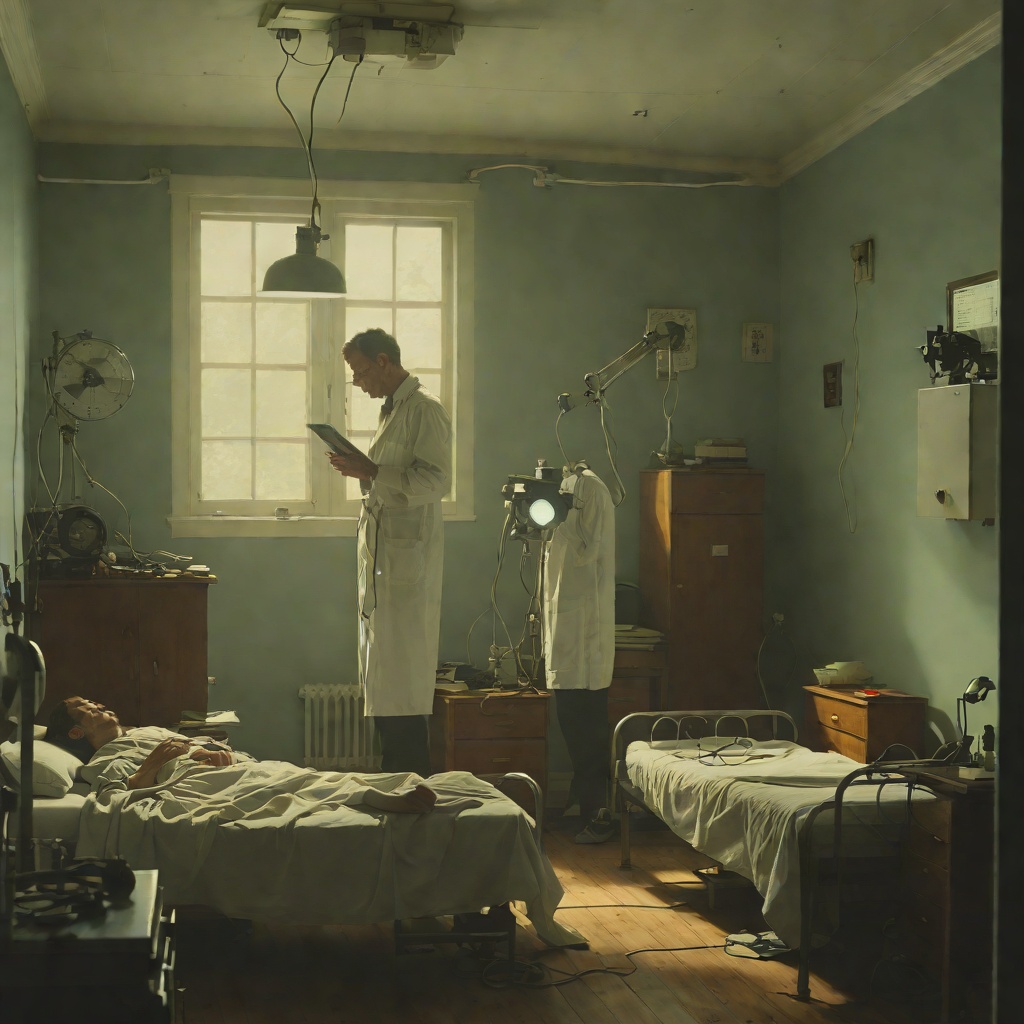
Die, My LoveThe attic of the radiologist's house is the clandestine heart of the narrator's affair, a space deliberately stripped of comfort and domesticity. It contains only a single bed, a chair, and a sentimental wall-hanging embroidered by the radiologist's wife—the 'other woman' whose unseen presence haunts the room. The narrator enters it alone, without knowing where the wife is, and the radiologist follows, locking the door behind them with an iron key. From downstairs, the mother and daughter would hear only the imagined sound of 'two rodents dancing tip tap tip tap tip tap,' a phrase that reduces their transgression to a furtive, animalistic scurry beneath the family's oblivious feet.
The Encounter and Its Intensity
Inside the attic, the narrator's desire becomes overwhelming and transformative. The radiologist takes her by the neck and inhales her, and she lets go of her body, allowing it to 'burn' and 'turn red.' He removes his clothes and lies his six-foot-two frame on top of her, his feet hanging off the narrow mattress. They 'mangle' each other, and the narrator sees herself reflected 'as though in a kaleidoscope,' her open mouth becoming 'many mouths.' In a feline motion, she turns over and climbs on top of him, wishing she could sodomise him, imagining herself as 'a sodomising rodent.' In this moment, she is close to forgetting where she is and who she is; there is 'no day or night, no attic or countryside.' The space itself dissolves, leaving only the raw, physical intensity of their union.
The Aftermath and Abandonment
The attic's promise of transcendence is brutally betrayed in the aftermath. The narrator looks at the radiologist's face, trying desperately to retain it, but she cannot, and the 'dark light of the morning after' floods in to find them 'lying one inside the other.' Then, in the middle of the night, he gets up from the narrow bed while she lies naked, leaving her only a 'prosaic note.' This abandonment marks the beginning of her 'terror.' A few hours earlier they had been 'levitating,' but the night before means nothing by the morning after. She leaps out of the little bed with a pasty mouth, only to find the house empty—the radiologist, his wife, and his daughter have all gone shopping. The attic, once a space of secret union, is now a space of solitary, bewildered desertion.
The Journey Away and Lingering Desire
The narrator's departure from the attic is a physical and emotional ordeal. She pedals the twelve miles back home, wanting to vomit, unable to separate herself from the taste of him in her saliva. The river of her desire pulls her along, and she feels like 'nothing but a dry branch.' Sticky, putrid, servile desire follows her all the way down the road. She imagines needing aggressive laser treatment to forget his jaw and rid herself of his forehead. On the journey, she passes a boy she has never seen doing a wheelie on his scooter, a cigarette clinging to his lower lip, and she thinks of her own son in a few years. She keeps pedalling with her long legs, wishing she could stomp on the ground 'like a mare with fangs.' The attic, and the desire it housed, does not end at its door; it trails after her, a persistent, corrosive presence on the road home.
The Attic as a Space of Transgression and Loss
The attic functions as a gothic, topoanalytical space that materializes the narrator's forbidden desire and her simultaneous loss of self. It is a locked, secret room within the radiologist's family home, a space where the narrator's identity as a mother and wife is shed along with her clothes. The presence of the wife's embroidery and the daughter's cries from below—the narrator hears the little girl howl, 'Lord, give us the peace that the earth cannot give'—anchor the transgression in the domestic world it violates. The attic is not a home but a temporary, unsustainable elsewhere, a place of 'ruin' as much as of ecstasy. Its bareness—no extra furnishings—mirrors the narrator's own stripped-down state, and its locked door, which once promised secrecy, becomes the symbol of her entrapment in a desire that leaves her abandoned and alone.