the hospital
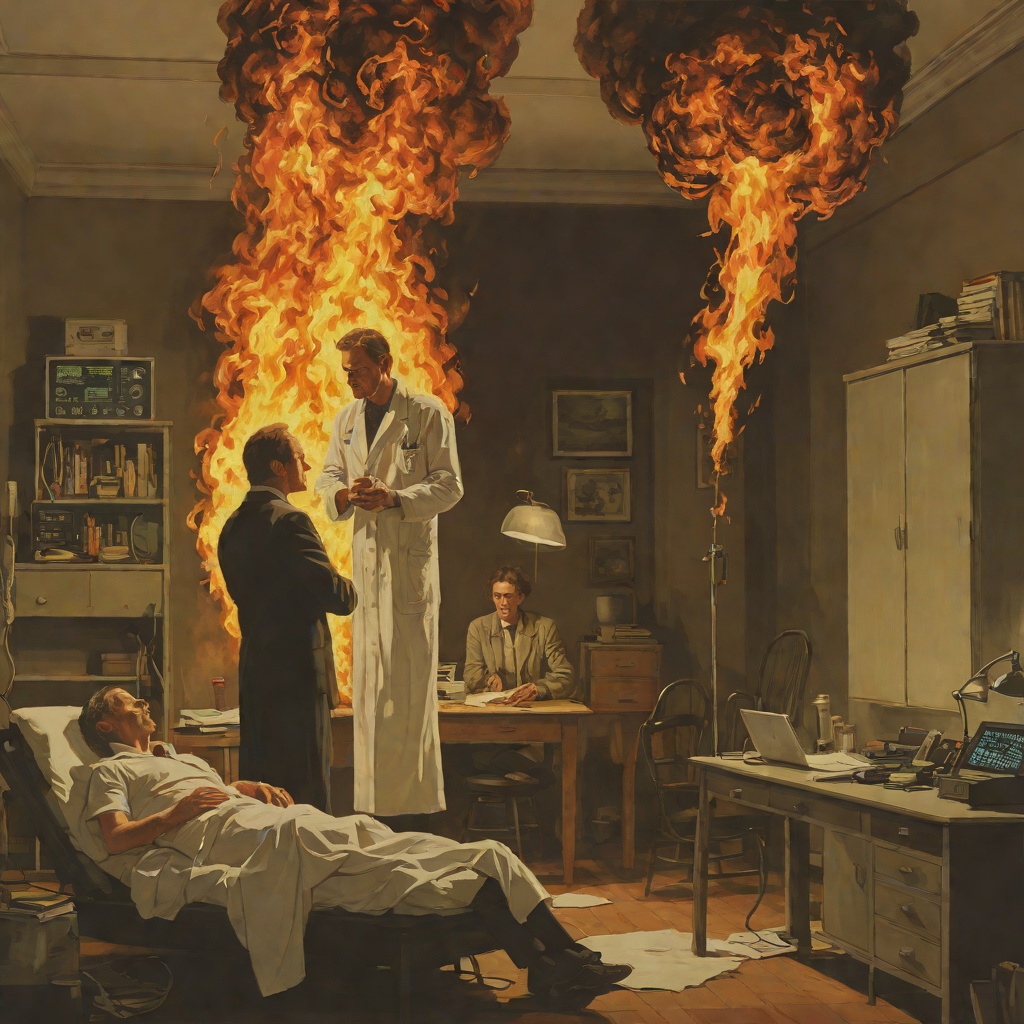
Die, My LoveThe hospital appears in the novel as the stark institutional counterpoint to the narrator's domestic life, the place where her private violence becomes a public, medical fact. It is here that she is brought unconscious, straight from the field, after fainting for the first time in her life, and it is here that the consequences of her self-harm are catalogued with clinical precision. The hospital is not a place of healing in any conventional sense; it is a space where the narrator's body is laid bare, where the cuts she has inflicted on herself are treated by nurses who stare at her for thirty seconds before approaching, making sure she notices their scrutiny. The institution does not understand her, and she does not expect it to, but it is the only place where the evidence of her suffering is acknowledged at all.
The Body as Evidence
The narrator's body, upon arrival at the hospital, is revealed to be covered in small cuts across her shoulder blades, chest, belly, and neck. The medical staff shine a light on her as she lies on the hospital bed and remove tiny shards from her skin: bits of blades, splinters, pieces of crystal, tiny mirrors, petals, and slivers of glass. The image is one of fragmentation made literal, the narrator's body having absorbed the debris of her own destruction. The cuts are small, but they are everywhere, and the nurses treat them with a mixture of professional detachment and pointed curiosity. They disinfect her and give her painkillers, and they instruct her to walk slowly, to avoid running at all costs, and to keep her feet raised when she can, a regimen that leaves her anticipating the instep of a zebra. The hospital's response is purely physical, addressing the wounds on the surface while the narrator's internal state remains untouched and unexamined.
The Husband's Visit and the Unspoken Accusation
The narrator's husband visits her in the hospital, entering with a performative knock-knock and pretending to hide behind a bouquet of flowers. He kisses her, carefully avoiding the gashes on her face that will not form scabs, a gesture that acknowledges her wounds without ever naming them. The narrator, for her part, can only think to say that she did not touch him, that she did not touch a hair on his head, a denial that hangs in the air unanswered. The husband claims not to know what she is talking about, but the conversation quickly turns to his own accusations: what were the condoms doing there, and what is it she needs to do so often at McDonald's instead of coming home early to be with them? His response, a sardonic 'nice move, you're learning,' reveals that the hospital bed has become the stage for a marital confrontation that has nothing to do with her injuries. He reaches out to stroke her, but his hand falls exactly, precisely, on the cut along her neck, a moment of accidental cruelty that underscores the impossibility of contact between them.
The Hospital as a Threshold
The hospital is not the narrator's first encounter with the idea of institutional care, nor is it her last. Her mind, she reflects, is spent, lost on the river bank, and her days are endlessly stagnant, a slow downfall. The hospital represents a temporary halt in this decline, a place where she is forced to be still, but it does not offer any resolution. The narrator's own fantasies of violence, the knife she dreams of using to bleed herself dry with one swift cut to the jugular, are the unspoken context for her presence here. The hospital treats the symptoms of her despair without ever addressing its source, and the narrator's time there is marked by a profound isolation, even as she is surrounded by medical staff. The nurses' stares, the husband's evasive tenderness, and the clinical extraction of glass from her skin all reinforce the sense that her suffering is being managed rather than understood.
The Failure of Institutional Language
The hospital, like the narrator's home, is a place where language fails. The narrator's attempts to explain herself, her insistence that 'it's not what you think,' are met with silence or dismissal. The nurses do not ask why she cut herself; they only tell her not to pull open her scabs, noting that a lot of patients pick at their wounds. The husband does not ask about her pain; he asks about the condoms. The hospital's discourse is one of procedure and caution, a language of disinfection and painkillers that has no vocabulary for the rage that drives the narrator to yank out clumps of grass, to throw a wooden chair at a mirror, to wrench the door off a wardrobe. The narrator's body, with its collection of shards and slivers, becomes the only text the hospital can read, and it is a text that remains illegible to everyone who encounters it. The hospital, in the end, is not a place of recovery but a pause, a limbo where the narrator's wounds are tended and her alienation is confirmed.