the knife
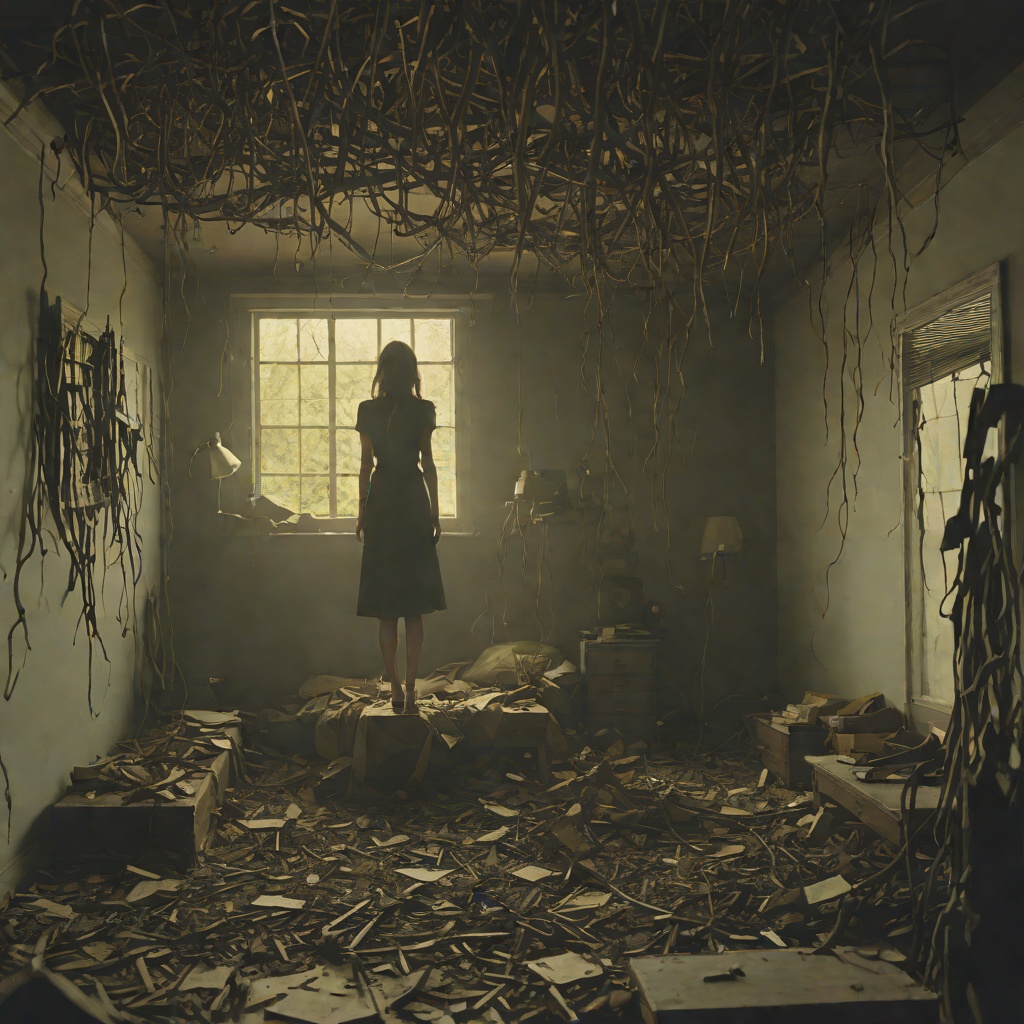
Die, My LoveThe knife is the novel's most persistent and charged object, a blade that never quite cuts anyone yet defines the narrator's inner life from the opening pages to her return from the psychiatric institution. It appears first not as a weapon but as a fantasy — the sun on her palm feeling like a knife she could use to bleed herself dry with one swift cut to the jugular — and it returns at the end as a 'dagger' in her hand, the reflection of 'the first knife I ever dreamt of.' Between those two moments, the knife moves through several transformations: a real blade left behind in a field, a shard of glass in a hospital bed, and a memory that refuses to fade. It is the object through which the narrator's desire for death, her rage at motherhood and marriage, and her sense of being an animal among animals all converge.
The Knife as Fantasy and Threat
The knife enters the narrative as a purely imagined instrument of self-destruction. Lying in the grass among fallen trees, the narrator feels the sun on her palm 'like a knife I could use to bleed myself dry with one swift cut to the jugular.' This is not a plan but a sensation, a way of testing the idea of death against the ordinary scene before her: her naked husband and son splashing in a blue paddling pool, the water at thirty-five degrees, on the Sunday before a bank holiday. The fantasy is immediately disowned — 'I wasn't going to kill them' — and the knife is dropped. Yet the image does not disappear; it is absorbed into the narrator's self-description as 'a weak, perverse woman' who dreams of a knife in her hand. The blade here is less a weapon than a measure of her alienation, the gap between the mother and wife she appears to be and the woman who burrows into the cracked earth, letting mosquitoes bite her, wanting to snarl and howl.
The knife's second appearance is more concrete. After the narrator has hung out the washing, pegging socks and underwear to the line 'like nothing had happened,' she lies back down among the tree trunks and leaves the knife in the scorched pasture, 'hoping that when I find it next it'll look like a scalpel, a feather, a pin.' The wish is telling: she wants the blade to be transformed into something harmless, medical, or delicate — anything but what it is. The knife is left behind, but the fantasy of transformation fails. The sun deflects 'the silvery reflection of the knife' back at her, blinding her, and the sky turns red and violet and trembling. The blade remains a blade, and the narrator remains a woman who has let herself go, with a mouth full of cavities, who no longer reads.
The Knife and the Glass
The knife is closely linked to another recurring image of self-harm: the glass door. In the narrator's son's room, lit by a faint blue light, she watches her nipple satisfy the baby and thinks of the patio doors, 'always toying with the idea of going right through the glass and cutting every inch of my body, always aiming to pass through my own shadow.' The glass is a transparent knife, a surface that promises to slice her into pieces if she could only walk through it. She stops herself each time and slides the door open instead, but the fantasy persists. The knife and the glass are twin expressions of the same impulse: a desire to break through the surface of her life, even at the cost of her body. The glass door is eventually crashed through — the narrator recalls it later as 'the glass door I'd once crashed through' — and the cuts she sustains are treated for days in the hospital.
The hospital scene makes the knife's consequences literal. The narrator lies on a hospital bed, unconscious, brought 'straight from the field.' Nurses remove 'tiny shards, bits of blades, splinters. Pieces of crystal, tiny mirrors, petals and slivers of glass' from her body. The cuts are small but everywhere: on her shoulder blades, her chest, her belly, her neck. The knife has become fragments, embedded in her flesh, and the nurses stare at her for thirty seconds each time they enter, making sure she notices their attention. 'It's not what you think,' she says, but the statement is ambiguous — what exactly is it, if not what they think? The knife's material trace is in her body, and the hospital's response is to disinfect and give painkillers, to tell her to walk slowly and avoid running. The narrator is told not to pull open her scabs, 'apparently a lot of patients pick at their wounds.' The knife has left her with the instep of a zebra, striped with scars.
The Knife's Return
After her release from the psychiatric institution, the knife returns in its most explicit form. The narrator sits on the sofa facing the fireplace in her house, which has been cleaned and updated in her absence — a microwave with the time flashing, a tablecloth embroidered with the petals of large flowers, a new cordless phone with a notepad next to it. Their movements are 'halos of light.' And then: 'The reflection of the first knife I ever dreamt of was in my hand again.' The phrasing is precise — it is not a new knife but the first knife, the one from the opening fantasy, now made real. The narrator immediately interprets it: 'If instead of being punished I'd been admitted on medical grounds, if instead of a place to rest it had been a real mental asylum, I wouldn't have this dagger in my hand.' The knife is the proof that the institution failed her, that she was punished rather than treated, and that her condition is unchanged.
Scared, she moves toward the glass door she once crashed through, now fitted with a mosquito mesh. She opens the door and runs outside 'to look for him' — the stag, whose antlers she needs to see. 'Oh, stag of mine, darling stag, my one and only. I hope you're out there.' The knife is dropped, or at least set aside, in favor of the stag, the novel's other central symbol of wildness and freedom. But the knife's presence in her hand, even momentarily, confirms that the arc of the novel has not been one of healing. The narrator has returned from the institution, been greeted by her husband and son, driven home through the town 'as though to the altar,' but the dagger is still there, the first knife she ever dreamt of, waiting.
The Knife as Symptom
The knife functions throughout the novel as a symptom of the narrator's unprocessed trauma and her refusal to be cured. It is never used — she never cuts herself with it, never harms her husband or son — but its constant presence marks the boundary between her inner life and her outward behavior. The knife is what she dreams of, what she leaves in the field, what she carries in her hand after the institution. It is also what she does not use: 'I wasn't going to kill them,' she says, and she drops the knife and goes to hang out the washing. The blade is a possibility she holds but never acts on, a way of keeping death close without dying. In this sense, the knife is less a weapon than a companion, a dark familiar that accompanies her through motherhood, marriage, and madness. Its final appearance as a 'dagger' — a word with medieval, almost ceremonial connotations — suggests that the knife has become part of her identity, something she cannot put down even when she wants to reach for the stag instead. The knife and the stag are the novel's two poles: the one a promise of violence and release, the other a promise of wildness and connection. The narrator ends the novel reaching for the stag, but the knife is still in her hand.