Bloody
Die, My LoveBloody is the dog whose violent injury and eventual death become one of the clearest revelations of the household’s moral and emotional disintegration. The animal enters the narrative without a settled identity, is injured in a collision with The Stag, receives a name from the blood surrounding that accident, and is later killed by The Narrator with The Father-in-Law’s shotgun. Bloody’s suffering does not remain a private incident: it returns at The Son’s birthday party, where the neglected grave and the memory of the shooting rupture the performance of domestic normality.
Identity and Introduction
Bloody begins as a new dog whose proper place in the family has not yet been decided. While The Narrator sits at the dinner table, the animal is about to urinate beneath it, tugs at the tablecloth, and breaks her glass. The Husband insists that the dog should receive a proper name and be made part of the family, whereas The Narrator says she would have no problem calling it Dog. This disagreement makes naming an early contest over whether the animal is merely an inconvenience or a family member with a recognized place in the household.
The dog is also positioned within the domestic routine as a dependent body requiring supervision. It sleeps with its snout between its paws during the family’s drive, occupies The Son’s seat in the car, and is watched through the windows as the household moves through the countryside. Yet the dog’s presence does not soften the family’s atmosphere. Its uncertain name and intrusive bodily needs instead expose the strain beneath the appearance of ordinary family life.
The Collision and the Making of Bloody
Bloody’s defining injury occurs during a car journey with The Narrator, The Husband, and The Son. The Husband is driving while The Smiths play on the radio. When the song reaches the line about a train passing and sadness, he raises his hands from the wheel, barely brakes, and strikes The Stag. The Stag’s head and body fly to the left of the car, leaving a large dent in the bonnet; the dog whimpers, and The Narrator is thrown forward, striking her forehead against the glove compartment because she is not wearing a seatbelt.
After the collision, The Husband carries the dog from the car. The Stag limps away, apparently surviving, while the dog licks its beaten body. The damaged radiator fills the scene with heavy smoke, and the family’s gestures become grotesquely misdirected: The Husband kisses the dog on the mouth, The Narrator kisses the trunk of a fallen tree, and The Husband then lowers his tracksuit bottoms a few feet from the wreck. The scene joins accident, bodily vulnerability, absurdity, and sexual indecency without allowing any of them to settle into a stable emotional register.
The animal does the practical work of removing blood and tissue from the bonnet by licking the remains. The family first christens it Blood, in English, and then settles on Bloody. The name therefore records the collision and the blood left by The Stag, but it also converts violence into identity. Bloody is not named through an affectionate quality or an individual trait; the dog’s place in the family is marked by the scene of damage that has already made it suffer.
Injury, Dependence, and the Demand for Care
The family’s attempt to return home turns Bloody’s injury into a continuing burden. The dog follows The Husband as he rinses the car with a hose, dragging its leg, watering at the eyes, and writhing so that its body makes holes in the ground. The animal’s pain is communicated through movement rather than speech, while its repeated cry, described as eeeeee, eeeeee, echoes throughout the house and drives The Narrator to the point of distraction.
The Narrator responds to the dog’s suffering by searching for a weapon rather than by immediately seeking care. In the garage, she rummages through dirt-covered wood, unused furniture, and swivel chairs until she notices the telescope, still clean beneath clear plastic. She then goes to the mother-in-law's house in wellington boots and almost naked, retrieves the keyring hidden in the flowerpot, and enters the house. The Father-in-Law is dead, but his shotgun remains available, and The Narrator imagines that he would have fired in any direction simply for the pleasure of pulling the trigger.
Inside the bedroom, The Mother-in-Law lies drugged and motionless, with a mask over her eyes and cotton wool in her ears. The Narrator finds the gun and aims it at The Husband, ordering him to kill the dog. The Husband asks why he should kill Bloody and says that a vet can be called the next day, but his refusal is not presented as active compassion. He turns away, faces The Narrator with his backside, and falls asleep, snoring almost as loudly as Bloody whimpers. The dog’s pain thus becomes a test of responsibility that both adults fail in different ways: The Husband postpones action, while The Narrator transforms relief from suffering into an act of execution.
The Killing and Its Aftermath
Carrying the shotgun, The Narrator moves from room to room until she reaches Bloody in the kitchen, where the dog lies twisted on a filthy rag and sobs with pain. She aims, experiences a blankness in her mind, and hears an imagined military command to fire. She pulls the trigger, making the killing the first time she has fired a gun. The act is therefore both an immediate response to the dog’s injury and a threshold in The Narrator’s own history of violence.
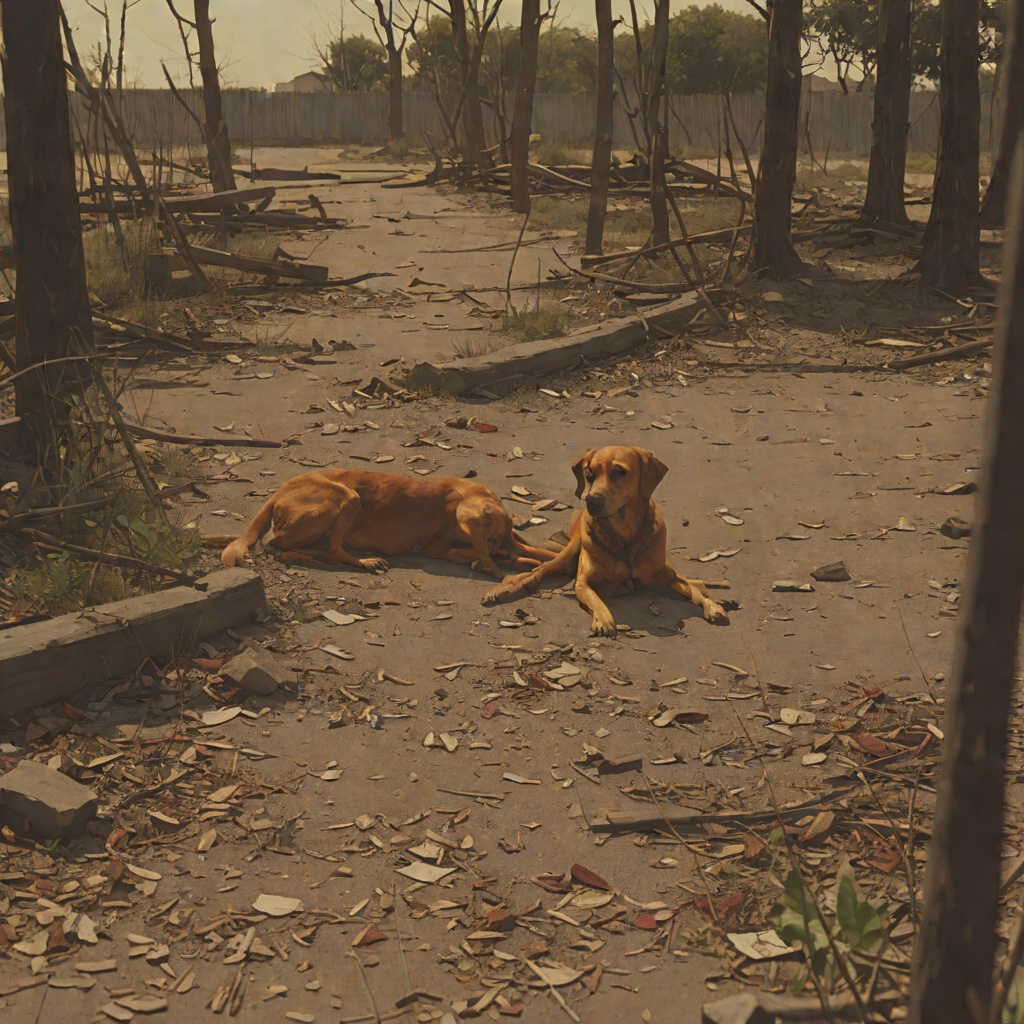
The killing does not produce closure. At The Son’s second birthday party, The Narrator sees a mound of earth in the garden and slowly recognizes it as Bloody’s grave. The dog had been placed there only at noon, after spending the whole night outside with a bullet in its body, unburied, its eyes filled with flies and its entrails exposed. The discovery changes the shooting from a hidden household decision into a physical fact that has been left to decay beside the celebration.
The birthday party continues around the grave. Children skip over the makeshift burial place while singing and laughing, and The Narrator’s perception of the scene is saturated by the contrast between their game and Bloody’s remains. At the same moment, she hears the gun go off, linking the present celebration to the earlier act of killing. Whether the sound belongs to another discharge or to the narrative’s destabilized perception, it makes the violence return inside the party’s ritual of family happiness.
The Narrator retreats to her bedroom, shuts the door, and wishes death on everyone present. She hears what seems to be Bloody barking and snarling outside the door, as though the dead dog were protesting against its own killing. She then leaves the room, crosses the gathering of departing guests, gets into the convertible, and drives away without knowing whether she has selected first or third gear. Her flight turns Bloody’s death into a direct cause of rupture: the animal’s neglected body breaks through the birthday tableau and helps precipitate The Narrator’s escape from the household.
Narrative and Thematic Significance
Bloody occupies an unstable position between animal subject and human instrument. The dog has a body that suffers independently of the family’s interpretations: its leg drags, its eyes water, its body digs into the earth, and its cry repeats through the house. These details grant Bloody a material presence that cannot be reduced entirely to symbolism. At the same time, the family repeatedly uses the dog to stage human conflicts over naming, responsibility, cowardice, violence, and belonging.
The dog also exposes the contradiction between family-making and abandonment. The Husband wants Bloody to have a proper name and become part of the family, yet he leaves the injured animal’s fate unresolved and sleeps while it cries. The Narrator rejects the sentimental language of family membership, but she is the one who cannot tolerate the ongoing sound of pain and acts decisively, although destructively. Bloody is therefore claimed as a member of the household in language, then abandoned in practice, and finally buried without dignity.
The contrast between Bloody’s death and The Son’s birthday party is especially severe. The party is carefully arranged with banners, miniature plates, party bags, music, bright colours, cameras, and other mothers’ approval. Bloody’s body lies beneath the garden while adults perform normal family life above it. The dog’s grave functions as the suppressed underside of that performance: a mound that initially appears almost prehistoric or incomprehensible, then becomes the evidence of a household that can decorate, celebrate, and socialize while leaving a suffering animal unburied.
Bloody’s trajectory also gives physical form to the book’s recurring entanglement of care and cruelty. The animal is carried, fastened into a seatbelt, watched, named, and ultimately shot; each gesture that appears protective contains a form of control. Its death does not resolve The Narrator’s distress or restore order. Instead, Bloody remains as a return of the violence that the family tries to contain, a wounded presence whose cry continues in memory and whose grave destroys the illusion that the birthday party represents a normal home.