Escaping the birthday party in the convertible
Die, My LoveEscaping the birthday party in the convertible is the decisive break in which The Narrator turns a carefully staged celebration of The Son’s second birthday into an act of flight, accusation, and threatened abandonment. The scene begins in the language of family normality—decorations, cameras, food, games, and parental approval—but ends with The Narrator driving away from The Husband and their child, shouting that The Son is his gift to keep. The escape therefore does more than remove her from a party: it exposes the violence beneath the domestic tableau and makes her rejection of the family publicly irreversible.
The Birthday Party as a Performance
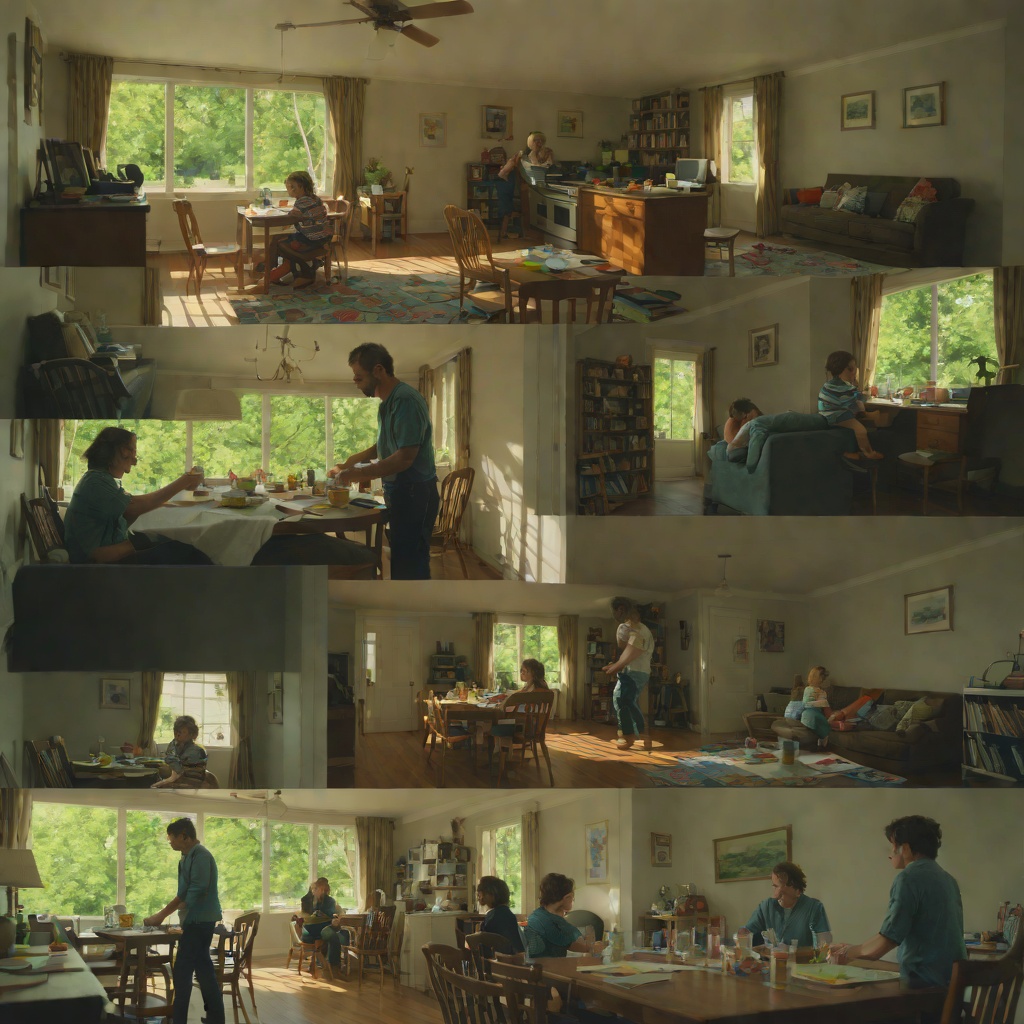
The party is arranged as an exemplary domestic spectacle. Banners decorated with little bumper cars hang above a table set with miniature plates of finger food; every guest has a party bag, and The Son is dressed for the occasion in bright colours surrounded by music. Yet The Narrator’s inner experience contradicts the scene’s orderly surface. Although The Son is already two years old, she remains mentally fixed in childbirth, still pushing while imagining that his tiny head is about to appear. Motherhood is thus experienced as an ongoing physical ordeal rather than a completed passage into contented family life.
The cameras intensify that contradiction. When the candles are blown out, The Husband stands behind The Narrator while numerous cameras aim at them, fixing the couple and their child in a photograph imagined as lasting for all eternity. The family appears decorated and walled in, preserved as an image rather than alive as a relationship. The Son’s own behavior briefly breaks the ceremony: he spits out his chocolate-and-banana cake and runs away, and The Narrator chases him, rugby-tackles him, kisses him, breathes him in, and then loses him again when he escapes. The affectionate pursuit is bodily and exuberant, but it cannot stabilize the scene.
The other mothers provide a chorus of social approval, their smiles marked by tiny threads of banana hanging from their teeth. The Narrator drinks the dregs of yesterday’s wine, then the dregs of another bottle and another, while moving through the party as a host is expected to do. She celebrates her own ability to organize the event even as the scene’s leftovers—wine sediment, smeared mouths, and discarded food—undermine its polished appearance. The gathering’s normality depends on everyone agreeing not to look too closely.
Bloody’s Death Beneath the Celebration
That agreement collapses when The Narrator notices a mound of earth in the garden. At first she cannot understand what she is seeing; the mound resembles an image of an event millions of years in the past, something viewed from a distant present. The Dog then leaps onto her lap and sinks a tooth into her, making the buried fact return through the body before it can be processed as explanation. Bloody is beneath the earth, and the party’s cheerful present is suddenly organized around an unacknowledged death.
The Narrator remembers that The Husband and she placed Bloody there only at noon, after the Dog had spent the entire night outside with a bullet in its body, unburied, its eyes full of flies and its entrails spread out. Bloody was so dead that it had not even produced a final howl. The grotesque corpse is not an incidental detail in the party; it becomes the hidden material truth beneath the family’s performance. Children skip over the makeshift grave while singing, laughing, and holding hands, turning the site of the Dog’s violent death into part of the party’s game-filled landscape.
A gunshot is heard as The Narrator looks at the remains. Whether it belongs to the immediate scene or echoes the act that killed Bloody, it binds the celebration to the weapon and to the threat of further violence. The children’s songs, the rancid wine, and the banana-stained mouths combine into an unbearable sensory collision. The Narrator rushes indoors, locks herself in the bedroom, and wishes death on every person present. The wish is not a detached judgment: it is the emotional and verbal threshold through which the escape begins.
The Flight from the House
The Husband comes to the bedroom door and calls to The Narrator through a succession of endearments, asking whether she is all right and urging her to come out because the guests are leaving. He is concerned not only with her condition but with the party’s completion: she must not ruin it, and someone must still account for the party bags. His appeals reveal the household’s priorities at the moment of crisis. The surface ritual must be maintained even when The Narrator has withdrawn from it and Bloody’s body lies outside.
The Narrator initially refuses to answer. She then opens the door and passes through the dining room while the guests are saying goodbye, searching for lost coats, touching one another farewell, and managing children who do not want to leave. The ordinary choreography of departure continues around her, but she no longer occupies the role of hostess within it. She crosses the room as an interruption to the social scene and reaches the convertible, converting inward refusal into physical movement.
She accelerates without knowing whether she has selected first or third gear. The uncertainty conveys the extremity of the act: escape precedes competence, planning, or legal permission. The Husband calls after her that she is crazy and does not have her license. His words frame the departure as both danger and transgression, while her driving makes the accusation concrete. She does not wait for agreement, explanation, or permission. The convertible becomes the instrument through which she tears herself out of the family arrangement.
Abandonment and the Gift of The Son
As she drives away, The Narrator tells The Husband that The Son is all his and calls the child her present to him. She promises to hand The Son over gift-wrapped, saying that The Husband deserves him more than she does. The language of the birthday party is redirected against the family: the child who was presented at the celebration becomes an object of transfer, and the mother who organized the gifts transforms herself into the giver of the most consequential one.
This declaration turns a private maternal crisis into a public renunciation. People come outside to watch, whispering that The Narrator has lost it again. Their response reduces the event to a recurrence of her instability, while the narrative preserves the specific cause: the concealed corpse of Bloody, the gunshot, the children playing over the grave, the alcohol, and the unbearable demand to continue hosting. The phrase about losing control may be socially convenient, but the action has a precise structure. The Narrator rejects the role of wife and mother as it is being imposed on her, and she directs the child back toward The Husband at the very moment the party has claimed to celebrate him.
The escape also exposes a conflict between possession and responsibility. The Narrator does not simply leave The Son behind; she rhetorically gives him away, treating parenthood as a burden that can be transferred through a birthday present. The gesture is cruel, theatrical, and desperate at once. It reverses the expected movement of a family celebration, in which the child is the center around whom adults gather, by making the child the token in a separation between adults.
The Road Toward The Radiologist
The convertible carries The Narrator through a landscape of repeated rural images: gates, sheep, chickens crushed on the tarmac, abandoned windmills, boats sunk in lakes, black smoke rising from chimneys, and animal pens. The route extends the party’s collision between domestic order and animal death. The cheerful games and decorative objects are replaced by damaged animals, abandoned structures, and machines or buildings marked by neglect. Her flight is therefore not a passage into a clean alternative world; it moves through a countryside already saturated with violence, exhaustion, and failed enclosure.
She eventually stops and enters The Radiologist’s house. His disabled daughter is visible in the window, but neither The Radiologist nor his wife is there. The Narrator searches the rooms, including the bed shared by the couple, the bathroom, his toothbrush, and the objects that surround his daily life. Her intrusion follows directly from the escape: having left The Husband’s domestic space, she enters The Radiologist’s, looking for evidence of the life connected to her desire. She even wonders whether The Radiologist and his wife have abandoned their daughter, allowing her own crisis to spread into an imagined judgment of his family.
The Narrator collapses into an embroidered armchair and falls asleep. Her dream of an antler’s sweet, hollow sound and The Radiologist lying on his back with his hair stuck to her skin carries the escape into a zone where desire, animal imagery, and bodily memory merge. When giggles announce The Radiologist and his wife returning with baskets overflowing with mushrooms, The Narrator is forced back into the social world she has just fled. The birthday escape thus ends not in freedom but in a new confrontation with domestic arrangements, secrecy, and the unstable boundary between the family she has abandoned and the lover she seeks.