Infidelity
Die, My LoveInfidelity is the destabilizing force that turns the narrator’s marriage, body, and idea of family into sites of suspicion and rupture. It is not treated as a discrete moral transgression with a clean beginning and end, but as a corrosive condition that enters domestic objects, sexual encounters, parental routines, and even the language available to the couple. Desire promises release from the family structure, yet it also produces surveillance, violence, self-division, and the dissolution of any stable account of who has betrayed whom.
Definition and Domestic Background
Infidelity first appears within a household already strained by motherhood, exhaustion, and emotional estrangement. The Narrator watches The Husband and The Son naked in a paddling pool while she hides among fallen trees, imagining a knife in her hand and asking how a woman who feels so weak and perverse can be the mother and wife of these two people. She ultimately drops the knife and returns to hanging out their socks and underwear, performing domestic normality after the fantasy of destruction. The contrast establishes the condition in which the affair develops: family life continues through repetitive tasks even as the Narrator experiences herself as radically outside it.
The marriage is also marked by bodily and emotional distance. In The Son’s room, the Narrator breastfeeds while The Husband smokes outside, their contact reduced to separate bodily routines and the mechanical sounds of his breathing. She repeatedly considers crashing through the sliding glass door, not because she wants to join The Husband in his world of stars and constellations, but because the glass represents a surface through which she might injure herself and pass beyond her own shadow. His enthusiasm for the telescope and the sky intensifies rather than repairs the separation between them: he seeks shared wonder in the stars, while she remains fixed on the starless absence of light.
Discovery, Suspicion, and Reciprocal Accusation
The explicit crisis begins with two parallel forms of uncertainty: a toxic dream in which The Husband imagines The Narrator in bed with the neighbour, and the condoms found in the car’s glove compartment, melted by the preceding summer. Their confrontation proceeds through questions, denials, and evidence, but language repeatedly fails to establish a common reality. The Husband demands to know who the neighbour is and what the neighbour wants; The Narrator answers that the man is no one, even while describing his gaze as a kitchen knife at her throat. The phrase “deny everything” becomes a survival tactic so extreme that the Narrator imagines denying even who she is.
The scene reveals that suspicion is not simply imposed by one jealous spouse upon an innocent other. The Narrator possesses knowledge she cannot or will not disclose: The Radiologist has entered her body, and she experiences that penetration as both erotic invasion and annihilation. She imagines him making space for himself with a machete, hearing the echo of her voice from within her darkened body, and killing her there. When The Husband grips her arm and demands the truth, she answers that nothing is happening, while the narration exposes the affair to the reader. This gap between spoken denial and narrated experience makes Infidelity inseparable from unreliable testimony: the truth exists, but it is fragmented across bodily sensation, fantasy, accusation, and concealment.
The confrontation escalates from jealousy’s conventional speeches into physical violence. The Husband’s suspicion and The Narrator’s refusal to explain produce kicks, blows, and insults before she runs outside and crashes through the glass. The broken door converts a domestic boundary into a material wound. She crosses the fields with blood on her body, lies in her kennel-like refuge among pruned trees, and spends the night looking at graves until sunrise. Her account turns sexual and emotional life into an extended vocabulary of death: sex becomes a celebration of the dead, falling in love becomes scattering earth onto a coffin, and masturbation becomes the desecration of crypts. Infidelity therefore does not merely threaten the marriage; it reorganizes the Narrator’s entire imaginative system around mortality.
Desire Outside the Marriage
The affair’s central alternative to marriage is The Radiologist, but the text presents their connection less as a stable romance than as an erotic force that temporarily breaks through social and domestic confinement. The Narrator meets him beyond the houses, amid November fog, a walnut tree, a falcon, parked cars, and the shriek of a cart. Their planned conversation about how to move forward and how to stop encountering a brick wall never becomes a meaningful exchange. Silence itself is enough, as are kisses on speed bumps and beside the road, under the toxins of a nuclear power plant.
Their encounter is defined by physical intensity rather than communicative resolution. The Narrator imagines them walking with their babies hanging upside down, their heads full of blood, their drool and shrieks echoing one another before both adults fall into a ditch. The imagery makes desire contagious and disorienting: the lovers resemble children and animals, while the babies watch from above and reach down to help. The scene’s erotic freedom is therefore inseparable from danger, absurdity, and bodily vulnerability. Infidelity creates an interval outside ordinary family language, but it cannot establish a secure world beyond it.
The Narrator also describes desire through animal transformations. When overwhelmed by lust, she becomes a cow with its head trapped; when desire burns, she becomes a stag entering the woods as a bridegroom enters a church. These images oppose the legal and social vocabulary of divorce, papers, signatures, and mutual consent. The affair is experienced as something more violent and elemental than a negotiated marital decision, a force capable of leaving her as shaken as the sight of a dying animal. Yet this elevation of desire does not make it innocent. The animal imagery joins erotic release to captivity, predation, and the collapse of the boundary between human conduct and instinct.
Consequences for Body and Family
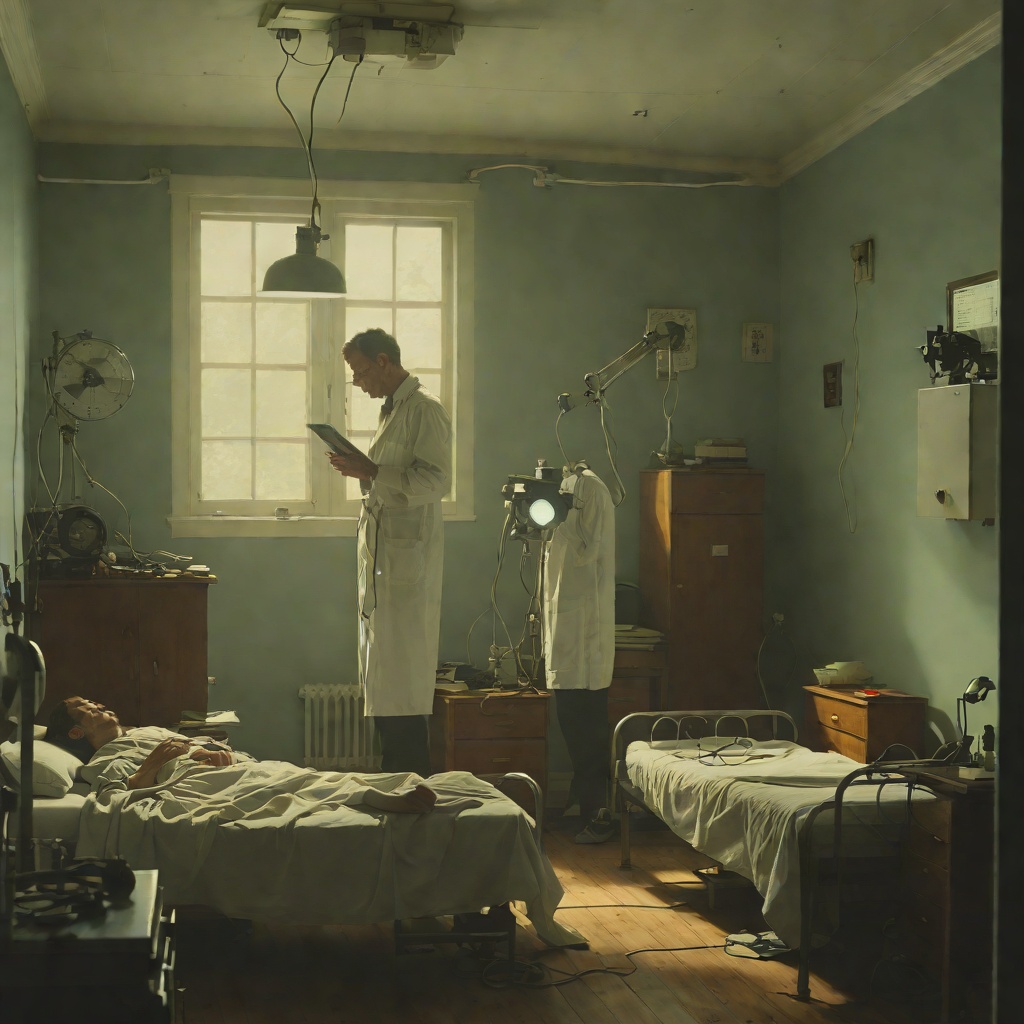
The aftermath of the glass-breaking episode makes the affair physically legible. The Narrator is taken unconscious from the field to the hospital, where nurses remove shards, splinters, pieces of crystal, tiny mirrors, petals, and slivers of glass from cuts across her shoulder blades, chest, belly, and neck. The injuries are small but numerous, and the medical staff repeatedly watch her to ensure that she understands what they suspect. Her body becomes evidence in the same way that the condoms function as evidence in the marriage: both are objects that cannot be made entirely transparent by explanation.
The Husband visits her hospital bed, kisses her while avoiding the gashes on her face, and then touches the cut along her neck with unsettling precision. Their conversation returns to the condoms and to his recurrent trips to McDonald’s instead of coming home early. His response that she is learning suggests that the couple’s conflict has become a contest in accusation and rhetorical maneuvering rather than an attempt at mutual understanding. The Narrator insists that she did not touch him, while the question of what he did with the condoms remains unresolved. Infidelity thus operates as reciprocal opacity: her affair is exposed by the narration, but his possible betrayal remains suspended between suspicion, evidence, and denial.
The condition also corrodes the family’s ordinary rituals. While The Husband cuts wood beside The Son in the buggy, the child watches the falling pieces and smiles at the dark flakes in the air, apparently expecting a normal mother who can receive his first kindergarten drawings. The Narrator instead sees herself breaking apart beside the tree. Her distance from The Son is measured not only psychologically but through the contrast between his innocence and her conviction that her body is becoming forensic evidence. The affair’s consequences therefore reach beyond the marriage: they alter motherhood, domestic space, and the child’s position within a family whose normality is increasingly theatrical.
Social Judgment and Narrative Significance
Infidelity is framed by the judgments of neighbours, relatives, drunken voices, and inherited legal history. When the Narrator emerges from isolation, The Husband is burning his fingertips on cigarette ends, while voices insist that it is wrong to run away with another man. The Mother-in-Law agrees, and two drunkards repeat the prohibition before invoking medieval France, where adulterous wives were supposedly stripped and made to chase a chicken through town. The historical image turns private betrayal into public spectacle and punishment, revealing how the regulation of women’s desire depends on humiliation, communal surveillance, and the conversion of sexuality into a civic offense.
The Narrator’s response is neither a clear defense nor a confession. She hears the prohibition as if it were a message intended for someone else, while The Stag appears in the distance and seems to carry a meaning she cannot decipher. Then she sees The Husband and The Son playing together, one on top of the other, surrounded by an audible hum of happiness. The sight does not resolve the affair or restore the marriage; it intensifies the contradiction between the family’s visible vitality and the Narrator’s secret dislocation.
As a state, Infidelity names that contradiction. It is an intimate relation concealed inside a public role, a desire that promises escape while binding the participants more tightly to jealousy, injury, and consequence. The text refuses to separate erotic liberation from maternal ambivalence, bodily disgust, violence, and grief. Infidelity is consequently both an event in the plot and a structure of perception: it makes the Narrator doubt the family, The Husband doubt the Narrator, and the Narrator doubt the coherence of her own body and speech.