My real man isn't human, I know, but who wants to be human
Die, My LoveThis is the narrator's declaration, made during the episode in which she and her young son are lost in the woods, that her true partner is not a human being but the stag — a statement that condenses the novel's radical rejection of human language and society in favor of animal communion. The line appears at the climax of the forest episode, when the narrator, having fled with her son into the wilderness, identifies the stag as "the man of my life, the one who can see into my infinite sadness." It is a moment of profound disaffiliation from the human world, and it crystallizes the book's central tension between the claims of family and the pull of an untamed, non-human existence.
Context and Setting
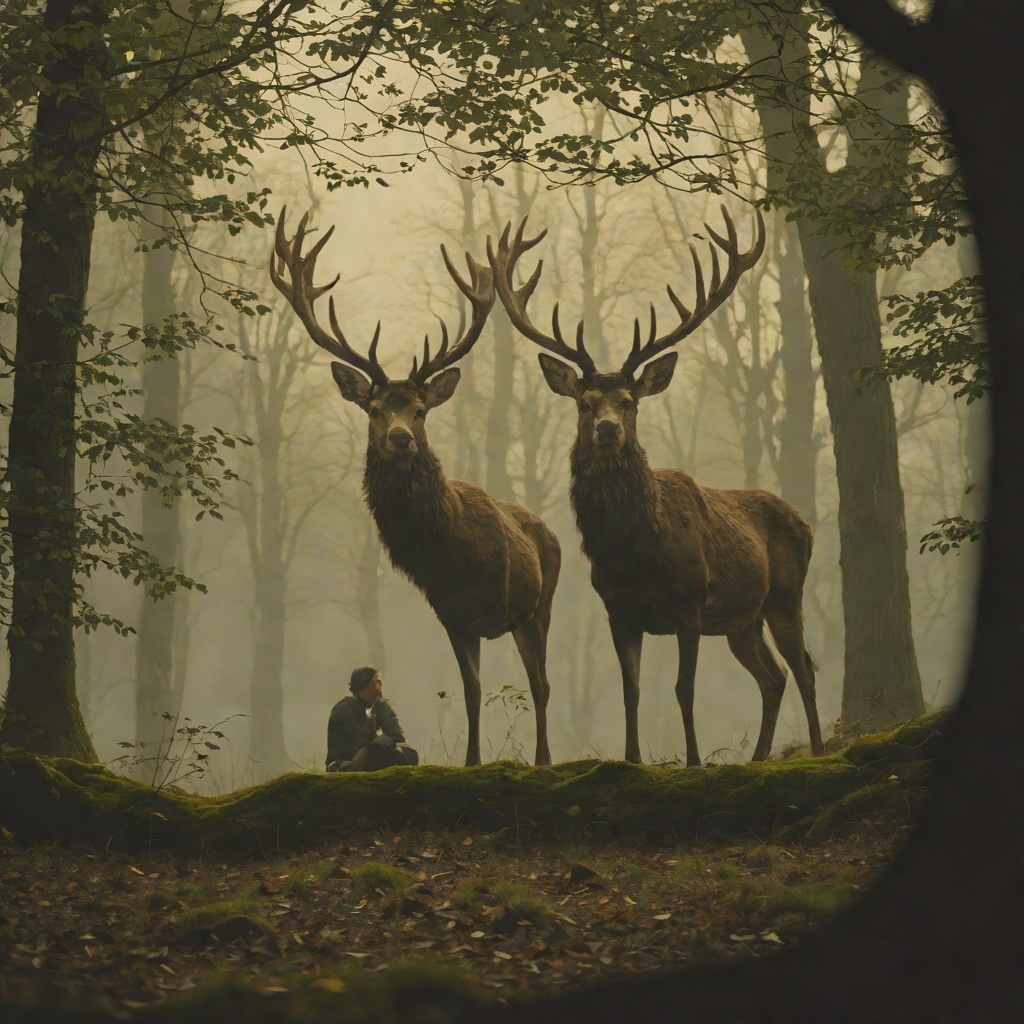
The declaration occurs during the episode in which the narrator and her son are lost in the woods, an environment that has transformed into "more like a jungle by now." The two have been wandering through this wilderness, tasting swamp water from the pond, eating petals from the most colorful and fragrant flowers, and chewing leaves for their sap. They have mimicked the calls of the animals around them, becoming "part of them," with the diurnal and nocturnal birds answering them back. The narrator has even dunked her son in the icy water and "baptised him by mistake," an act she immediately regrets with the plea "May God forgive me." It is in this state of immersion in the natural world that the stag appears, stopping in his tracks, "embalmed, eyes of glass," so touchingly still that he seems almost a vision rather than a living creature.
The Stag as the True Partner
The narrator's claim that the stag is her "real man" is built on a stark contrast between the animal and the human men in her life. "The others are just men," she says, dismissing them with a phrase that reduces all her human relationships — her husband, her father-in-law, the radiologist — to a single inadequate category. The reason for this dismissal is linguistic: "What good are men when they speak a language that falls short?" Human language, in this view, is a failed instrument, incapable of reaching the depths of feeling that the narrator experiences. The stag, by contrast, communicates without words, and its silent presence is enough to see into her "infinite sadness." The narrator acknowledges the strangeness of her choice — "My real man isn't human, I know" — but immediately dismisses the objection with a rhetorical question: "but who wants to be human?" The question is not merely rhetorical defiance; it is a genuine expression of her alienation from the human condition as she has experienced it.
The Rejection of Human Society
The declaration is made against the backdrop of an active search for the narrator and her son. Voices are calling their names, but the narrator notes that "we forgot them long ago." The searchers — the neighbours with giant lanterns, and "Daddy" — are described as a hostile force: "The crowd is like a stabbing pain. It can only do harm." The narrator's response to being found is to propose camouflage: "Let's camouflage ourselves, let's cover our skin with dirt and greenery." The animals, she observes, are mocking the human searchers, and she dismisses their calls as "Blah blah blah or cock a doodle doo, it doesn't matter." The human world, with its language and its lanterns, is presented as an intrusion into a more authentic existence, and the stag stands as the emblem of that alternative world.
The Son's Role in the Scene
The narrator's son is present throughout this episode, and his behavior complicates the picture of pure animal communion. He pulls on the stag's triangular ear and its black snout, but "the animal doesn't laugh." The child, who has "only just started walking and already" is climbing trees, is described by his mother as "a little savage." Yet the narrator's relationship with him in this scene is one of intense physical closeness — she scrambles up to where he is in the branches and they "sat holding on to each other." The son is both a participant in the animal world and a reminder of the human ties the narrator is trying to escape. His presence grounds the scene in the reality of motherhood even as the narrator reaches toward a purely non-human connection.
Thematic Significance
The line "My real man isn't human, I know, but who wants to be human?" is the novel's most explicit statement of its posthumanist impulse. It rejects the human as the default category of meaningful existence and proposes the animal — specifically the stag — as a more authentic partner. The stag's "golden eye" and its ability to see into the narrator's sadness suggest a form of recognition that transcends language and social convention. The declaration also carries a feminist charge: the narrator's human relationships have all been marked by constraint and disappointment, and her turn to the stag is a rejection of the roles — wife, daughter-in-law, mother — that human society has assigned her. The line thus functions as a manifesto for the novel's broader critique of the "normal family" as "the most sinister kind," and it anticipates the narrator's eventual flight from that family into a state of exile and madness. The stag, in this reading, is not merely a symbol but a genuine alternative to the human world, an embodiment of the freedom and recognition that human language and society have failed to provide.