The Attic Encounter
Die, My LoveThe Attic Encounter is the clandestine sexual consummation of the affair between The Narrator and The Radiologist, and it stands as the novel's most intense and transgressive scene. It fuses voyeuristic obsession with the radiologist's disabled daughter, a violent animalistic eroticism, and the narrator's radical dissolution of self, only to end in an abrupt, prosaic abandonment that triggers her terror and a twelve-mile bicycle ride home in a state of disgust and unquenchable desire. The scene is a concentrated expression of the novel's central themes: the failure of language, the animality of human desire, and the narrator's exile from the normal family she both covets and despises.
The Voyeuristic Prelude
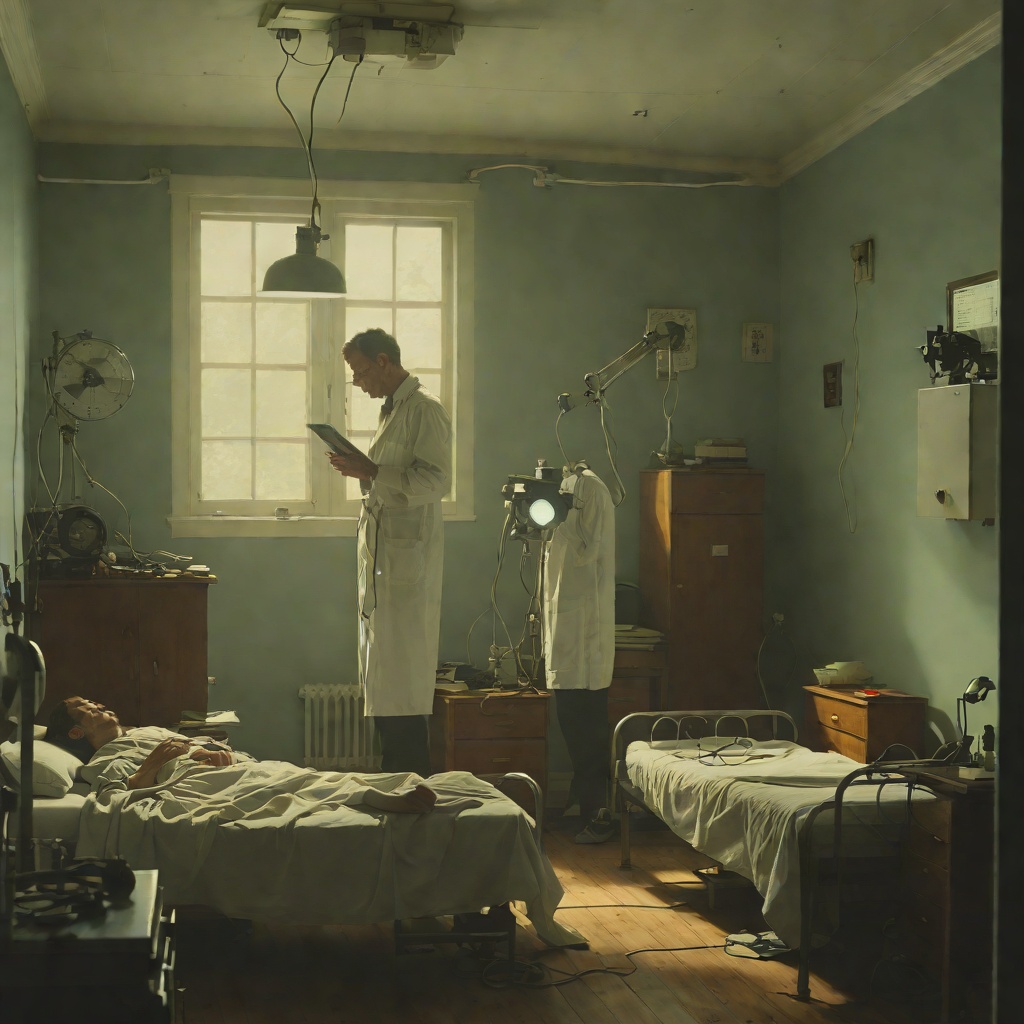
The encounter begins not in the attic but in the bushes outside the radiologist's house, where The Narrator has positioned herself as a spy. She has arrived on her bicycle, having been told her husband is on the road and her child is safe at his grandmother's house, where she imagines the grandmother is feeding him up and making the most of having someone else around. Inside the house, she watches The Radiologist trying to calm the spasms of his daughter, whom she describes as his empty-headed angel, a little fish with no scales. The narrator's gaze is clinical and grotesque: she sees him swaying from side to side, gripping her bones, crushing her hips, while the girl's eyes roll with wild delight at her father. The girl complains and dribbles on his face; the narrator calls her a little she-wolf, caged and spoilt. The father squeezes her too hard, pinches her skin, and smothers her with kisses. The narrator notes that the left side of the girl's brain is flat, that she takes after her mother, and that she can't talk, can't walk, can't sit up, doesn't cry, doesn't drink water, and doesn't focus her gaze. When the convulsions subside, the electricity leaves her body and she goes limp, lying exhausted in her crib with her legs and curls protruding through the bars. The narrator reflects that the girl's textureless brain won't stop her body in its path towards putrefaction, or from menstruating or ceasing to menstruate. She watches The Radiologist wrap his daughter in a feather duvet, turning her into a pheasant with a ring of white plumage around her neck, and wonders what the girl could be thinking, whether she will remember any of this when she is old enough to have a memory, what she will say to herself without words, without language. The narrator's desire is immediate and violent: she wants him so badly she could put her fist through the window, climb in and rape him right then and there, with the infant breathing softly nearby and the tiny glow-in-the-dark stars twinkling on the ceiling.
The Ditch and the Iron Rod
The narrator's spying is discovered. The Radiologist comes out in slippers with his belt undone, grabbing an iron rod as a precaution before coming to see what's moving in the bushes. The narrator describes him as a bow-legged caveman with his hair hanging loose, a primate. She backs away and falls into a ditch, and the mud obliterates her femininity. He aims at her legs, wanting to take the intruder's head off to make himself feel like a man, a family man, to shout about it from the mouth of the cave. He prods her gut and the iron rod sinks into her flabby flesh; he smells his armpits to work up the courage. Lying in the pit, all the narrator wants is to take off her skirt in a bedroom with a view of the river, or one where she can hear the river rushing towards her, sharp stones and all. She wants to have her legs on top of those of the tall, bony father, to take off her skirt and press her knickers into his face, her hips onto his eyebrows, to make him even more cross-eyed and make his mouth fuchsia. His iron rod feels its way along her neck. No animals roam the pastoral horizon; they've all been dragged away by the current, and the air is filled with fine ash. He pokes her again and she shakes violently. Finally, he recognises her movements and rescues her, pulling her up by her muddy rump. Through the window they hear his little girl howl, and the narrator hears a prayer: 'Lord, give us the peace that the earth cannot give.' From there, in his arms, she heard the bwa bwa bwa or pfa pfa pfa of water against a coast that was sometimes rocky, sometimes made of concrete, and sometimes a gentle slope slipping down towards the shore.
The Attic Itself
The Radiologist takes The Narrator by the hand and leads her towards his house, but she goes into the attic alone, with no idea where his wife is. The attic is furnished with a single bed, a chair, and a sentimental wall-hanging embroidered by the other woman, with no need for extra furnishings. He comes in and locks the door behind him with an iron key. From downstairs, the mother and daughter will think the two of them are rodents dancing tip tap tip tap tip tap. His presence makes her light-headed. He takes her by the neck and inhales her, and she lets go of her body, lets it burn, lets it turn red. He takes off his clothes and lies his six-foot-two frame down on top of her, his feet hanging off the mattress. They mangle each other and she sees herself reflected as though in a kaleidoscope, her open mouth becoming many mouths. In one feline motion, she turns over and climbs on top of him, and reflects that she'd have sodomised him if she could, a sodomising rodent. She is close to forgetting where she is, who she is; there is no day or night, no attic or countryside. But first, she looks at his face and does everything she can to retain it, and obviously she can't, and the dark light of the morning after comes flooding in to find them lying one inside the other.
The Abandonment and the Ride Home
The morning after brings the terror. The Radiologist got up from the narrow bed in the middle of the night while The Narrator was lying there naked, leaving her a prosaic note. A few hours earlier they had been levitating, but what does the night before matter by the morning after? She leapt out of the little bed, her mouth pasty, and found no one downstairs; the three of them had gone shopping. She reflects on how many times he had moved in and out of her, the attic air turning to honey around them, how many times desire had brushed against the unbearable, the mouth of an alligator open as wide as it could go. The river pulled her along and she was nothing but a dry branch. She pedalled the twelve miles back home wanting to vomit, pedalling and pedalling without separating herself from the taste of him in her saliva. Desire, which she calls sticky, putrid, servile desire, followed her all the way down the road, and she concludes that she'll need aggressive laser treatment to be rid of it.
Narrative Role and Significance
The Attic Encounter is the novel's most concentrated expression of The Narrator's radical ambivalence towards desire and domesticity. The scene's setting is itself a gothic inversion of the madwoman-in-the-attic trope: rather than a woman imprisoned in the attic, the narrator freely ascends to it as a space of transgressive liberation, while the disabled daughter downstairs represents the caged, speechless body that the narrator both pities and uses as a stimulus for her own desire. The narrator's voyeurism of the radiologist's care for his daughter is inseparable from her erotic fixation on him, and her clinical, grotesque descriptions of the girl's disability reveal the novel's uncomfortable entanglement of desire, pity, and animality. The scene's abrupt reversal, from levitating ecstasy to prosaic abandonment, encapsulates the novel's larger pattern of desire followed by disgust, and the twelve-mile bicycle ride home, wanting to vomit yet unable to separate herself from the taste of him, is a perfect image of the narrator's entrapment in a desire she simultaneously craves and despises. The encounter also deepens the novel's meditation on the failure of language: the daughter has no words, the narrator's clever brain skilled in rhetorical trickery folds flat in the face of desire, and the note left by the radiologist is merely prosaic, a final, deflating confirmation that the night's intensity cannot be sustained or articulated.