The Fight over the Condoms
Die, My LoveThe Fight over the Condoms is the decisive domestic rupture in which suspicion, concealed desire, and competing denials overwhelm the fragile routines of the Narrator’s family. What begins with a toxic dream and a concrete discovery in the car becomes a struggle over truth, jealousy, and sexual betrayal; it ends with the Narrator crashing through the sliding glass door and entering a long night of blood, cold, graves, and self-erasure.
Causes and Background
The confrontation has two beginnings at once: the Narrator’s dream of finding the Husband in bed with the neighbour, and the discovery of the condoms in the glove compartment. The condoms have been melted by the sun during the infernal summer, so they are both physical evidence and damaged objects whose altered condition intensifies their accusatory force. The Husband says that he cried all morning after dreaming of the Narrator with the neighbour, although the Narrator notes that she never remembers her dreams. His dream therefore enters the argument as an emotional claim, while the condoms offer the harder appearance of fact.
The dispute is also rooted in an already divided domestic life. The neighbour is identified through his nocturnal appearance and the repeated sound of his motorcycle passing by each day. The Narrator refuses to name him, turning her back while feeling the neighbour’s gaze at her throat like a kitchen knife. Her silence protects the affair with the Radiologist, but it also gives the Husband room to treat omission as proof. The resulting conflict is not simply a question of whether either spouse has been unfaithful; it is a contest over who may define reality when both parties conceal what they know.
The Husband’s jealousy is sharpened by the Narrator’s own evasions. He asks who the neighbour is and what he wants, while she answers that he is no one. She repeatedly denies that anything is happening, even as the narration reveals the sexual encounter that she cannot bring herself to confess. The scene thus makes language unstable: questions are answered with denials, evidence is met with counter-evidence, and the command to deny everything becomes a survival tactic rather than a route to reconciliation.
What Happens
The quarrel begins with accusations and quickly becomes bodily. The Narrator and the Husband beat at each other’s heads like birds in a cockfight while military planes perform drills overhead, an image that places their private violence beneath the machinery of a war already ending. The Husband demands an explanation for the condoms; the Narrator replies by asking what he has been doing so often at McDonald’s instead of coming home early to the family. His response recognizes the force of the counterattack rather than resolving it.
The argument then shifts from suspicion to explicit accusation. The Husband says that he only needs to know whether the Narrator is sleeping with the neighbour and promises to leave her alone if she answers. The Narrator describes the familiar speech about jealousy as something that destroys both the jealous person and the person who provokes jealousy. That analysis offers no distance from the scene: the speech gives way to kicks, blows, and insults, including accusations that she is a liar and a crazy bitch. The language of emotional explanation collapses into the blunt vocabulary of assault.
The Narrator runs outside and, for the first time, crashes straight through the sliding glass door. The glass that normally separates the house from the fields becomes a weapon and a threshold at once. It cuts her body, covers her in blood, and converts an invisible domestic boundary into a material record of the marriage’s violence. She crosses the pastures as though they were a park, trampling rabbits and barn owls, then imagines the reversal in which the animals may have been trampling her. She finally lies down in her kennel, the cave among the pruned trees, with wet socks, cold skin, and dried blood adhering to her body.
The Husband appears to search for her, but he eventually becomes tired and falls asleep. The Narrator remains sprawled on the ground, shaking, while the long night begins. She looks at graves until daylight, brushes her hair, sleeps under the reflected light of tombstones, and reads the names of dead people she never knew. The escape from the house does not produce freedom in any ordinary sense. It carries the domestic conflict into a landscape where the Narrator’s body, the dead, and the animals become parts of one indistinct field of existence.
Consequences and Aftermath
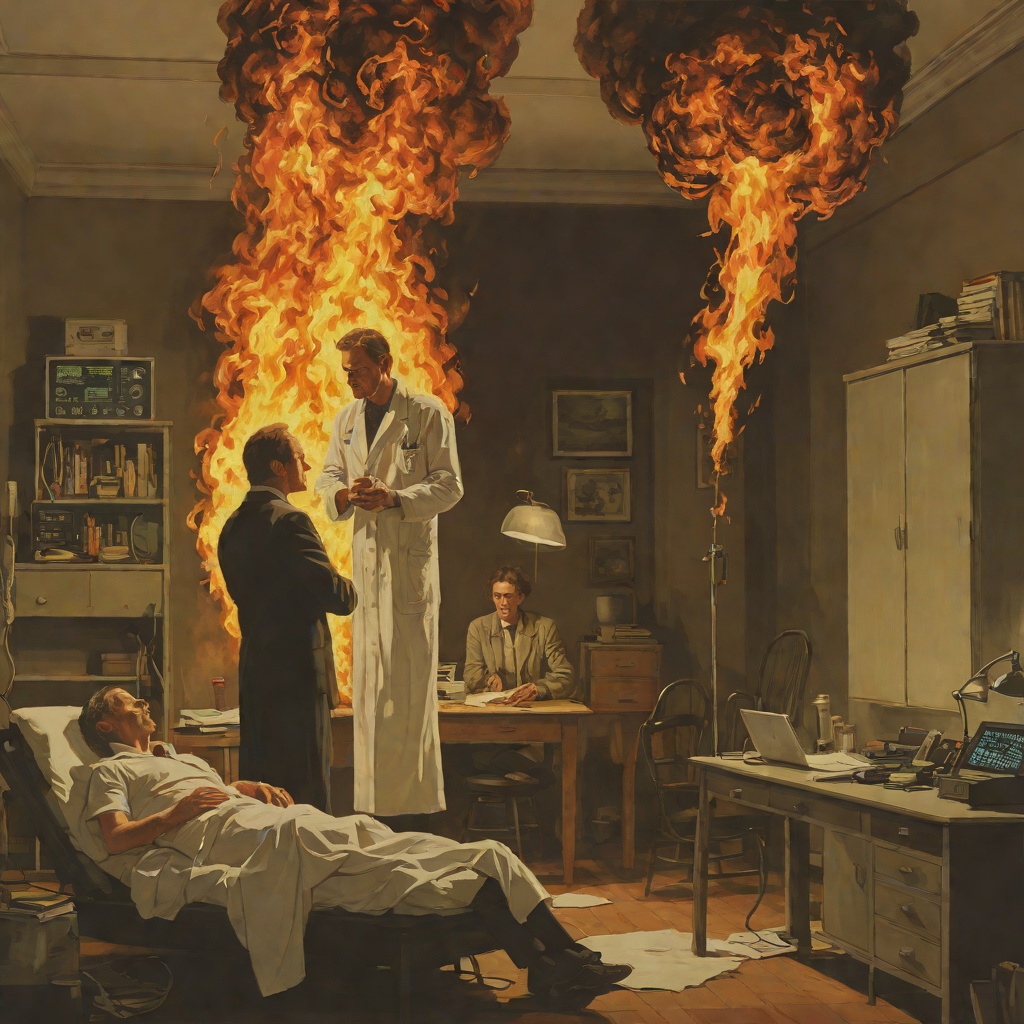
The immediate consequence is hospitalization. The Narrator is brought from the field unconscious, having fainted and become lost to the world for the first time. Nurses treat cuts across her shoulder blades, chest, belly, and neck, removing shards, splinters, and slivers of glass from her body. The wounds are described as small, but their distribution makes the whole body a site of the event. Each new nurse pauses to stare at her, ensuring that she sees the injuries and the judgment attached to them.
The medical aftermath extends the scene’s concern with broken boundaries. Pieces of glass emerge from the Narrator like tiny mirrors, crystal fragments, and petals, so the shattered door continues to exist inside her after she has left the house. Nurses disinfect the wounds and administer painkillers, while warning her not to pull open the scabs. The instruction establishes a contrast between clinical care and compulsive self-interference: the hospital attempts to close the body, whereas the Narrator remains drawn toward reopening it.
The Husband visits the hospital carrying flowers and pretends to hide behind them before kissing the Narrator while avoiding the gashes on her face. Their exchange does not settle the original accusation. The Narrator insists that she did not touch him or a hair on his head, and the Husband responds that he does not know what she is talking about. She returns to the condoms and asks why he so often needs to go to McDonald’s instead of coming home early to be with the family. He calls the question a nice move, reaching toward her in an apparently tender gesture, but his hand lands precisely on the cut along her neck. Care and injury occupy the same movement, leaving the marriage neither repaired nor cleanly ended.
The Event’s Larger Pattern
The glass crash is not an isolated eruption but part of the Narrator’s recurring attraction to self-destruction. Earlier, while lying in the grass near the Husband and the Son, she imagines the sun on her palm as a knife with which she could bleed herself dry, then drops the knife and returns to hanging out the washing as though nothing had happened. Later, in the Son’s room, she repeatedly considers going through the glass and cutting every inch of her body, but stops before impact and slides the door open instead. The Fight over the Condoms transforms that repeated fantasy into action.
The event also discloses the gap between the Narrator’s social role and her felt identity. She is a wife and mother living among the routines of childcare, laundry, food, and seasonal preparation, yet she experiences herself as already dead. After the crash, she assigns deathly meanings to ordinary acts: sex becomes a celebration of the birthdays of the departed, falling in love becomes scattering earth onto a coffin, masturbation becomes desecrating crypts, rocking the Son becomes saying amen, and smiling becomes unplugging an iron lung. These associations do not merely decorate the aftermath; they show how the argument has reorganized her perception so that intimacy, care, pleasure, and death share one vocabulary.
The body remains the principal scene of this reorganization. In the aftermath of the glass crash, the Narrator cannot see her whole body but knows that it is cut everywhere; later, during another violent episode, she pulls grass from the lawn until worms and soil blend in her hand, sees her body as something that is falling apart, and recognizes the blood in her underwear as the remains of herself rather than evidence of a new pregnancy. The conflict over the condoms therefore opens onto a wider crisis involving maternity, desire, rage, and the inability to maintain a stable border between inner violence and the world outside.
Narrative Significance
The event produces a value reversal from the appearance of domestic order to irrevocable rupture. The family home, already filled with suspicion, can no longer contain the Narrator; the transparent sliding glass door becomes visible only when it fails, and its failure exposes the material force hidden in an apparently open household. The Narrator’s escape is simultaneously an act of self-harm, a refusal of confinement, and a movement into a space governed by graves, animals, and darkness rather than marital language.
Its significance lies especially in the collapse of reliable testimony. The Husband’s dream, the condoms, the Narrator’s denials, and the hidden affair all compete without producing a stable public truth. What can be verified is the consequence: violence, shattered glass, unconsciousness, wounds, and a hospital bed. The scene therefore makes the failure of language tangible. When speech cannot acknowledge desire or betrayal, the body supplies the testimony, and the broken door becomes the clearest statement either spouse has managed to make.