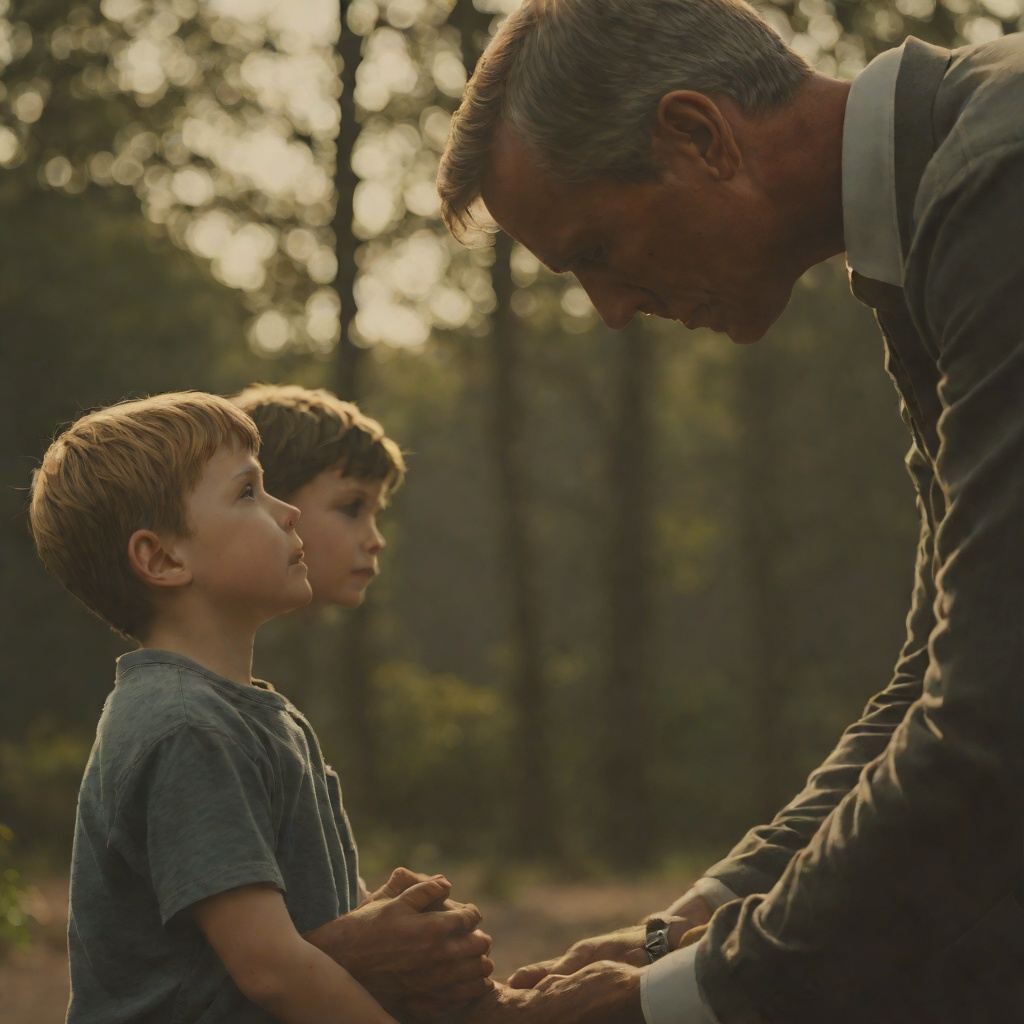
The Husband and His Son (Father-Son)
Die, My LoveThe Husband and His Son (Father-Son) is one of the book’s most visibly intimate relationships, presented through shared bodies, routines, journeys, and performances of domestic happiness. The Husband and The Son are repeatedly seen together as a pair, yet their closeness is filtered through The Narrator’s hostility toward motherhood, marriage, and the demand to appear normal. Their bond therefore carries a double significance: it is a concrete father-son attachment, and it is also part of the family tableau from which The Narrator feels increasingly alienated.
Identity and Domestic Setting
The relationship first appears in the countryside, where The Husband and The Son are naked together in a blue paddling pool beside the house. The Narrator hides among fallen trees and underbrush, spying on them while they splash in water heated to thirty-five degrees. Their shared play is ordinary and domestic, but the scene is made disturbing by the distance between their ease and The Narrator’s thoughts of self-harm and violence. The Husband and The Son occupy the visible centre of family life while The Narrator burrows into the ground, watching them as though they belong to an intact household from which she has been excluded.
The domestic division of labour reinforces this arrangement. After dropping the knife, The Narrator hangs The Son’s and The Husband’s socks, underwear, and shirts on the washing line before returning to the kitchen. The clothes make the father-son unit materially present even when the two are not described individually. Their garments become evidence of a family routine that The Narrator can reproduce mechanically while inwardly rejecting the role it assigns her. The Husband and The Son’s relationship is thus embedded in the everyday infrastructure of the normal family: laundry, food, drink, birthday preparations, and shared leisure.
Affection, Play, and Paternal Care
The Husband’s relation to The Son includes tenderness, supervision, and an active effort to create memorable family rituals. At The Son’s six-month celebration, The Husband asks The Narrator whether he should have a blonde or dark beer, while The Son appears to have soiled himself and requires attention. The scene joins the father’s casual participation in the celebration to the bodily demands of infancy. The Son is not an abstract symbol of happiness; he is a baby whose speech, excrement, biting gums, and dependence repeatedly interrupt the adults’ attempts to make family life appear smooth.
The Husband also tries to give The Son a future-oriented emblem of belonging by wanting to plant a tree for the baby’s long life. The gesture turns paternal care into a promise of duration, rooting the child in the land and in the family’s continuing presence. Yet The Narrator’s smile conceals her awareness that the ritual cannot resolve the marriage’s hostility. The Husband’s investment in The Son’s life is genuine as an action, but it is also part of a family performance that The Narrator experiences as intolerable.
After The Narrator’s release from the institution, The Husband and The Son greet her together. The father is dressed up, The Son wears his football kit, and the two hold hands as they wait for her. Their linked hands provide the clearest visual sign of their alliance: The Husband does not merely receive The Narrator alone but arrives as one half of a father-son pair. The reunion culminates in an embrace among the three of them, and The Husband treats her return as a restoration of family life, even joking that they can finally live in peace now that she is out. The joke attempts to convert institutional trauma into a manageable domestic story.
Movement Through the Family Landscape
The Husband and The Son’s shared excitement becomes especially visible during the drive home. The Husband stops beside a river and tells The Narrator to close her eyes, while The Son cannot contain his happiness. When the convertible roof opens, The Son raises his hands and lets the air pass between his fingers, then throws stones into the river. The Husband does nothing when The Narrator warns that the wind could carry the child away. The moment reveals both freedom and negligence: The Son experiences the journey as exhilarating, while The Narrator interprets the same exposure as danger. The father-son bond is communicated through bodily exhilaration rather than explanation, and The Husband’s permissiveness allows The Son’s excitement to govern the scene.
As the family drives from the countryside toward their town, The Husband accelerates to intensify the journey’s excitement while The Son continues to participate in the spectacle. The return is staged like a procession to an altar, with tractors, sheds, and neighbours appearing as signs that the old world has been restored. The Husband and The Son are therefore not only travelling together; they are carrying the image of the family back into a community that recognizes and validates it. The family home has changed, with a microwave, embroidered tablecloth, and cordless telephone, but the father-son unit helps make the altered house seem continuous with the past.
Their relationship is also central to The Son’s second birthday party. The Husband stands behind The Narrator as cameras record the moment when The Son blows out the candles, fixing the family in an image intended to last forever. The party is carefully furnished with banners, miniature plates of finger food, party bags, bright colours, and music. The Son, now officially no longer a baby, spits out chocolate-banana cake and runs away; The Narrator chases him, tackles him, kisses him, and breathes him in before he escapes again. The physical chase shows a child becoming independent, but it also displays the family’s attempt to turn instability into a conventional celebration.
Strain, Repetition, and Loss
The father-son relationship acquires a darker force because The Narrator repeatedly measures it against her own refusal of maternal feeling. The Husband and The Son can appear naked and happy in the paddling pool, hold hands at her release, travel together in the convertible, and stand at the centre of the birthday photograph, while The Narrator remains capable of wishing that all of them would die. Their closeness does not cure the family’s violence; instead, it sharpens the contrast between visible affection and the narrator’s concealed despair.
The birthday party exposes this contradiction most brutally. While the children play hide-and-seek, tag, and duck, duck, goose, The Narrator drinks the remains of several bottles of wine and notices a mound of earth in the garden. She then remembers that Bloody, the family dog, has been left there dead after being shot, with flies filling its eyes and its entrails exposed. As the children skip over the makeshift grave, singing, laughing, and holding hands, a gun goes off. The Son’s world of games and communal celebration is placed directly beside the household’s capacity for shooting, burial, and concealment. The father-son relationship is not presented as separate from this violence: it is protected by the same family setting that normalizes and hides it.
The Son’s development also becomes a source of emotional displacement. After the family has returned home, The Husband tells The Narrator that The Son is no longer a baby. The statement is ordinary on its surface, but The Narrator understands it as meaning that he is no longer her baby. The father-son relation thus survives the child’s growth in a form that excludes her. What The Husband experiences as maturation and continuity, The Narrator receives as the loss of maternal possession and evidence that the family can continue without her.
Narrative Significance and Ending
The relationship’s narrative significance lies in its unstable mixture of intimacy and display. The Husband and The Son form a recognisable family pair through touch, hand-holding, play, travel, and ceremonial photographs. These gestures communicate attachment before anyone explains it. The child’s raised hands, the father’s acceleration, the football kit, and the birthday candles create a bodily language of belonging. At the same time, the scenes are narrated through The Narrator’s fractured and hostile consciousness, so every sign of affection is shadowed by the possibility that domestic happiness is a performance imposed upon her.
The father-son bond also provides the family’s most durable continuity. The Son grows from a baby who speaks in fragments and bites with his gums into a two-year-old who runs, plays, eats cake, and is declared no longer a baby. The Husband accompanies each stage with rituals of celebration and movement. Yet the continuity is not consoling for The Narrator. It makes the family seem capable of renewing itself while she remains trapped in resentment, maternal ambivalence, and the memory of violence. The relationship’s final force is therefore paradoxical: The Husband and The Son’s closeness confirms that affection exists within the family, but it also demonstrates how completely that affection can coexist with exclusion, denial, and death.