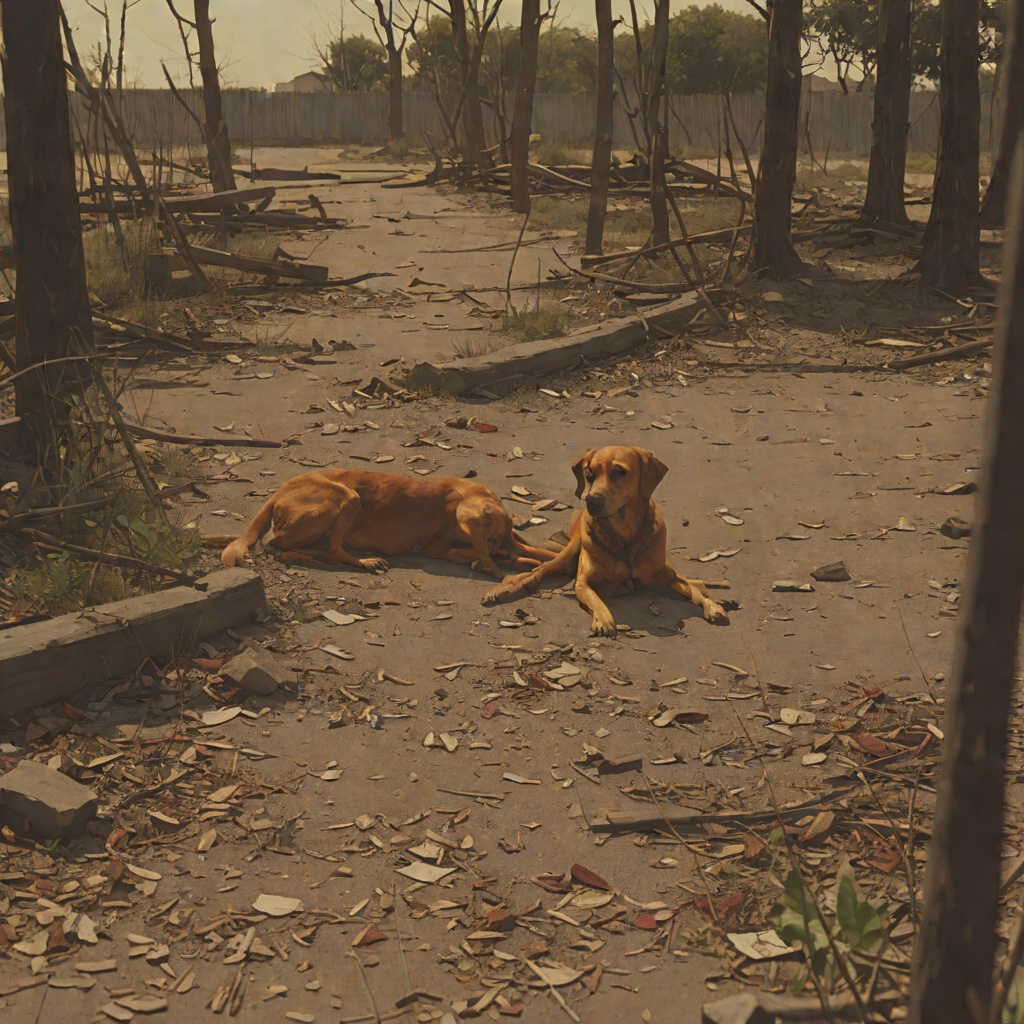
The Killing of Bloody
Die, My LoveThe Killing of Bloody is the novel's most violent and most revealing act, the moment when The Narrator's accumulated rage, isolation, and despair find their first lethal outlet. The dog, christened Bloody after being struck by a stag during a family drive, lies in the kitchen twisted on a filthy rag, sobbing with pain. The Narrator, holding her dead father-in-law's shotgun, aims, feels her brain go blank, hears an internal command to fire, and for the first time in her life pulls the trigger. The act is at once a mercy killing, a rebellion against her husband's cowardice, and a rehearsal for the greater violences—against herself, her marriage, and her sanity—that will follow.
The Wound and the Trigger
The killing is the direct consequence of the stag collision, an accident that unfolds during a drive with The Husband at the wheel. As a song plays on the radio—"And when a train goes by, it's such a sad thing"—a stag hits the windscreen, its head and then its body taking off to the left of the car like some kind of flying creature. The bonnet is left with a huge dent. The Narrator, who has forgotten her seatbelt, is thrown forward and hits her forehead against the glove compartment, left feeling dazed. The Husband, more concerned with the dog than with her, turns to the excited, panting animal fogging up the windows, and only then notices its leg, swaying disobediently to the rhythm of the windscreen wipers. The stag runs off limping, as though it doesn't understand it has survived. The dog, injured and in pain, is wrapped up and placed in the back of the car with its seatbelt fastened. The Narrator pushes the car while The Husband accelerates, running so hard she thinks they are trying to leave her behind. At home, the baby is standing in his crib, hands sticking through the bars, screaming for the prison warden—a detail that frames the domestic world as a site of confinement from the very start.
The Night of Suffering
That night, Bloody's cry—"eeeeee, eeeeee"—echoes throughout the house, driving The Narrator crazy. The dog follows The Husband around with a pained look, its eyes watering, its leg dragging, its body writhing as it makes holes in the ground. The Narrator gets up, grabs a small torch from the tool drawer, and goes into the garage. She rummages through everything, finding layers of filth accumulated on pieces of wood, unused furniture, and swivel chairs. Only the telescope seems clean, sheathed in clear plastic. The garage, like the rest of the house, is a space of neglect and decay, a physical correlative to the emotional rot of the family. She goes outside in wellies and half-naked, leaving the front door open so the cold air chills the house, and walks to her mother-in-law's place. She finds the rabbit-paw keyring hidden in the flowerpot next to the front door and lets herself in, noting that if her father-in-law had been alive, he'd have fired, no matter the direction, just for the pleasure of pulling the trigger. The pile of ironed shirts and the books organised on the shelves give no impression that someone has recently died. She climbs the suspended staircase, holding onto the ropes on either side, and finds her mother-in-law asleep, doped up, a plank of a woman with her eyes covered by a mask and two pieces of cotton-wool in her ears—a flat-chested, sexless body like a table wrapped up in sheets. Next to her are a piano and a Japanese drawing of a small island. Her bedroom is snow. The Narrator lights a candle, feels an urge to play a note on the piano, and searches. She reflects that some people need to be able to see the ocean, but she needs to be able to see a firearm, even if it's motionless, dirty, and unloaded.
The Confrontation with the Husband
Back home, shotgun in hand, The Narrator finds The Husband with one eye open and aims at him. He is so scared he can't say a word. "Kill him," she says. "What, kill who?" "Eeeeee, eeeeee. Kill the dog." "Why would I kill him?" "Because he's suffering." "So what? Leave him alone. You can't be serious." She insists they'll call the vet tomorrow, but he rolls over onto his side, his arse facing her, and lets out a snore almost as loud as Bloody's whimpers. She stays there, watching him sleep, astonished by his relentless cowardice. The scene is a devastating portrait of marital failure: The Husband's refusal to act, his retreat into sleep, and his physical turning-away from his wife's desperation. The Narrator's demand is not merely for the dog's sake; it is a test of whether her husband will meet her in the space of suffering and decision. He fails. His cowardice is the final push that sends her from the bedroom to the kitchen, from words to the trigger.
The Act Itself
Shotgun in hand, The Narrator goes from room to room until she reaches the corner of the kitchen where Bloody is sobbing with pain, all twisted on a filthy rag. She aims. Her brain goes blank. She feels like an Israeli soldier and suddenly, in her mind, she hears the order: "Fire! Fire, you bastard!" And there, for the first time in her life, she pulls the trigger. The simile is jarring and deliberate—the domestic kitchen becomes a battlefield, the suffering dog a target, and The Narrator a soldier obeying an internal command. The blankness of her brain suggests a dissociation, a moment when conscious thought and moral deliberation are suspended and replaced by pure, mechanical action. The killing is both an act of mercy and an act of violence, and the two are inseparable. It is the first time she has ever fired a gun, and the act marks a threshold: she has now done the thing that cannot be undone, crossed a line that separates her from the normal family she is supposed to inhabit.
Aftermath and Significance
The killing of Bloody is not an isolated incident but a turning point in The Narrator's descent. It follows the stag collision and precedes the novel's later violences—the threats to jump out of the car, the reaching for the gun, the final separation from her husband. The act establishes a pattern: when language fails and her husband refuses to act, The Narrator turns to violence as the only remaining form of agency. The shotgun itself is her father-in-law's, a weapon inherited from a man who would have fired "just for the pleasure of pulling the trigger," and in using it she steps into a lineage of masculine violence that she both inherits and subverts. The killing also deepens her identification with animality, a theme that runs through the novel: the stag's golden eye, the moles' Shoah, the child as a wild animal. Bloody's death is the first and most explicit instance of the novel's central question—what does it mean to be a creature that suffers, and what does it mean to be the one who ends that suffering? The Narrator's answer is ambiguous: she acts, but the act isolates her further, confirming her husband's view of her as mad and her own sense that she is not human, or not only human. The killing is thus both a mercy and a condemnation, a moment of clarity and the beginning of her exile.