The Mother-in-Law
Die, My LoveThe Mother-in-Law is the narrator's husband's mother, a figure who embodies the novel's central tension between the appearance of normal family life and the madness it conceals. She is introduced as a woman devoted to doctors, one who "loves them, idolises them," and who is ready to call one at the slightest sneeze. This devotion is rendered with the narrator's characteristic venom: "I bet she gets wet even saying the word." Yet beneath this caricature lies a woman whose life is defined by a slow, grinding grief, and whose mourning becomes one of the novel's most sustained meditations on loss, time, and the impossibility of moving on.
Identity and Domestic Rituals
The Mother-in-Law's identity is inseparable from her domestic role. She is the keeper of the house, the one who serves dessert, scraping the bottom of the bowl with pears baked in brandy or covered in chocolate. She is also the one who knocks on the narrator's door at dawn, entering timidly with a glass of water and a green-and-white pill, offering Prozac to a mother-to-be. This gesture—simultaneously caring and invasive—captures her character: she is a woman who responds to emotional distress with the rituals of the body, with water and medication, unable to grasp the depth of the narrator's despair. Her own body is a site of decay and neglect. After her husband's death, she lives in her body "as though it were an infested house," tiptoeing through it trying not to touch the floor. Her breakfast consists of white bread left out in the kitchen for days, and she does not check the expiry date on the medication she started taking the day of the funeral. She does not scare away the flies or remove the eggs they have laid in the jar of homemade chestnut jam. This neglect is not mere slovenliness but a symptom of her profound dislocation: she watches the fingers bringing the bread to her mouth as though they belonged to someone else.
The Widow's Grief and Its Symptoms
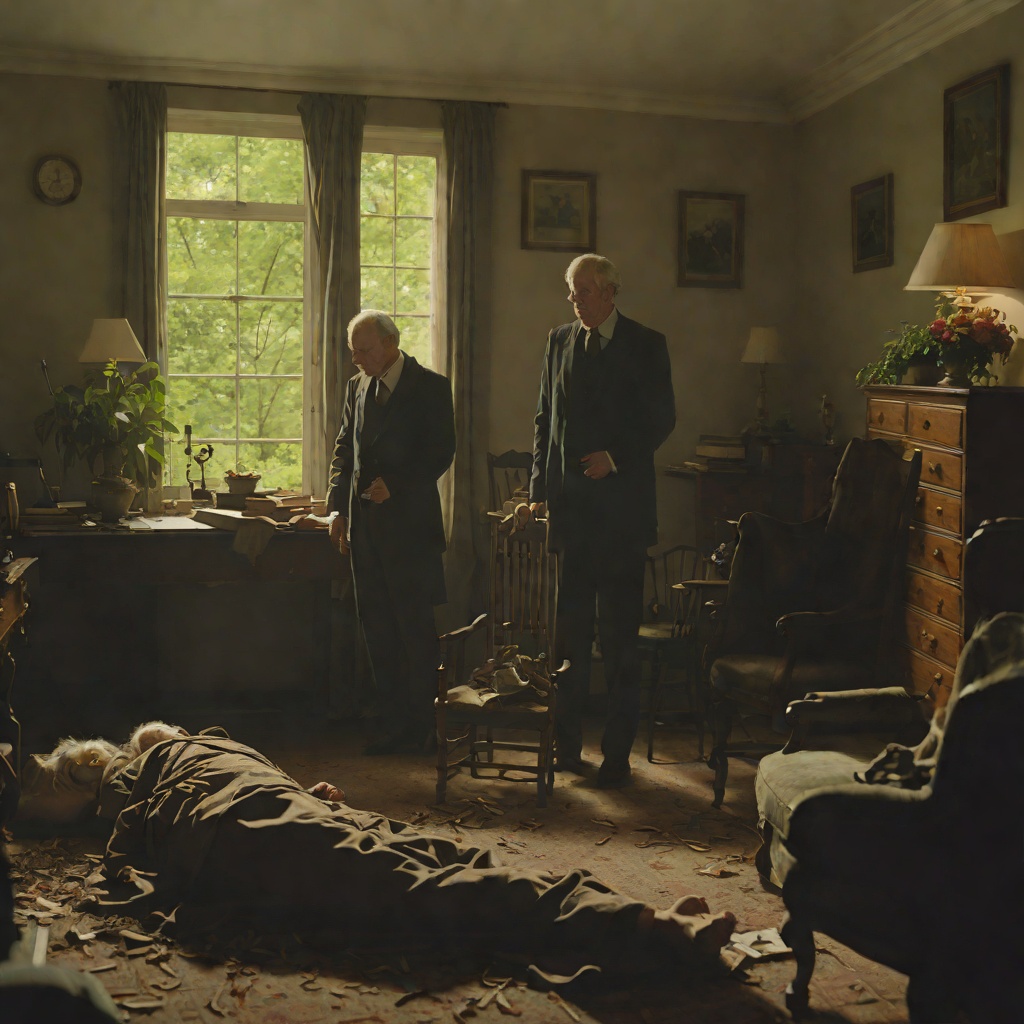
The death of her husband, the Father-in-Law, who died in his sleep, initiates a period of mourning that is both obsessive and surreal. She relives his death day after day, continuing to wash his trousers, cook for two, change the pillowcases, and mend his underwear torn at the crotch. She gives his socks away to the neighbours who have the same size feet. Her grief manifests in a series of disturbing behaviors: she sleepwalks, once strolling through the village in a nightie shouting "Fire!" and another time using a shoe as a phone to converse with God. She does the hoovering at four in the morning. She tells the family that her husband squeezed her hand tight just before he died, but that the doctor said it had only been a reflex reaction. This detail—the doctor's cold dismissal of her final moment of connection—is devastating. It is at this moment that the narrator feels close to her for the first time, recognizing in the Mother-in-Law's insistence on meaning a shared refusal to accept the banality of death. The narrator's understanding is so intense that she wants to run over and climb into her chest, stick her fingers into her eyes, get inside her dressing gown. Yet she says nothing, playing the role of daughter-in-law while feeling like "a wolf in sheep's clothing." The narrator reflects that "understanding one another is too violent. It's better to keep quiet, play dumb."
The Perpetual Limbo of the Left Behind
The Mother-in-Law's grief is articulated most powerfully through the narrator's observation that "time doesn't pass for the person who's left behind. It's a perpetual limbo." This limbo is rendered as a physical sensation, "like a wet shirt, clammy against the body, something that doesn't go away, that won't come unstuck." The narrator imagines her mother-in-law's future in vivid, painful detail: opening up the house to air it out, throwing away her dear husband's spectacles, smelling him on the backrest of the rocking chair where he used to doze, cooking for herself with the same pans she used for his fried eggs and porridge. The narrator sees her in slow motion, an elderly woman gasping for air after sliding a door shut or closing a skylight, her nightgown revealing her dark purple nipples and swollen ankles, covering her mouth with her hand, clinging to her husband's bedpan. The Mother-in-Law's marriage itself is revealed to have been hollow in its intimacy. The Father-in-Law never spent long hours embedded inside her, never considered whether she got aroused; he imagined his wife had a stone in the depths of a cave instead of a vagina. Yet despite this emptiness, he had been her companion, and his absence leaves a void that no ritual can fill.
The Sunday Outings and the Return to the World
Eventually, the Mother-in-Law's mourning gives way to a performative recovery. She "no longer mourns and now acts like any other widow, one of the many who sit at tables in modern-looking cafés eating pastries." She has only just begun to cut her nails again, to sleep through the night without feeling for the dead man's body, to eat breakfast without sobbing into her milky coffee. She insists on the Sunday outing, demanding that the narrator come up with a destination, that they "must appear enthusiastic, must show others we enjoy life." She wants to take the child here and there, buy him balloons, let him ride on the merry-go-round to nowhere, take pictures of him, because "that's how you give your child a childhood." Her only child takes his old mother out of this sewer, and it does her a world of good. Yet this recovery is fragile and self-conscious. In a scene set at four in the morning, she wakes to the sight of her husband sitting in a striped deckchair reading the paper, listening as he turns the pages. She asks her son, "When will I start feeling like he's dead? When will I be able to pray for him?" and "What does it mean for a man to die?" from the heights of her aged lust. Her son, worried about her health, stirs her herbal tea, refusing to put sugar in it, and rubs her shoulders. The narrator observes that "parents become children when they're in pain."
Narrative Role and Thematic Significance
The Mother-in-Law functions as a dark mirror for the narrator. Both women are trapped in the same house, the same family, the same rituals of domesticity. The Mother-in-Law's grief is the narrator's own alienation made visible, a future the narrator fears and a past she cannot escape. The narrator's identification with her mother-in-law is one of the novel's few moments of genuine empathy, yet it is immediately undercut by violence and distance. The Mother-in-Law's devotion to doctors, her sleepwalking, her obsessive rituals—all of these are presented as the acceptable face of madness, the madness that the normal family tolerates and even nurtures. She is the living proof of the novel's central claim that "a normal family is the most sinister kind." Her grief is not a private emotion but a public performance, a set of rituals that the family observes and enables. In this sense, she is not merely a character but a symptom, the embodiment of everything the narrator fears about marriage, motherhood, and the passage of time. Her perpetual limbo is the narrator's own condition, and her inability to move on is the novel's bleakest commentary on the possibility of healing.