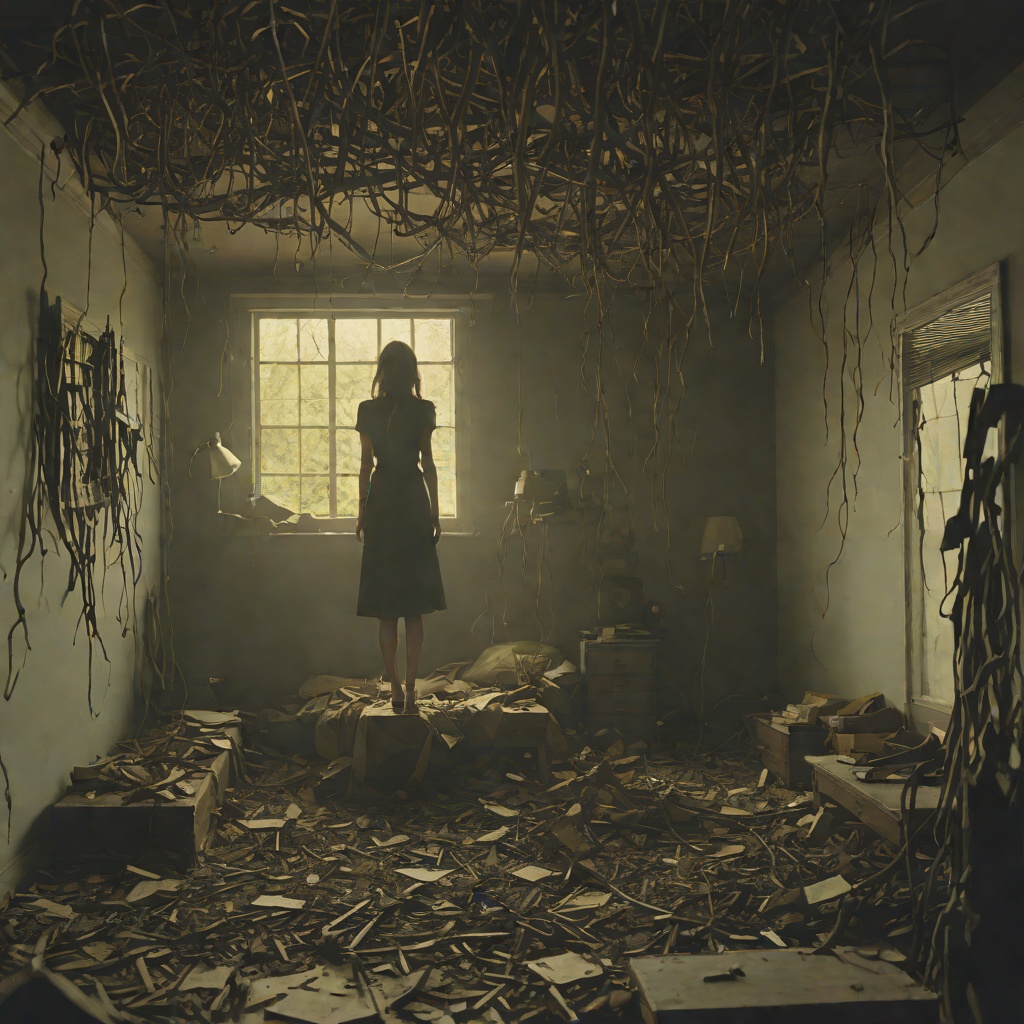
the sliding glass door
Die, My LoveThe sliding glass door is the architectural heart of the narrator's confinement and her most persistent symbol of escape. It separates the domestic interior of the house — once a dairy farm — from the sloping garden that descends into the woods, and it recurs throughout the novel as the precise point where the narrator's impulses toward self-destruction and liberation converge. The door is never merely a door: it is a threshold she approaches again and again, a transparent barrier she imagines shattering, and finally a surface she actually crashes through. Its repeated appearances trace the arc of her crisis, from the early fantasy of cutting her body on its glass, to the first real breakthrough, to the repaired and screened door she confronts upon her return from the psychiatric institution.
The Threshold of Self-Destruction
The narrator's relationship with the sliding glass door begins as a recurring fantasy of violence against herself. In her son's room, lit by a faint blue light, she watches her nipple satisfy the baby and hears her husband smoking outside, the puffs coming at regular intervals. After the baby burps and becomes a dead weight, she throws out the heavy nappy and walks toward the patio doors, toying with the idea of going right through the glass and cutting every inch of her body, always aiming to pass through her own shadow. But just before hitting it, she stops herself and slides it open. This is the pattern that defines her: approach, imagine the shattering, then pull back at the last instant. The glass becomes the material form of her ambivalence — the place where her death wish meets her survival instinct, where she rehearses annihilation without committing to it. The fantasy is not merely suicidal; it is an attempt to pass through her own shadow, to escape not just the house but her own reflection, her own identity as mother and wife.
The First Crash-Through
The fantasy becomes reality during the confrontation over the narrator's affair with the radiologist. When her husband's jealous rage escalates from accusations to physical violence — kicks, blows, and the banalities of "idiot, piece of shit, crazy bitch" — the narrator runs outside, and for the very first time she crashes straight through the glass. The act is both escape and self-harm, a literal breaking of the barrier she had only imagined crossing. Red all over, she crosses the pastures as though they were a park, trampling on rabbits and barn owls as she goes, or perhaps being trampled by them. She lies down in her kennel, her cave among the pruned trees, and spends the long night looking at graves until there is sun in the sky, brushing her hair and sleeping under the reflection of the tombstones, reading the names of dead people she never knew. The crash-through is the point of no return: it converts her private fantasy into public fact, and it inaugurates the period of her life she describes as being already dead. The glass, once the imagined instrument of her self-cutting, becomes the actual wound through which she exits her marriage and enters a kind of living death.
The Repaired Door and the Watching Outsider
After the crash, the sliding door is repaired, but the narrator's relationship to it changes. She becomes an outsider looking in. On one occasion, she leaves the baby sitting by the fire and goes out through the recently repaired sliding door, standing freezing cold and watching her husband and child through the glass. Her face is glued to the glass; she sees them grow foggy on the other side of her breath, and she sees her breath erase them from her life. The door that once promised escape now serves as the lens through which she observes her own family becoming strangers. When the baby crawls toward the fireplace and sticks his hands into the embers, she watches her husband react the way Bush did when he heard about the Twin Towers, running off to look for bandages with his stupid towel around his waist. She does not go in because she is a stranger, an outsider: she does not know how to speak without causing offence, she spies on people's homes, and she has not showered in days. The glass door has become the membrane of her alienation — she can see her family but cannot rejoin them, and her breath literally erases them from her field of vision, a small daily rehearsal of the disappearance she both fears and desires.
The Return and the Mosquito Mesh
When the narrator returns from the psychiatric institution, the house has changed: a microwave with the time flashing, a tablecloth embroidered with the petals of large flowers, a new cordless phone with a notepad next to it. She sits on the sofa facing the fireplace, and the reflection of the first knife she ever dreamt of is in her hand again. Scared, she moves toward the glass door she had once crashed through, which now has a mosquito mesh on it. The mesh is a small but telling alteration: the door that once offered the possibility of violent escape has been domesticated, screened against insects, made safe. Yet the narrator's impulse is unchanged. She opens the door and runs outside to look for the stag, needing to see the tips of his antlers, calling him her one and only. The door, even repaired and screened, still opens onto the woods and the wild animal that represents her true attachment. The mosquito mesh cannot contain her longing; it only marks how the domestic world has tried to seal itself against the wilderness she still seeks. The return through the door is not a homecoming but a continuation of the same escape impulse, now directed not at self-destruction but at the stag, her real man who is not human.
The Glass as Threshold Between Worlds
The sliding glass door functions throughout the novel as the boundary between two incompatible worlds: the domestic realm of the husband, the baby, the telescope, and the first-aid kits, and the wild realm of the woods, the stag, and the graves. The narrator's repeated approach to the glass enacts the Lacanian mirror stage in reverse — instead of recognizing a unified self in the reflection, she sees a self she wants to shatter and pass through. The door is the transparent surface on which her identity as mother and wife is projected, and her desire to crash through it is a desire to escape that projection entirely. The fact that she finally does crash through, and then returns to find the door repaired and screened, suggests that the boundary cannot be permanently crossed in either direction. The glass is both the obstacle and the opening, the thing that keeps her in and the thing that lets her out, and its persistence across the novel — imagined, shattered, repaired, screened — mirrors the persistence of her crisis, which no institution, no repair, and no mosquito mesh can truly resolve. The door is the novel's most precise image of the narrator's condition: transparent, fragile, and always between one world and another.