Buster Friendly and His Friendly Friends
Do Androids Dream of Electric SheepBuster Friendly and His Friendly Friends is the omnipresent, twenty-three-hour-a-day television and radio talk show that dominates the media landscape of a post-apocalyptic Earth and its Martian colonies. Hosted by the seemingly immortal comedian Buster Friendly, the program functions as the primary instrument of mass entertainment, propaganda, and social control, its relentless stream of chatter and commercials filling the void left by a dying world. The show's most significant act is its carefully documented exposé of Mercerism, the dominant religion of empathy, which it reveals to be a hoax, thereby striking at the very foundation of human identity and community.
Format and Ubiquity
The Buster Friendly Show is a perpetual broadcast, running twenty-three hours a day, seven days a week, with the remaining hour reserved for a religious sign-off and sign-on. It is transmitted via satellite across Earth and beamed to the colony planets, including Mars, and practice transmissions had even been attempted toward Proxima. The show's format is a talk show built around a core of recurring guests, most notably the beautiful, conical-breasted Amanda Werner and several other foreign ladies from vaguely defined countries, along with bucolic humorists. These guests appear with astonishing frequency, sometimes as much as seventy hours a week, and never seem to repeat themselves or run out of witty retorts. The show's content is a mix of banter, weather reports (announced by the "Mongoose satellite"), and commercials, such as the one for Mountibank Lead Codpieces that Iran Deckard finds so hateful. The program is so pervasive that John Isidore, a "chickenhead" living in a nearly abandoned building, depends on it for time signals, and its voice booms through the empty halls of his decaying apartment complex.
Role as Propaganda and Distraction
The show serves as a key propaganda arm for the United Nations' colonization program. On Interspace Horizons Day, the program is entirely devoted to promoting emigration, featuring interviews with recent immigrants like Mrs. Maggie Klugman, who extol the dignity of life on Mars and the reassurance of having an android servant. The commercials, directed at the remaining "regulars" on Earth, constantly remind viewers of the dangers of radioactive dust and the benefits of leaving, thereby frightening "specials" like Isidore, who cannot emigrate. Beyond its overt propaganda, the show functions as a pervasive distraction, filling the oppressive silence of the world with a constant, cheerful noise. For Isidore, the silence of his empty building is a palpable, living force, and the TV set is his primary defense against it. The show's relentless chatter, however, also carries a subtle, persistent hostility toward Mercerism, with Buster Friendly frequently making jokes that chip away at the religion's core beliefs, a fact that deeply irritates Isidore.
The Exposé of Mercerism
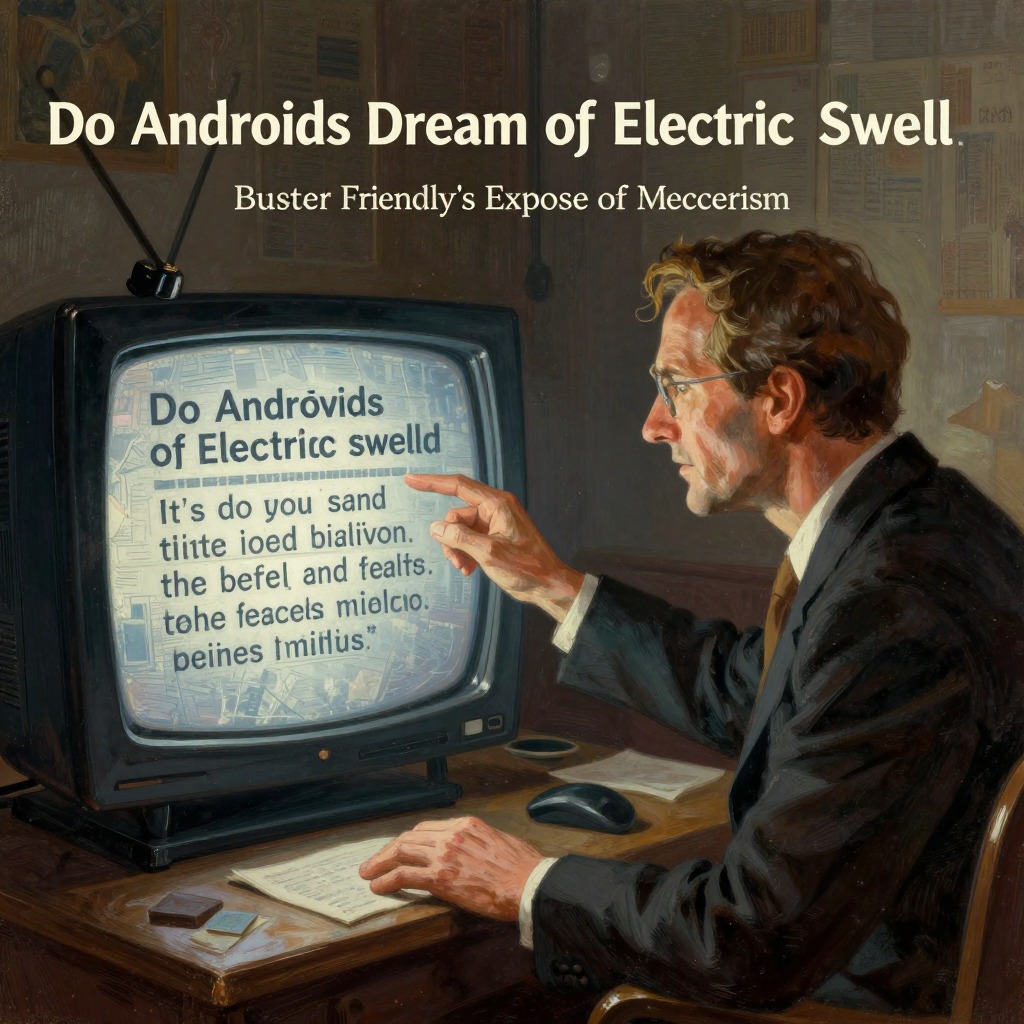
The show's most consequential act is its meticulously planned exposé of Mercerism. After weeks of buildup, Buster Friendly reveals that his research staff has proven that the world of Wilbur Mercer is a fraud. Using blowups of video pictures, they demonstrate that the sky is painted, the moon is a painted backdrop with visible brushstrokes, and the weeds and stones are likely fake. They track down a former Hollywood special-effects man, Wade Cortot, who identifies the figure of Mercer as a bit player marching across a sound stage. The research team locates this actor, an old man named Al Jarry, who confirms he made the films for an unknown employer, that the "rocks" were made of soft plastic, and the "blood" was catsup. Buster Friendly declares, "Mercerism is a swindle!" The exposé is broadcast to nearly every human in the Sol System, and its immediate effect is to shatter the faith of many, including John Isidore, who experiences a profound crisis of meaning.
Nature and Significance
The show's host, Buster Friendly, is revealed to be an android, a fact known to the escaped androids who have been waiting for his announcement for months. His immortality—his ability to do forty-six hours of show a day—is a consequence of his artificial nature. The show thus represents the ultimate triumph of the inauthentic: a machine-hosted program that exposes the central spiritual experience of humanity as a fabrication. It is a weapon of the culture industry, wielded by an android to destroy the one thing—empathic fusion—that distinguishes humans from machines. The exposé does not, however, end Mercerism for everyone; Wilbur Mercer himself tells John Isidore that the research is "sincere" and "true" from the androids' standpoint, but that nothing has changed because he and Isidore are still there. The show's revelation is a fact, but it is not the whole truth, and the experience of fusion persists despite the debunking of its literal reality.