Depression
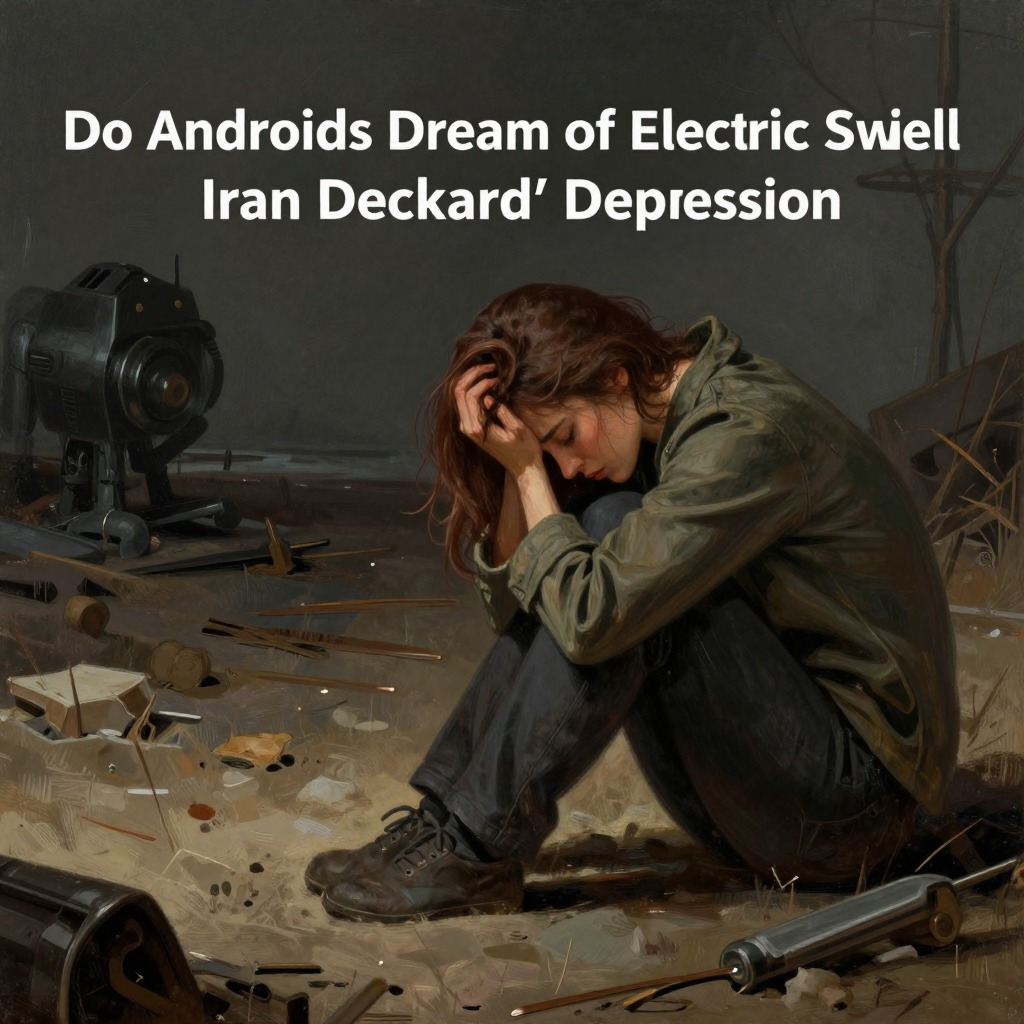
Do Androids Dream of Electric SheepDepression, in the world of Do Androids Dream of Electric Sheep?, is not merely a personal affliction but a deliberate, scheduled response to the existential vacuum of post-World War Terminus Earth. It is most vividly embodied by Iran Deckard, who, unlike her husband Rick, refuses to use her Penfield mood organ to escape into a programmed state of well-being. Instead, she has programmed a six-hour self-accusatory depression into her schedule twice a month, a choice that baffles and irritates Rick. She explains that she arrived at this setting after an experience of profound emptiness: while watching television, she turned off the sound and heard the silence of the building, the "empty apartments" that surround them. This auditory encounter with the absence of life, which she knew intellectually but had not felt, led her to experiment with her mood organ until she found a setting for despair. She considers this a reasonable amount of time to feel hopeless about everything, about staying on Earth after everybody who is small has emigrated. Rick warns her that such a mood is self-perpetuating and dangerous, but Iran has programmed an automatic resetting for three hours later, a 481 setting that brings awareness of the manifold possibilities open to her in the future. This calculated oscillation between despair and hope reveals a deep, almost ritualistic engagement with the emotional landscape of a dying world, a stark contrast to the relentless pursuit of happiness through technology.
The Texture of Despair
Iran's depression is not a passive state but an active, almost philosophical stance. She describes the moment of its origin: sitting alone, having turned off the TV sound, she heard the building, the empty apartments, and felt the "absence of life, not just in this building but everywhere." Her first reaction was gratitude for being able to afford a Penfield mood organ, but then she read how unhealthy it was to sense this absence and not react—a condition once called "absence of appropriate affect." This self-awareness transforms her depression into a form of protest against the very mechanism designed to eliminate it. The mood organ, which can dial any desired emotion, becomes a tool for experiencing the authentic, if painful, reality of the world. Iran's depression is thus a conscious, willed act of bearing witness to the entropy and loss that define her environment, a refusal to let the artificial cheerfulness of Buster Friendly or the mood organ's settings paper over the void.
The Contrast with Rick Deckard
Rick Deckard's relationship with depression is more conventional and reactive. He relies on the mood organ to maintain a "businesslike professional attitude" and is genuinely disturbed by Iran's scheduled despair. He argues that a mood like that is self-perpetuating and that she is apt to stay in it, not dial her way out. His own depression emerges not from a philosophical choice but from the cumulative trauma of his work as a bounty hunter. After retiring six Nexus-6 androids in a single day, he experiences a profound, disorienting depression that leads him to flee to the desolate Oregon border. He tells his secretary that he has become Wilbur Mercer, permanently fused with him, and cannot unfuse. This is a depression born of moral exhaustion and the violation of his own identity, a state where the distinction between hunter and hunted, human and android, collapses. Unlike Iran's scheduled, controlled depression, Rick's is a crisis that threatens to consume him entirely, a direct consequence of the violence and moral ambiguity of his profession.
Depression and the Android Condition
The novel also explores a form of depression that is inherent to the android condition. Rachael Rosen, a Nexus-6 android, reveals a deep, existential despair about her own existence. She tells Rick that androids cannot bear children, and asks if that is a loss, admitting she has no way to tell. She describes herself as a "chitinous reflex-machine" that is not really alive, and her lament is tinged with a cold, intellectual acceptance of her own finitude. This android depression is not a mood that can be dialed away; it is a structural defect, a consequence of being a manufactured being with a limited lifespan and no capacity for genuine empathy or reproduction. It is a despair that mirrors the human condition but is stripped of the hope or transcendence that Mercerism offers. The androids' inability to experience the fusion of Mercerism, their exclusion from the shared emotional life of humanity, creates a unique form of depression that is both a limitation and a source of bitter, self-aware sorrow.