Empathy box
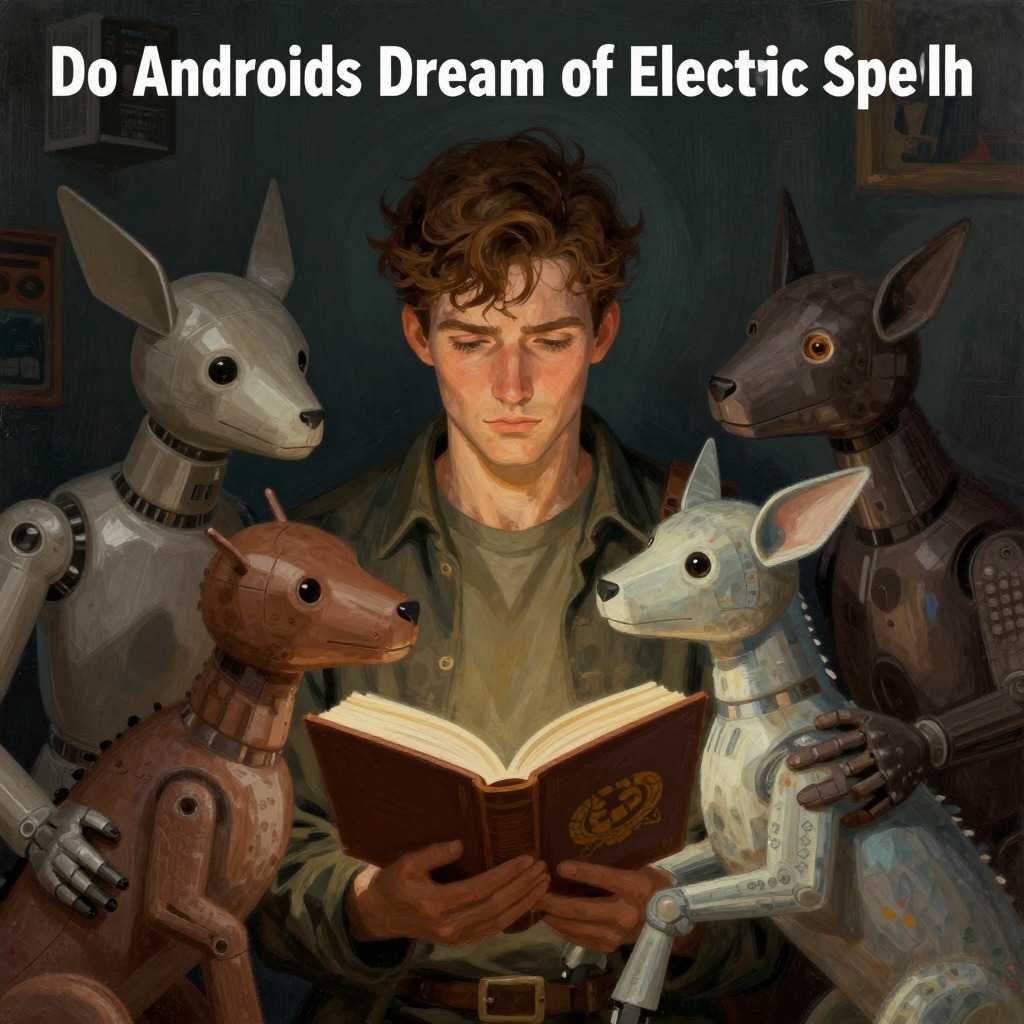
Do Androids Dream of Electric SheepThe empathy box is the physical and spiritual apparatus through which the religion of Mercerism is practiced. It is a black box, typically kept in the home, that when activated produces a faint smell of negative ions and a cathode-ray tube glow of apparently random colors, trails, and configurations. The experience only congeals into meaning when the user grasps its twin handles. At that moment, the user's living room fades away and they find themselves entering the bleak, barren landscape of a hillside, their own feet scraping among loose stones, their own senses perceiving the acrid haze of an alien sky. They become one with Wilbur Mercer, the elderly robed figure who toils endlessly up the slope, and simultaneously fuse with every other person who at that moment clutches the handles anywhere in the system. The fusion is described as a physical merging accompanied by mental and spiritual identification; the user hears the babble of the collective thoughts and feels the rocks that are hurled at Mercer, experiencing the pain as their own. This shared suffering and the knowledge that one is not alone in it is the core of the Mercerite experience. The box is the most personal possession a person can own, described as an extension of the body and the way one stops being alone. Even John Isidore, a "chickenhead" or mentally diminished special, can participate fully, and he reflects that Mercer does not care about such distinctions. The experience is so powerful that users, even the elderly and physically fragile, accept the risk of cardiac arrest from the intense physical and emotional ordeal, particularly during the later, more violent stages of the ascent.
Operation and the Fusion Experience
The empathy box operates through a process of fusion. When John Isidore turns on his box and grasps the handles, the visual image congeals into the famous landscape of the old, brown, barren ascent. He experiences a waning of his dilapidated living room and finds himself entering the landscape, no longer merely witnessing Mercer's climb but feeling his own feet seeking purchase among the loose stones. He has crossed over in a perplexing fashion, physically merging with Mercer and mentally and spiritually identifying with him. This fusion extends to all other users; Isidore experiences them, incorporates the babble of their thoughts, and hears in his own brain the noise of their many individual existences. They all care about one thing: the hill, the climb, the need to ascend. The mutual babble of everyone else in fusion breaks the illusion of aloneness. When a rock strikes Mercer's arm, Isidore feels the pain, and the voices of the collective confirm they were hit too. The experience is not passive; the user actively climbs, and the collective consciousness of all participants accompanies them. Rick Deckard, who rarely uses the box, experiences a similar fusion later in the novel, finding himself in the same desolate landscape where the air smells of harsh blossoms and there is no rain. He speaks directly with Mercer, who appears before him as a man with a sorrowful light in his weary, pain-drenched eyes. This direct communication, however, does not provide the comfort Isidore finds; Mercer tells Deckard that there is no salvation and that he must go on and do his task even though he knows it is wrong.
The Empathy Box as a Diagnostic Tool
The empathy box and the Mercerism it enables are the foundation for the Voigt-Kampff empathy test, the primary method for detecting androids. The test measures autonomic responses to morally shocking stimuli, specifically capillary dilation in the facial area and fluctuations of tension within the eye muscles. These responses are believed to be involuntary and are not engendered in androids, who lack the empathic faculty. Rick Deckard reflects that an android, no matter how gifted intellectually, can make no sense out of the fusion which takes place routinely among the followers of Mercerism, an experience that even subnormal chickenheads manage with no difficulty. The inability to participate in the shared, group experience of the empathy box is the definitive proof of a lack of empathy, which in the novel's logic is the defining characteristic of humanity. The box is thus not merely a religious device but a crucial piece of law-enforcement technology, the only reliable means of distinguishing a Nexus-6 android from a human being. The Rosen Association's attempt to undermine the Voigt-Kampff test by having Rachael Rosen, an android, pose as a human is a direct attack on the entire system of detection that the empathy box underwrites.
The Exposé and Its Aftermath
The empathy box and the reality of the Mercerite experience are directly challenged by Buster Friendly's televised exposé. Friendly's research team claims to have proven that the sky behind Mercer is painted, that the "moon" shows brushstrokes, that the stones are made of soft plastic, and that Mercer is merely a bit player named Al Jarry on a Hollywood sound stage. The exposé is a devastating blow to the faith, and John Isidore, upon hearing it, immediately sinks into the tomb world, a state of despair and decay. However, Mercer appears to Isidore even in this state and admits the truth of the exposé, saying, "I am a fraud." Yet Mercer also insists that nothing has changed, that he will continue to lift Isidore from the tomb world. This paradox—that the experience is both a constructed fraud and a genuine source of meaning and connection—is central to the novel's conclusion. Later, Rick Deckard, after retiring the last of the androids and finding a toad in the desert, has his own solitary ascent up a hill, where he is struck by a real rock and experiences the pain and isolation of the Mercerite ordeal alone, without the box. He realizes he has permanently fused with Mercer and cannot unfuse. The experience is not mediated by the box but is a direct, personal encounter with the same suffering and the same landscape, suggesting that the truth of the experience transcends the mechanism that originally delivered it. When Iran later discovers that the toad is electric, Deckard reflects that "the electric things have their lives, too. Paltry as those lives are," a final, quiet acknowledgment that the capacity for empathy, not the authenticity of the object, is what matters.