Mercerism
Do Androids Dream of Electric SheepMercerism is the dominant religious and ethical system in the post-apocalyptic world of Do Androids Dream of Electric Sheep?, centered on the fusion of consciousness through an empathy box with the suffering figure of Wilbur Mercer. It provides the moral framework that distinguishes humans from androids, defines the sanctity of all life, and ultimately survives a devastating exposé that reveals its physical origins as a fraud.
Nature and Practice
Mercerism is practiced through a device called an empathy box, which, when its twin handles are grasped, produces a fusion of the user's consciousness with that of Wilbur Mercer and all other users across Earth and the colony planets. The experience is described as a "physical merging — accompanied by mental and spiritual identification" with Mercer, in which the user feels the old man's painful ascent up a barren, brown hillside, the sting of rocks hurled by unseen antagonists, and the presence of a "mutual babble of everyone else in fusion." The user's own feet scrape the loose stones, and they smell the acrid haze of an alien sky. The experience is not merely visual or auditory; it is visceral, with users reporting real wounds from the thrown rocks. The empathy box emits a faint smell of negative ions when turned on, and the cathode-ray tube glows with random colors until the handles are grasped, at which point the visual image congeals into the familiar landscape. The fusion is described as a "compound figure" of Mercer, with the user no longer witnessing the climb but experiencing it as their own. The experience is so powerful that users, even elderly and physically fragile ones, risk cardiac arrest to undergo it, especially the later, more intense stages at the top of the hill.
Ethical and Theological Foundations
Mercerism provides a comprehensive ethical system, most famously encapsulated in the dictum "You shall kill only the killers." This principle is central to the moral justification of bounty hunters like Rick Deckard, who view escaped androids as the embodiment of "The Killers" — an absolute evil that plucks at the threadbare cloak of the tottering, ascending old man. The concept of The Killers is nebulous within Mercerism, allowing followers to locate it wherever they see fit. For Deckard, an escaped humanoid robot that has killed its master, possesses superior intelligence, has no regard for animals, and lacks the ability to feel empathic joy for another life form's success or grief at its defeat, epitomizes The Killers. The religion also enforces a strict moral and theological structure regarding animal ownership. Owning an animal is seen as essential for "true fusion with Mercer," and having two animals while a neighbor has none is considered a violation of the "whole basic theological and moral structure of Mercerism." The religion teaches that all life is one, a principle that John Isidore invokes when he says, "All life is one; 'no man is an island,'" and that the cycle of life is complete for animals too, as they ascend with Mercer, die, and return. The experience of fusion is described as a sort of "biological insurance" for herd animals like humans, where as long as some creature experiences joy, all others share a fragment of it, but if any living being suffers, the shadow cannot be entirely cast off.
The Exposé and Its Aftermath
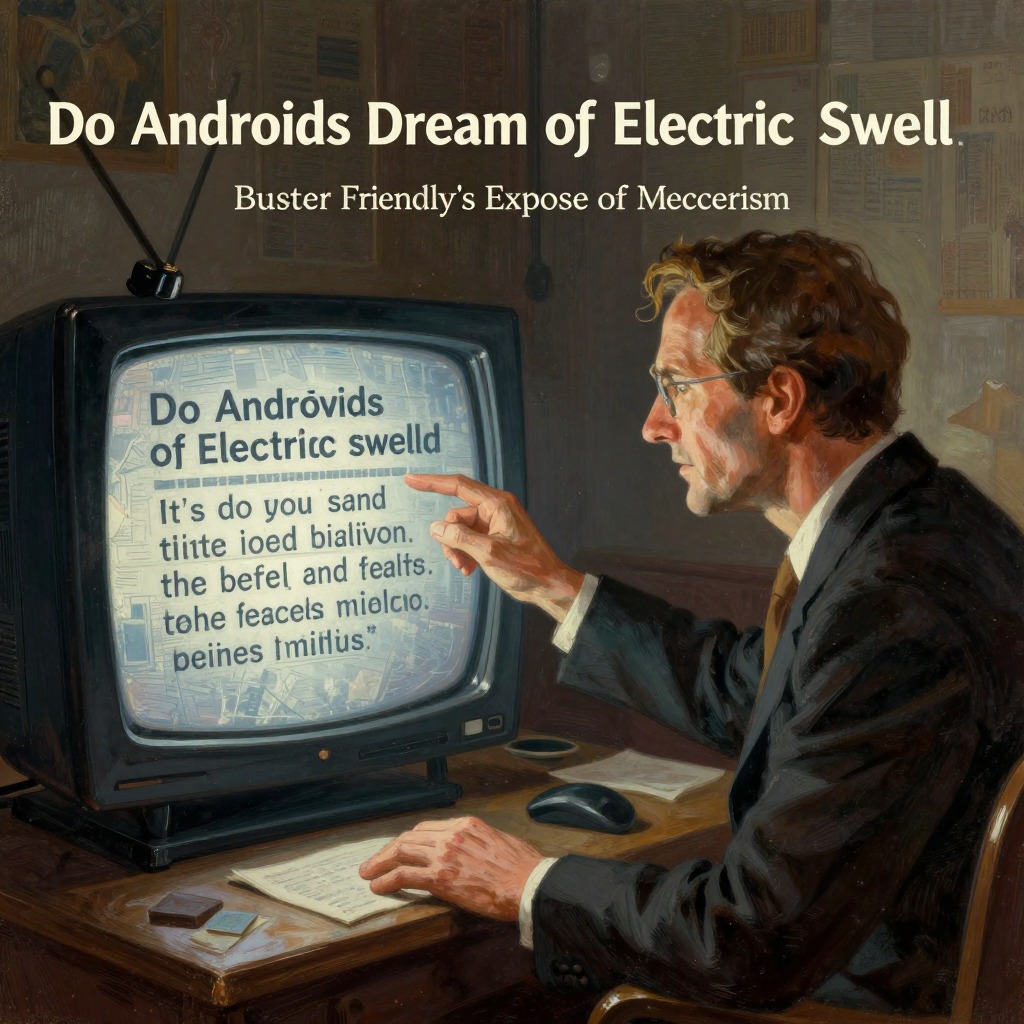
Mercerism faces a devastating challenge when Buster Friendly, the system-wide TV comic, reveals a carefully documented exposé on his show. Friendly's research team, led by Earl Parameter, presents evidence that the gray backdrop of sky and daytime moon against which Mercer moves is not only not Terran but is artificial. The "moon" is painted, with brushstrokes visible under magnification, and the scraggly weeds, sterile soil, and even the stones hurled at Mercer are equally faked, possibly made of soft plastic causing no authentic wounds. Friendly's team tracks down a former Hollywood special-effects man, Wade Cortot, who recognizes the stage as one used by a now out-of-business minor moviemaker. They then locate an elderly bit player named Al Jarry, who confirms he made a series of short fifteen-minute video films for an employer he never met, using rubber-like plastic for rocks and catsup for blood. Friendly declares, "Mercerism is a swindle!" The androids, who have been waiting for this moment, celebrate, with Roy Baty stating, "Buster said it out loud, and nearly every human in the system heard him say it. 'Mercerism is a swindle.' The whole experience of empathy is a swindle." However, the exposé does not destroy the faith. When John Isidore confronts Mercer in the tomb world, Mercer admits, "I am a fraud. They're sincere; their research is sincere. From their standpoint I am an elderly retired bit player named Al Jarry. All of it, their disclosure, is true." Yet Mercer insists that nothing has changed, because Isidore is still there and Mercer is still there, and he will continue to lift Isidore from the tomb world. Rick Deckard, after his own solitary ascent, also affirms, "Mercer isn't a fake. Unless reality is a fake." The faith persists not because of the literal truth of its physical manifestation but because of the genuine experience of fusion and the ethical framework it provides.
Narrative and Thematic Significance
Mercerism serves as the central ethical and metaphysical axis of the novel, providing the criteria by which humanity is defined and androids are judged. The Voigt-Kampff empathy test, the primary tool for detecting androids, is explicitly derived from the principles of Mercerism, measuring the empathic faculty that androids lack. The religion's concept of "The Killers" provides the moral justification for the bounty hunters' work, while its promise of fusion offers a counter to the pervasive loneliness and isolation of the post-apocalyptic world. The exposé of Mercerism as a fraud does not invalidate the religion's function; instead, it deepens the novel's exploration of faith, reality, and the nature of truth. Mercer's own admission of being a fraud, coupled with his continued presence and ability to lift followers from the tomb world, suggests that the value of Mercerism lies not in the literal truth of its origin but in the genuine experience of connection and empathy it provides. The religion's survival of the exposé underscores the novel's central theme: that the capacity for empathy, even if based on a constructed narrative, is what defines the human and gives life meaning in a world of radioactive dust and android killers.