The Killers
Do Androids Dream of Electric SheepThe Killers occupy a paradoxical place in the theology of Mercerism: they are at once the story's most concrete evil and its most elusive abstraction. In the Mercerite fusion experience, the old man Wilbur Mercer toils up a barren hillside while unseen antagonists hurl rocks at him. These are "the old antagonists, manifesting themselves at the periphery of his vision," and they have followed him all the way up the hill. The identity of The Killers is never made explicit within the fusion itself; a Mercerite "sensed evil without understanding it." This ambiguity is structurally essential, because it allows each follower to locate the nebulous presence of The Killers wherever he sees fit.
Theological Origin and Mercer's Personal History
The concept of The Killers has its roots in Mercer's own biography, as revealed during his fusion with John Isidore. Mercer recalls that in his sixteenth year, local law prohibited the time-reversal faculty by which he could bring dead animals back to life. "Without his parents' consent they — the killers — had bombarded the unique nodule which had formed in his brain, had attacked it with radioactive cobalt." This assault plunged him into the tomb world, a pit of corpses and dead bones from which he struggled for years to ascend. The Killers, then, are first encountered as the agents of a punitive authority that destroyed Mercer's unique gift and condemned him to suffering. This personal history gives the theological concept a traumatic origin: The Killers are those who, by force, cut off the possibility of resurrection and renewal.
Rick Deckard's Identification of The Killers with Androids
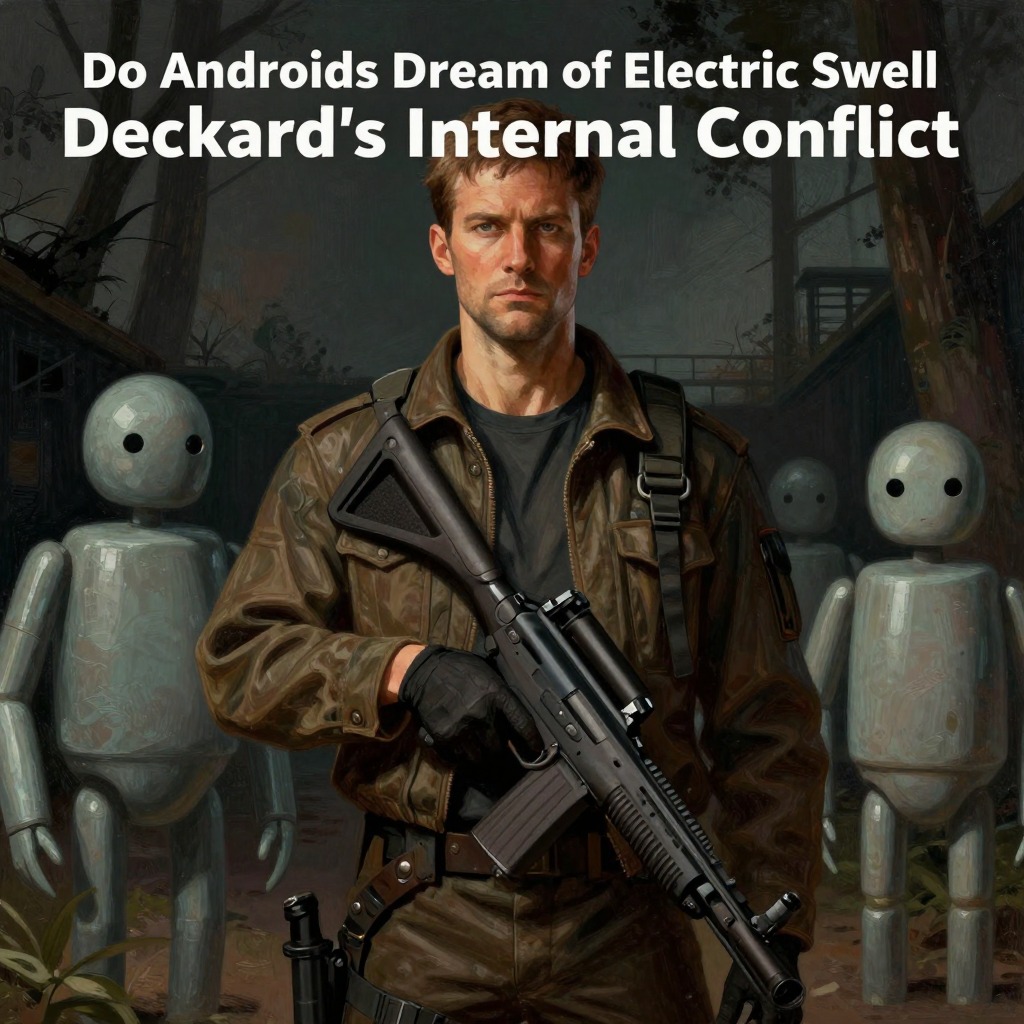
For bounty hunter Rick Deckard, the theological abstraction of The Killers finds a precise, actionable referent. He reflects that "an escaped humanoid robot, which had killed its master, which had been equipped with an intelligence greater than that of many human beings, which had no regard for animals, which possessed no ability to feel emphatic joy for another life form's success or grief at its defeat — that, for him, epitomized The Killers." This identification is not merely personal; it is grounded in the core teaching of Mercerism. Mercer had told his followers, "You shall kill only the killers," a commandment that provides moral sanction for the bounty hunter's work. By equating androids with The Killers, Deckard transforms his profession from murder into a sacred duty. The androids themselves, however, invert this logic. When Roy Baty learns of Buster Friendly's exposé proving that Mercerism is a fraud, he declares, "It's done. Buster said it out loud, and nearly every human in the system heard him say it. 'Mercerism is a swindle.'" For the androids, the revelation that Mercer is a bit player on a sound stage means that the entire moral framework that condemns them is itself a fabrication.
The Killers as the Curse of Wrongdoing
The most radical redefinition of The Killers occurs during Rick Deckard's solitary ascent after retiring the last of the Nexus-6 androids. Exhausted and morally shattered, Deckard drives to the desolate Oregon border and begins to climb a hill. Rocks strike him — "the first rock — and it was not rubber or soft foam plastic — struck him in the inguinal region." He realizes he is experiencing the Mercerite ordeal alone, without the empathy box, and that he has become Mercer. When he returns home, his wife Iran interprets his bleeding cheek: "The killers that found Mercer in his sixteenth year, when they told him he couldn't reverse time and bring things back to life again. So now all he can do is move along with life, going where it goes, to death. And the killers throw the rocks; it's they who're doing it. Still pursuing him. And all of us, actually." Here The Killers are no longer a specific group — not androids, not the authorities who bombarded Mercer's brain — but the universal condition of existence itself. They are the force that compels every living creature to "violate your own identity," as Mercer told Deckard during their fusion. The curse that feeds on all life, the ultimate shadow and defeat of creation, is the work of The Killers. They are not external enemies to be defeated but an inescapable aspect of being alive in a fallen world.
The Killers and the Culture Industry
The concept of The Killers also operates on a cultural level through the figure of Buster Friendly. The television comedian's relentless mockery of Mercerism — his "subtle, almost inconspicuous ways" of ridiculing the empathy boxes — positions him as a kind of Killer in the public sphere. John Isidore senses this competition: "Maybe Buster is jealous. Sure, that would explain it; he and Wilbur Mercer are in competition. But for what? Our minds." Buster's eventual exposé, which proves that Mercer is a fraud and that the "stones" thrown at him are made of soft plastic, is the ultimate act of killing — not a physical death, but the murder of a belief system. Yet Mercer himself, when confronted by Isidore in the tomb world after the exposé, admits the truth of the revelation while denying its power to change anything: "I am a fraud. They're sincere; their research is sincere. From their standpoint I am an elderly retired bit player named Al Jarry. All of it, their disclosure, is true." The Killers can expose the mechanism, but they cannot destroy the experience. The ascent continues.
Significance: The Unkillable Killers
The Killers are never defeated. They are not a villain to be overcome but a permanent feature of the moral landscape. Mercer tells Deckard, "You will be required to do wrong no matter where you go. It is the basic condition of life, to be required to violate your own identity." The Killers are the agents of that requirement. They are the ones who throw the rocks, who destroy the unique, who expose the fraud, who compel the bounty hunter to kill what he has come to love. In the novel's final movement, the concept dissolves the boundary between hunter and hunted: Deckard, having killed six androids, finds himself on the hill being stoned, and Iran tells him that The Killers are still pursuing "all of us, actually." The Killers are not the androids, not the authorities, not Buster Friendly — they are the structure of reality itself, the curse that feeds on all life, and they cannot be retired.