Wilbur Mercer and Al Jarry
Do Androids Dream of Electric SheepThe relationship between Wilbur Mercer and Al Jarry constitutes the explosive core of Buster Friendly's meticulously documented exposé of Mercerism. For the millions who had fused with Mercer through the empathy box, the revelation that their spiritual guide was a former Hollywood bit player named Al Jarry, performing on a cheap sound stage with rubber rocks and catsup blood, threatened to shatter the theological foundation of their shared experience. Yet the relationship between the archetypal figure and the elderly actor proved far more complex than simple fraud, as Mercer himself acknowledged the truth of the disclosure while insisting that nothing had changed.
The Exposé and Its Claims
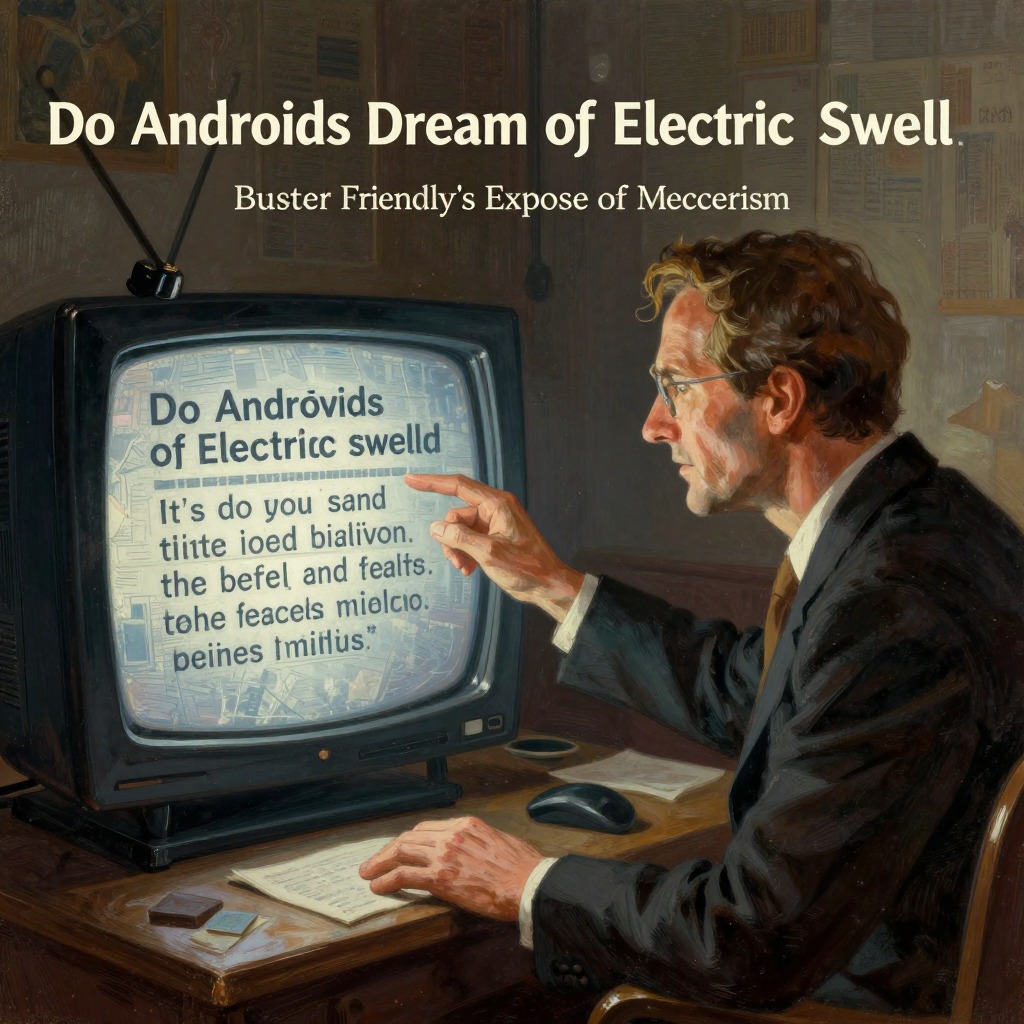
Buster Friendly's research team, led by Earl Parameter, presented blowups of video footage showing that the gray backdrop of sky and daytime moon against which Mercer moved was not only not Terran but artificial, with visible brushstrokes on the painted moon. The team tracked down a former Hollywood special-effects man, Wade Cortot, who recognized the stage as one used by a now out-of-business minor moviemaker. Further investigation led them to Al Jarry, a very old man living in a tottering, shabby house in East Harmony, Indiana. A member of the research team scanned Jarry's mind by telepathic means and found that he had indeed made a series of short fifteen-minute video films for an employer he never met. The rocks were made of rubber-like plastic, the blood was catsup, and the only suffering Jarry underwent was having to go an entire day without a shot of whisky. Buster Friendly declared to his vast audience that Mercerism was a swindle.
Mercer's Acknowledgment and Reinterpretation
When John Isidore, deep in fusion with Mercer after the mutilation of his spider, confronted the old man with the exposé, Mercer did not deny it. "I am a fraud," Mercer said. "They're sincere; their research is sincere. From their standpoint I am an elderly retired bit player named Al Jarry. All of it, their disclosure, is true. They interviewed me at my home, as they claim; I told them whatever they wanted to know, which was everything." He confirmed the detail about the whisky. Yet Mercer immediately reframed the meaning of this truth: the androids, he explained, had better perspective because they were too far away, and that was why they saw brushstrokes. "They will have trouble understanding why nothing has changed," Mercer said. "Because you're still here and I'm still here." He lifted Isidore from the tomb world and restored the mutilated spider with its snipped-off legs intact, demonstrating that the empathic fusion itself remained operative regardless of the physical circumstances of its production.
The Relationship's Thematic Significance
The Mercer-Jarry relationship embodies the novel's central paradox about authenticity and value. The figure who had been experienced as an archetypal entity from the stars, superimposed on human culture by a cosmic template, turned out to be a lonely, alcoholic old man in a kipple-filled house. Yet the fusion experience — the shared ascent, the mutual suffering, the empathic connection among all who grasped the handles — continued to function. Mercer's own words to Rick Deckard during an earlier fusion had already prepared the ground: "There is no salvation," he had said. "To show you that you aren't alone. I am here with you and always will be. Go and do your task, even though you know it's wrong." The exposé did not destroy Mercerism because Mercerism had never depended on the literal reality of its icon; it depended on the genuine empathic connection among its practitioners. The relationship between the immortal archetype and the mortal actor collapsed the distinction between authentic and fraudulent, suggesting that what matters is not the origin of the symbol but the lived experience it enables.