sanctity of animal life
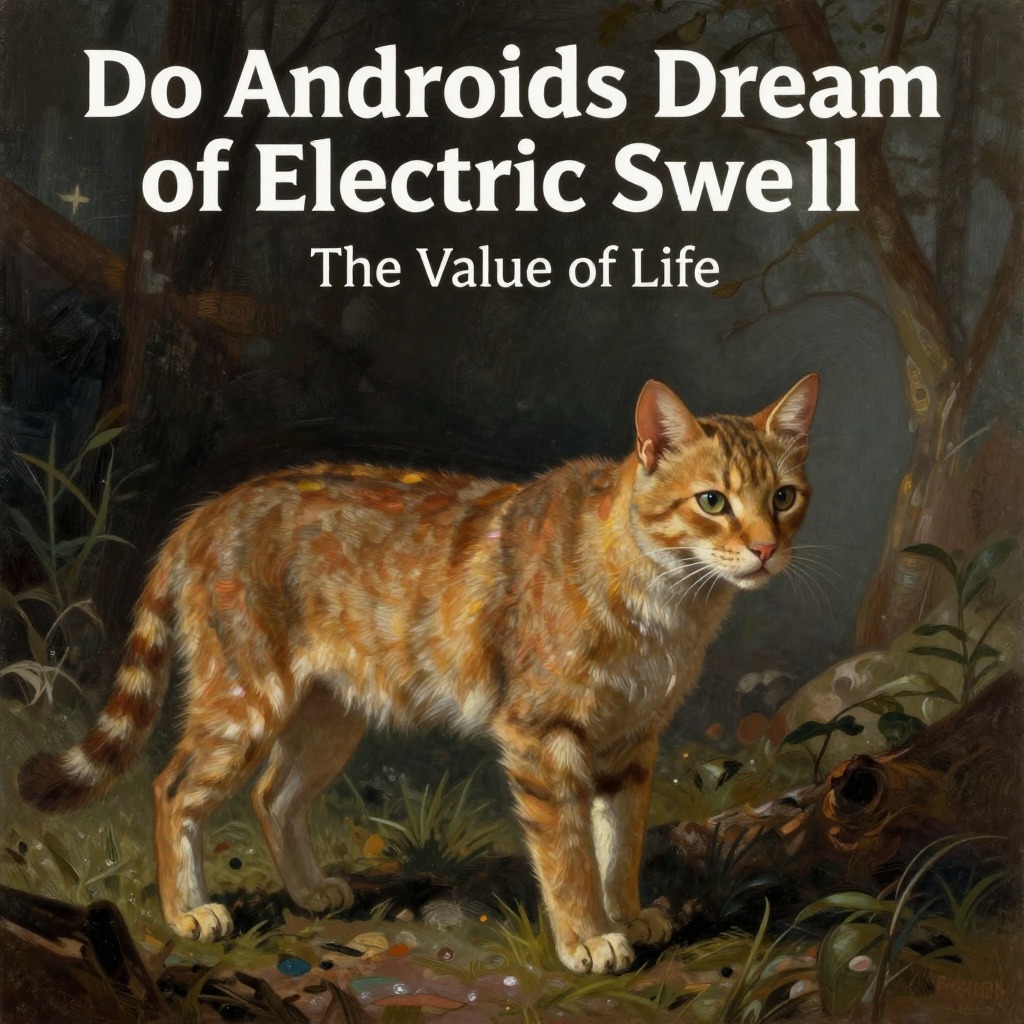
Do Androids Dream of Electric SheepIn the world of Do Androids Dream of Electric Sheep?, the sanctity of animal life is not merely a cultural value but a deeply embedded moral, legal, and theological axiom that shapes every aspect of society. After World War Terminus rendered most of Earth's fauna extinct, the few surviving living animals became objects of near-religious veneration, protected by stringent laws and carrying immense social and spiritual weight. The principle asserts that all organic life—from the largest mammal to the smallest insect—is sacred and inviolable, a belief that permeates the Mercerite faith, the legal system, and the daily interactions of the remaining human population. This reverence stands in stark contrast to the treatment of androids, who, despite their organic composition, are denied any such protection and are hunted as mere machines.
Legal and Social Framework
The legal protection of animals is absolute and rigorously enforced. The fine for counterfeiting a living animal is enormous—two and a half times the full market value of the genuine article—a deterrent that underscores the seriousness with which society guards the authenticity of life. Owning a real animal confers immense prestige, while possessing a fake one is a source of shame and social risk; Rick Deckard's electric sheep is a carefully guarded secret, as admitting to owning a fraud would invite moral condemnation from neighbors who consider it "immoral and anti-empathic" to neglect an animal. The social pressure is so intense that Deckard feels compelled to maintain the pretense of caring for his electric sheep as if it were alive, because "you have to keep your eye on it exactly as you did when it was really alive." The Sidney's Animal & Fowl Catalogue, the authoritative price guide, lists extinct species with a telltale "E" and records the astronomical prices of the last transactions, making the value of living animals a matter of public record and economic obsession.
Theological Foundation in Mercerism
The sanctity of animal life is the cornerstone of Mercerism, the dominant religious faith of the era. Through the empathy box, followers fuse with Wilbur Mercer and experience his eternal climb up a barren hill, a journey that embodies the interconnectedness of all life. Mercer's own backstory reinforces this: in his youth, he possessed the ability to bring dead animals back to life, a power that was outlawed and forcibly removed by "the killers" who bombarded his brain with radioactive cobalt. This act plunged him into the "tomb world," a pit of corpses and bones from which he could only escape when the dead creatures around him grew back into living beings. The Mercerite creed, "You shall kill only the killers," explicitly prohibits taking life, and the faith teaches that all life—including animals—participates in the cycle of ascent and descent. When John Isidore, a "chickenhead" (a mentally impaired special), finds a spider, he instinctively protects it, and when the androids Pris Stratton and Irmgard Baty mutilate the creature, cutting off its legs one by one, Isidore is horrified. His subsequent fusion with Mercer in the tomb world reveals the spider restored, a miracle that reaffirms the sacredness of even the smallest creature.
The Electric Animal as a Moral Problem
The existence of electric animals—sophisticated robotic imitations—creates a profound moral and existential dilemma. These fakes are designed to be indistinguishable from living animals, complete with "disease circuits" that mimic organic illness, yet they are mere machines, incapable of feeling or participating in the Mercerite fusion. Deckard reflects bitterly on the "tyranny of an object" when he tends to his electric sheep, realizing that it "doesn't know I exist" and has no ability to appreciate the existence of another. He draws a direct parallel between the electric animal and the android, calling the former a "subform" of the latter and the latter a "highly developed, evolved version of the ersatz animal." Both viewpoints repulse him. The electric toad that Deckard discovers near the Oregon border, believing it to be a living specimen of an extinct species, is ultimately revealed to be artificial when his wife Iran finds its control panel. Deckard's crestfallen reaction is immediate, but he eventually accepts the revelation with a resigned wisdom: "The electric things have their own lives, too. Paltry as those lives are." This statement marks a subtle expansion of the sanctity principle, acknowledging that even the artificial has a kind of existence worth recognizing.
The Androids' Violation and Its Consequences
The androids' systematic violation of the sanctity of animal life serves as the ultimate marker of their inhumanity. Pris Stratton, Irmgard Baty, and Roy Baty, the last surviving Nexus-6 androids from the escaped group, demonstrate a complete lack of empathy for living creatures. Pris, using Irmgard's cuticle scissors, calmly snips off the legs of Isidore's spider while the creature writhes, explaining that it "probably won't be able to run as fast" and that "it'll die anyway." Roy Baty later burns the spider with a match to make it move, and Pris eventually drowns the mutilated creature in the sink. This casual cruelty is not merely a character flaw but a direct consequence of their android nature: they are incapable of the empathic identification that Mercerism demands. The novel makes clear that this incapacity is what allows bounty hunters like Rick Deckard to "retire" androids without moral qualm—they are, in the Mercerite framework, "the killers" who must themselves be killed. Yet the novel complicates this binary when Deckard, after killing Pris Stratton (who is physically identical to Rachael Rosen, the android with whom he has had sex), feels a profound sense of loss and violation, and when Rachael retaliates by pushing his newly purchased goat off the roof of his building, the act is a deliberate attack on the very principle of animal sanctity that defines Deckard's humanity.
The Curse and the Cycle
The sanctity of animal life is ultimately tied to the novel's central theological concept: the curse that feeds on all life. Mercer explains to Deckard that "you will be required to do wrong no matter where you go. It is the basic condition of life, to be required to violate your own identity." This curse manifests in the inevitable death and decay that follows all living things, a process that the radioactive dust and the spread of kipple (useless objects that reproduce when left unchecked) symbolize. The tomb world, where Mercer sinks after being struck down at the top of the hill, is a realm of "corpses and dead bones" from which he can only rise when the dead creatures around him are restored to life. This cycle of death and rebirth is the pattern of all existence, and the sanctity of animal life is the fragile principle that holds it together. When Buster Friendly's exposé reveals that Mercer is a fraud—a bit actor named Al Jarry on a painted sound stage—the revelation threatens to undermine the entire moral order. Yet Mercer himself admits the truth of the exposé, telling Isidore, "I am a fraud," while simultaneously affirming that the experience of fusion and the sacredness of life remain real. The novel thus leaves the sanctity of animal life as a paradox: it is a principle that is both absolutely true and demonstrably false, a necessary fiction that sustains the possibility of empathy in a dying world.