“Until you sleep”
Doctor Sleep“Until you sleep” names the promise at the heart of Dan Torrance’s bedside care: he will stay with a dying person, meet fear with reassurance, and not leave before the person has passed beyond his help. The phrase turns sleep into a gentle way of speaking about death, but its force comes less from metaphor than from the promise of company. In Charlie Hayes’s and Fred Carling’s final hours, Dan’s words and touch make the passage less solitary; the phrase also recurs as a chapter heading, carrying that work of care into the book’s closing movement.
Meaning and Use
The expression is not a general assurance that everything will be well. It is specific to the moment when a patient is dying and to Dan’s decision to remain at the bedside. When Fred asks for help, Dan answers, “You only need to sleep.” Fred’s fear and need are answered not with a medical claim or a promise of recovery, but with the simpler pledge, “I’m here. I’ll stay here until you sleep.” The second sentence gives the first its full meaning: the comfort lies in Dan’s presence as much as in the words themselves.
Sleep softens the language of death without making the scene’s stakes disappear. The people Dan comforts are close to death, and the phrase does not describe treatment that could cure them. Instead, it offers a form of care suited to what remains possible: listening, touching, reassuring, and staying. In this sense, the expression marks a boundary between the limits of medicine and the value of accompaniment. Dan cannot reverse the dying process, but he can help keep the person from facing it alone.
Charlie Hayes and the Border
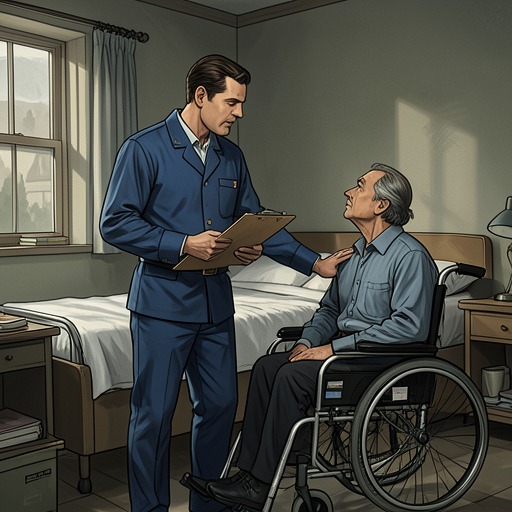
The phrase’s meaning is prepared by Dan’s visit to Charlie Hayes, a ninety-one-year-old man in the Alan Shepard Suite. Charlie is painfully thin and barely seems present; Dan waits to be certain that his chest is still rising. Azzie lies curled beside him, a quiet witness to the room. When Charlie confesses, “I’m pretty scared,” he specifies that he is not afraid of hell so much as of there being nothing after death. His question makes the fear spiritual and existential, not merely physical.
Dan takes Charlie’s hand rather than checking his pulse, recognizing that the old man is near death. As he touches him, Charlie’s life comes to him in a rush of remembered images: his children on swings, his wife, work and family scenes, and moments from different ages. The memories blur together, and Dan understands that this is the kind of moment for which his own painful history has prepared him. Charlie has come to the border. Dan answers his fear by saying, “We never really end, Charlie,” while admitting that he does not know how this works or what it means. The exchange does not turn uncertainty into proof; it gives Charlie company and reassurance at the very edge of life.
Fred Carling and the Promise
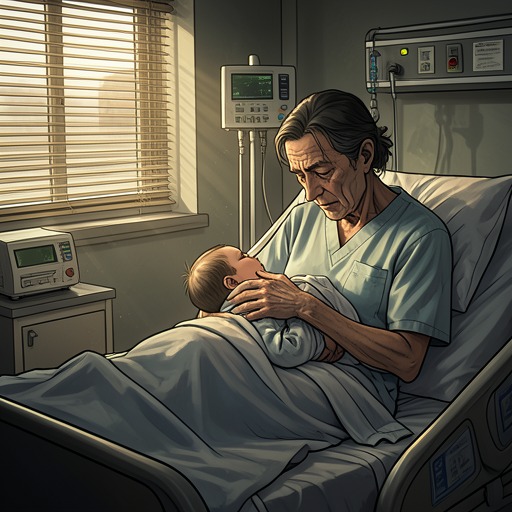
The expression reaches its clearest form in Dan’s final encounter with Fred Carling at Rivington House. Fred’s breathing rattles, and he looks up at Dan as if asking for help. Dan tells him that Brownie will be cared for by a girl Dan knows—his niece, whose birthday it is—addressing a practical concern even as Fred’s life draws to a close. Then Dan tells him, “You only need to sleep.” When Fred’s unspoken plea is not to be left, Dan answers it directly: “No,” Dan says, “I’m here. I’ll stay here until you sleep.” He clasps Fred’s hand in both of his and smiles. The final repetition, “Until you sleep,” makes the promise an action: Dan stays and holds Fred’s hand.
This bedside scene belongs to a wider pattern of care rather than standing as an isolated gesture. At Concetta Reynolds’s bedside, Dan straightens her displaced cannula, takes her hand, and speaks with her; she manages to caress his cheek and tells him she is ready. Her exchange differs from Fred’s: she affirms her readiness, while Fred’s scene turns on his appeal not to be left. Together, these moments show Dan responding to the person before him, not imposing a single script for dying. His care cannot remove illness or loss, but it can attend to fear, practical needs, readiness, and the wish for company.
Recurrence and Narrative Role
“UNTIL YOU SLEEP” appears as a chapter heading after Dan looks back at Roof O’ the World, where the confrontation has ended, and again before the chapter that opens with Abra Stone’s fifteenth birthday. The repeated heading connects the aftermath of violence to the quieter work that follows. It also gives the phrase a structural role: what first reads as Dan’s bedside assurance returns as a marker for the book’s movement toward its closing scenes.
The recurrence links two forms of presence without making them identical. At the end of the confrontation, Dan looks back at what remains of his father before leaving with Billy Freeman; the later heading precedes a section that eventually returns to Dan’s work with the dying. The phrase’s central promise is therefore both intimate and vocational. Dan’s words do not explain death or erase grief. They define what he can offer in its presence: attention, a steady hand, and the refusal to leave before the person is asleep.