Azreel
Doctor SleepAzreel is the freely roaming cat of Rivington House, a twelve-pound presence whose daily habits make him both a familiar companion to the residents and a quiet attendant at the end of life. Dan Torrance jokingly presents himself as Azreel’s assistant rather than the doctor, but the distinction points toward the cat’s unusual place in the house: he seems to know when a guest is dying and goes to be with them. His rounds give that knowledge a physical, unceremonious form—a cat arriving at a bedside, settling down, and purring.
Identity and Place at Rivington House
Azreel is a stray adopted by guests at Rivington House. The people who brought him in have since died, but he remains part of the life of the three-building complex. The residents like him, and he appears to return their affection. His size—twelve pounds—makes his gentleness especially noticeable: he sometimes climbs into an elderly resident’s lap, yet lands lightly and does not seem to hurt them.
Dan treats Azreel’s judgment as dependable, drawing on nearly six years of experience. A colleague’s confidence in the cat becomes especially persuasive when Charlie Hayes, who had seemed lively only hours earlier, is suddenly found near death. Azreel is already beside him. The cat’s presence is not a medical diagnosis, but within the house it is a sign Dan knows how to read.
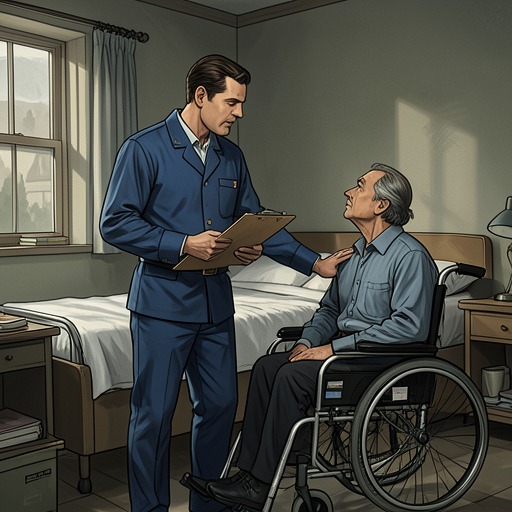
Dan describes himself as Azreel’s assistant, a playful inversion of the usual relation between a caregiver and an animal. Mrs. Clausen dismisses the notion that the cat could be a doctor, calling him an ordinary stray who cares about his twice-daily bowl of Friskies. Dan does not argue; both of them know the description is incomplete. The joke allows the book to hold two views at once: Azreel is plainly a cat with ordinary appetites, yet his behavior carries a significance that the residents and Dan recognize.
Daily Rounds and Night Patrol
Azreel spends much of the afternoon in the recreation room, curled on a sofa or draped across a card table, sometimes over a half-finished jigsaw puzzle. He moves among the complex’s other spaces as well: the spa, the Health Suite, and even an abandoned gurney. At times he stares into empty air at things only cats can see. He also stalks the back lawn, but if he catches birds or chipmunks, he carries them away to a neighboring yard or the town common before dismembering them.
His routines change after the residents leave and the television goes off. As night settles over Rivington House, Azreel becomes restless and patrols the corridors like a sentry. His mouse-colored fur blends into the dimness, so he may be hard to spot unless someone looks directly at him. The contrast between his visible, social afternoons and these shadowed rounds makes his nocturnal presence feel watchful without turning it into an explanation: he goes where he has things to do, though the narrative leaves some of those things beyond human sight.
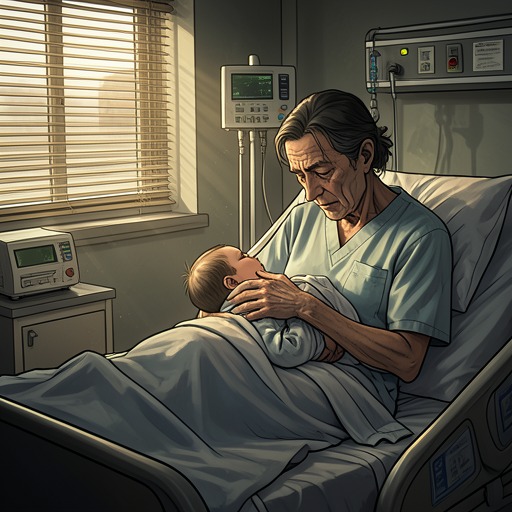
Azreel does not enter guest rooms casually. He goes into one only when a guest is dying. If the door is open, he slips inside; otherwise, he waits outside, tail curled around his haunches, and gives a low, polite meow to be admitted. Once allowed in, he jumps onto the bed and settles beside the dying person, purring. The guests accept him as a friend, and Dan has never known anyone to demand that he be removed. His care is intimate but undemanding: he asks entry, stays close, and does not require the person to speak or respond.
Companionship at the Border
Charlie Hayes’s death brings Azreel’s role into focus. Dan finds the ninety-one-year-old in the Alan Shepard Suite, pale and nearly motionless, with Azreel curled beside his hip. The cat surveys Dan as he enters. When Dan takes Charlie’s hand, he understands that the old man has reached the border; Azreel’s arrival has already marked the moment as one that calls for a different kind of attention.
Charlie admits that he is frightened—not of hell, but of the possibility that death means nothing follows. Dan holds his hand and reassures him. Azreel gives a small, troubled meow, apparently sensing Dan’s feelings. The gesture does not replace Dan’s work of listening and comforting, but it places the cat alongside him in the room: both respond to a vulnerable person without demanding that fear be hidden. As Charlie’s life passes through Dan’s mind in images from childhood, marriage, work, and old age, Azreel remains a solemn, living presence at the bedside.
The cat’s attentiveness also reaches beyond the people whose beds he visits. After Charlie’s death, Dan senses someone watching from an empty doorway and asks whether the visitor is Abra Stone. Faint piano notes answer. Dan cannot be sure whether he has heard them through his own perception or the shining, but Azreel’s ears twitch and his eyes remain fixed on the doorway. The shared attention confirms that something is there, even though the visitor is unseen. After the notes stop and the presence is gone, Azreel stretches, jumps down, and leaves without looking back. He registers the encounter through his own alertness, then resumes his rounds.
The Cat as Caregiver and Witness
Azreel’s importance comes less from any explanation of his abilities than from the pattern of his actions. He moves freely through the house, but reserves the guest rooms for the dying; he waits to be admitted, then settles beside the person who is crossing from life. That repeated choice turns an ordinary housecat into a familiar companion at the threshold, without making him a clinician or a substitute for human care.
Later, when Dan visits Concetta Reynolds, he imagines that Azreel would be curled beside her, waiting for Doctor Sleep to arrive before returning to his patrol. The imagined presence connects her room to the same practice established at Charlie’s bedside: in Dan’s understanding, the cat belongs wherever someone is approaching death. Azreel’s rounds thus give Rivington House a quiet ritual of companionship. His presence does not erase fear or illness; it makes the last moments less solitary.