Cycling
Doctor SleepCycling is a recurring, terminal change in which members of the True Knot fade from solid form toward transparency, briefly return, and then disappear. The process makes the group’s apparent longevity precarious: what its members have treated as an exceptional danger becomes a visible threat to the people around them, and, in the closing attack, a means by which the True Knot is destroyed.
Pattern and Recognition
The process is established first as a feared possibility rather than a settled diagnosis. Petty reports that she thinks Grampa Flick has cycled, prompting Rose the Hat to ask whether anyone else, including Baba or Sue, witnessed it. The uncertainty matters: the True Knot has already lost members, but Rose resists treating Grampa’s condition as evidence that the same danger has reached him. When Crow says Grampa’s mind is breaking down, the concern is still partly about his mental state; the reported cycling gives that decline a more alarming physical dimension.
Grampa’s first clearly observed episode makes the change unmistakable. His skin turns milky and then translucent, allowing Rose to see his internal form before he returns to solidity. He reaches for her hand and asks her not to leave. Rose’s instinctive hesitation gives way to contact, despite her fear that he may be contagious. Her response brings the group’s collective exposure into focus: if the suspicion of infection is right, the danger is no longer confined to Grampa.
The episode overturns Rose’s confidence in the True Knot’s endurance. She had accepted that some members died, but regarded those deaths as exceptions, generally attributable to carelessness. Watching Grampa cycle makes that explanation untenable. His condition does not resemble an isolated accident; it is a process unfolding in front of the group, and one Rose had not allowed herself to imagine as a threat to its long-term survival.
Grampa Flick’s Final Episodes
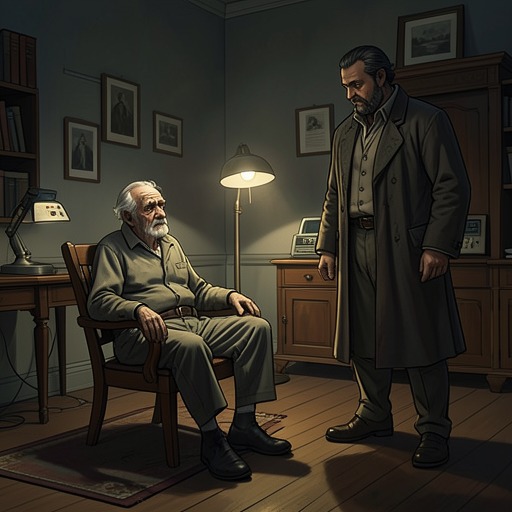
Grampa’s cycling quickly becomes more frequent and severe. At his RV, he alternates between transparency and solidity, with each transparent phase lasting longer and more of him vanishing from view. Rose recognizes that he understands what is happening and is frightened by it. When he returns to solidity, he pleads for the pain to stop. Rose tries to reach him mentally, but finds no stable presence to comfort: his mind has become a rush of broken images, and she withdraws, shaken.
The others consider whether they can ease his suffering. Big Mo suggests that Walnut might have something to give him, but Walnut judges that medication would no longer help: Grampa’s condition is progressing too quickly for his body to circulate it. The group therefore remains with him as the episodes continue. Rose counts four more full cycles; on the fifth, Grampa disappears. His eyes linger briefly, then vanish as well. The people at the bedside wait, not entirely certain that he will not return, but only the indented pillow and the marks left by his hair tonic remain. The repeated transitions have ended in absence.
The Outbreak and the Spread of Cycling
Later episodes connect cycling to the True Knot’s measles crisis. Barry is still solid when Crow checks on him, though he is feverish and covered in red spots. As the group travels toward the area where Abra is believed to be, Barry begins cycling in earnest. He has little interest in the juice Walnut offers and becomes increasingly distressed each time he returns to solid form. He tries to speak privately to Crow, but another cycle begins before he can. When he reappears, he screams and urges Crow to listen. The episode is not merely a visible change of form: it interrupts communication and leaves the group watching as Barry’s condition worsens.
The crisis reaches Jimmy Numbers as well. He sees the first spots on his own arms just before Barry disappears during another cycle. This establishes the spread of the illness through the group, while distinguishing the onset of symptoms from the cycling already underway: Jimmy notices the spots, but this scene does not show him cycling. Later, Walnut is seen cycling rapidly after being wounded in the confrontation with Dan and John. His clothes and body repeatedly fade and return, making the same pattern visible in the aftermath of the fight. These episodes place the phenomenon across different circumstances, but the evidence does not make every injury or every disappearance identical to Grampa’s illness.
Snakebite Andi also cycles while dying after the confrontation. She returns to solidity long enough to speak about her past and her life with Rose, then begins to fade again. Near the end, she holds on to her physical form for a moment before another cycle takes her out of sight. Her final words are followed by a last disappearance. The scene gives her a measure of agency in her final exchange: she uses the brief interval in which she can still speak to explain that she and the others did not choose what they were, even as the people confronting her reject that claim.
The True Knot’s Collapse
Cycling becomes most consequential when Dan uses Concetta Reynolds’s steam against the True Knot at Bluebell Campground. The group has already been weakened by measles, and the red mist spreads among its members. Some last longer than others, but the process is swift. Members begin cycling as the steam overwhelms them; two embrace as they disappear, their clothes left behind. The repeated alternation that had marked individual deaths now becomes a collective end. The scene briefly attends to the bond between the members even as their reliance on steam turns against them.
Rose is struck by the experience of the True Knot dying around her. She recognizes that the group’s companions are gone and believes herself to be the last, though Snakebite Andi remains. In the final confrontation, Rose herself is killed and begins cycling. Dan holds Abra’s hand as Abra cycles between her back stoop and Roof O’ the World, and they watch Rose fade. Rose’s remaining features disappear last. The parallel is stark: the cycle that had revealed the True Knot’s vulnerability in Grampa, Barry, and Andi finally reaches its leader.
Significance
Cycling is both a physical pattern and a structural refrain. Its recurring sequence—fading, return, and further fading—makes the True Knot’s hidden frailty impossible to dismiss as an isolated mishap. Rose’s changing understanding, from disbelief about Grampa to recognition of the group’s destruction, gives the recurrence its narrative force. Each return offers a short interval in which a member can be seen, heard, or comforted; each renewed disappearance narrows that interval.
The phenomenon also marks a reversal in the True Knot’s relation to steam. The group expects steam to nourish its members, and initially hopes it will help Grampa. At Bluebell Campground, however, Concetta’s steam becomes lethal to the already weakened group. Cycling makes the consequence visible: members pass repeatedly between presence and absence before disappearing for good. What begins as an alarming condition at one RV bedside thus anticipates the end of the True Knot’s shared claim to endure.