Fred Carling
Doctor SleepFred Carling is a night-shift orderly at Rivington House whose indifference to the people in his care puts him at odds with Dan Torrance. His story turns on a pointed reversal: after showing little regard for a dying resident, Carling becomes critically injured himself and asks Dan for help. Dan’s response makes Carling’s final scene a test of the hospice worker’s compassion, not of whether the two men like one another.
Identity and Work at Rivington House
Carling works the midnight-to-eight shift as one of three orderlies at Rivington House. The other two rotate onto day shifts twice a month; Carling does not. He calls himself a night owl, and his substantial build and tattoo-covered arms suggest a biker past, though the account does not elaborate on that history. When Dan encounters him near the snack alcove, Carling is eating peanut butter crackers and reading an old Popular Mechanics. Later, he appears on a shaded bench with a grease-spotted McDonald’s bag and a Big Mac, details that establish his recurring appetite for convenience food.
Carling’s work brings him into contact with hospice residents, but the scenes involving him emphasize a gap between the responsibilities of care and his manner toward the dying. When Dan asks about Charlie Hayes, Carling reports that Charlie has had a nosebleed and says he put the bloodied towels in a proper waste bag, in Laundry A. The practical detail shows that he has followed at least one required procedure, but Dan questions how a bleed requiring several towels could be described as minor. Claudette likewise considers Carling useless and hopes he will be fired. The contrast between procedural compliance and attentive care becomes central to how the narrative presents him.
Conflict with Dan Torrance
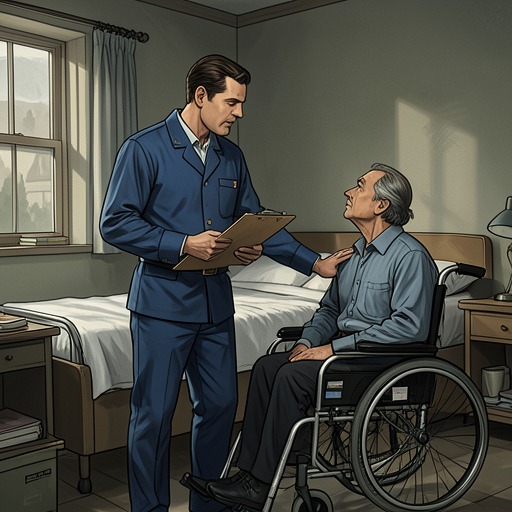
Carling calls Dan Doctor Sleep and makes a joke about Dan’s supposedly secret identity, teasing him rather than treating his work seriously. Dan privately considers him an unfeeling dolt and doubts that he earned his position on merit. Their dislike is mutual: Carling sees Dan as a meddling moralizer, while Dan regards Carling as lazy and sadistic. For a time, they manage the hostility through avoidance. Years later, Dan sees Carling at Rivington House; neither man greets the other, and Dan is content so long as they remain out of one another’s way.
The antagonism becomes more direct after Charlie dies. Carling responds to the news without looking up from his magazine and treats the death as an ordinary reason for residents to be at the hospice. Dan reacts physically, hooking a foot behind Carling’s chair and pulling it away so that Carling falls. He then holds Carling back against the wall with a foot to his chest and demands his attention. The episode marks the force of Dan’s anger at Carling’s apparent indifference, but it does not resolve their relationship: Carling continues working, and the two later return to avoiding each other.
The Collision and Its Consequences
Carling’s familiar habits recur in the circumstances of his injury. He is struck by a car while crossing Cranmore Avenue on the way to get his evening cheeseburger. Claudette says he sometimes looks for traffic and sometimes assumes drivers will stop. The driver who hit him is reported to have been so drunk she could hardly stand, and a serious four-car collision elsewhere delays the ambulance response. Staff stabilize Carling at the hospice, but his injuries are critical, and Claudette believes he will die before transport becomes possible.
The accident brings Carling into the Alan Shepard Suite, the same room where Charlie died. Dan recalls Carling’s earlier response to Charlie’s death, including his casual manner as he sat eating Junior Mints, and recognizes the return of the situation as a turn of the wheel. The parallel does not make Carling’s fate a simple moral punishment: the immediate cause is a drunk driver’s collision, while the narrative’s emphasis falls on the repeated setting and on Dan’s memory of how Carling treated another dying person.
Final Request and Change in Dan’s Response
Although Dan and Carling are not friends and Dan does not like him, Carling asks for Dan while he is still conscious. Claudette passes on the request and urges Dan to come promptly. Dan tells Abra Stone that he must go, and she notices the contradiction between his willingness to answer and his dislike of the man. The request changes the terms of their encounter: Carling, previously the person whose conduct Dan condemned, is now dependent on the hospice worker he had mocked.
Dan finds Carling gravely injured in the suite, with Azzie curled at the foot of the bed. Carling can respond only faintly, and his breathing indicates how close he is to death. He also worries about Brownie; Dan tells him that his niece would be glad to take care of the cat and that it is her birthday. The exchange gives Carling a concrete concern beyond his own condition and gives Dan a way to reassure him before the final passage.
Carling silently asks for help. Dan understands that he can provide it and treats the work as a sacrament: accompanying a dying person is what he is there to do. He tells Carling that he only needs to sleep. The ending reverses the earlier encounter with Charlie. Dan had confronted Carling for responding coldly to another resident’s death; now, despite their history, he gives Carling the attention and assistance he had wanted Carling to show. Carling’s final significance lies in that contrast, and in the fact that Dan’s care is not conditional on affection or approval.