Grampa Flick
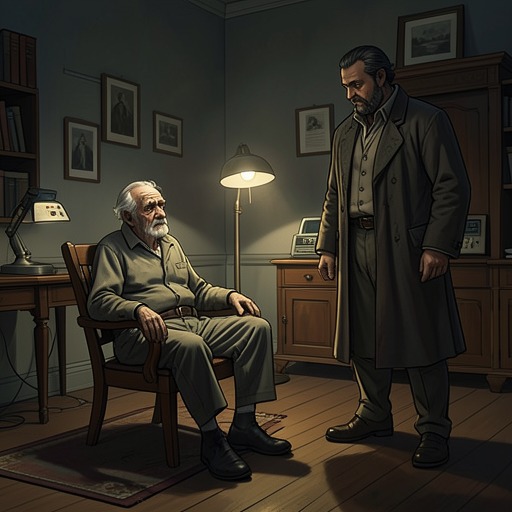
Doctor SleepGrampa Flick is an elderly member of the True Knot, a nomadic group that feeds on steam and presents its survival as a shared creed. He occupies two roles at once: he helps locate potential sources of steam, and he can lead the group’s ceremonies. Yet his declining health and occasional confusion make his place in that collective life precarious. The contrast between his frail appearance and the force of his ritual speech gives him particular weight in the group’s portrayal: he is both a keeper of its vows and evidence that its promise of endurance has limits.
Identity and Public Persona
Grampa Flick is introduced as an old man traveling with Rose O’Hara and Barry Smith. At a weekday movie showing, he watches the couple seated ahead of them and grunts that the film is interesting. The response is characteristic of his habitual contrariness, but his attention to the couple also places him among the True Knot members observing Andi Steiner before she joins them. The scene establishes him as an observer within a group that studies potential recruits and sources of steam, rather than as a stranger who appears only when the ritual begins.
His public identity includes an adaptable, unreliable account of his military past. At Sinatra Park, where the True Knot joins the crowds watching the aftermath of the September 11 attacks, Grampa Flick wears a cap marked as belonging to a veteran. He once claimed to have served in the Spanish-American War, later shifted the claim to World War I, and by this period said he had served in World War II. He even anticipates eventually changing the story to Vietnam. The narration identifies him as a military-history enthusiast and notes that plausibility has never troubled him. His shifting account works as a practiced persona: he can adjust his story to the passage of time, while the cap supplies a concise public signal that helps him blend into the crowd.
Ceremonial Authority
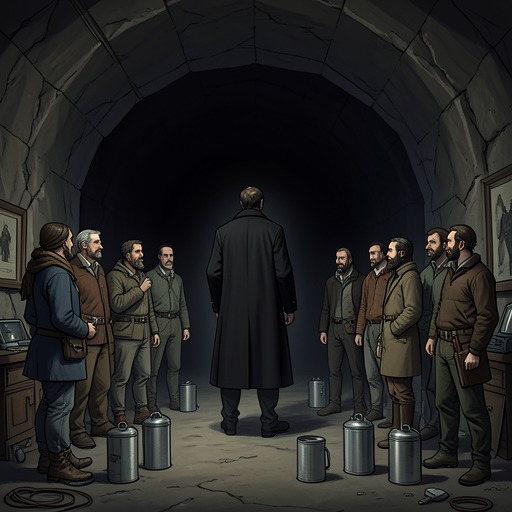
Grampa Flick’s authority becomes unmistakable during Andi Steiner’s induction. Rose O’Hara asks him to lead the gathering, and he raises his hands as the others join in. The group’s linked formation gives visual shape to its name and its ideal of being tied together. His authority is not simply a matter of age: he speaks the True Knot’s name and leads the exchange through which the group asks whether Andi will bind her life to theirs.
The scene contrasts his body with his voice. He appears extremely frail, dressed in loose shorts, high white socks, and sandals; when he raises his hands, the assembled members look like a chain of paper dolls. But when he proclaims the group’s endurance, his voice is no longer trembling. It sounds deep and resonant, like that of a much younger, stronger man. The moment gives the ceremony an uncanny intensity without erasing the visible vulnerability that surrounds it. Rose releases a puff of silver mist from a canister, and it begins to descend toward Andi after she agrees to join. Grampa Flick’s part is to lead the words and make the group’s bond explicit; the ritual’s promise of shared endurance is voiced through someone whose own frailty remains in view.
A Working Member of the True Knot
The True Knot’s ability to locate individual steamheads is rare within the group. Rose O’Hara recalls that only three members have the specialized sonar needed to find them: Grampa Flick, Barry Smith, and Rose herself. That capacity makes him useful in a practical way, connecting his unusual perception to the group’s search for sustenance. The distinction also clarifies why the True Knot’s members value different kinds of ability: disasters can draw the group toward abundant suffering, but locating a single target requires a more specialized sense.
Grampa Flick also appears in the group’s collective response to September 11. Around midmorning, as crowds gather along the riverbank, Pea and Pod push him in his wheelchair to Sinatra Park. The gathering gives the True Knot cover among ordinary mourners: some members cry on demand, while the others adopt expressions of sorrow and amazement. Grampa’s changing veteran story and cap help him fit the public setting, while his presence in the wheelchair makes him part of the group’s outward presentation. The passage depicts the True Knot not only as a secretive family but as a group practiced in adjusting its appearance to the people around it.
Decline and Narrative Significance
The contrast between the True Knot’s creed and Grampa Flick’s condition grows sharper when the group discusses his health. Six weeks after a previous good feeding, he is again feeling poorly. At Sam’s Supermarket, Barry Smith is concerned, while Rose O’Hara reassures him that Grampa will recover, describing him as tough. The exchange conveys both familiar affection and dependence: his companions know his recurring vulnerability, but they continue to count on his resilience.
That confidence is not always borne out by his behavior. During a journey with Apron Annie and Long Paul, Rose checks over the radio to ask whether he is all right. Annie sounds anxious; Grampa replies that he is fine, and Rose judges him to sound more like himself than when he is befuddled. Shortly afterward, another psychic ping arrives, and he recognizes that they are traveling in the wrong direction. The episode keeps his capacities and limitations in the same frame: he can detect a signal and correct the group’s course, yet those with him are alert to changes in his mental and physical state.
Grampa Flick therefore embodies a tension at the center of the True Knot’s self-image. The group declares that it endures, and he is entrusted to voice that declaration at a moment of recruitment. At the same time, his wheelchair, recurring illness, and lapses into confusion make endurance a condition to be managed, not an unquestioned fact. His role joins ritual, camouflage, and practical perception, while his vulnerability quietly tests the promise that the True Knot makes about itself.