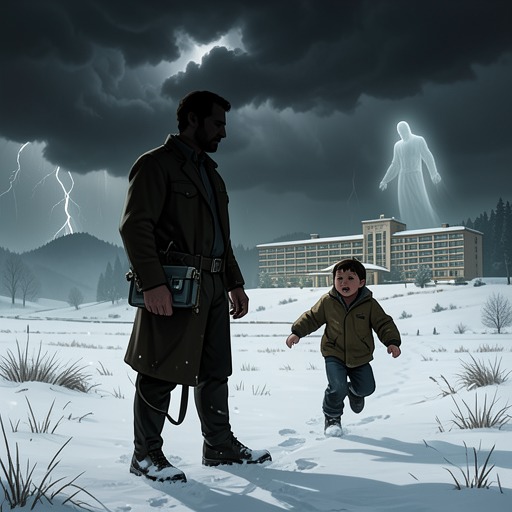
Hallorann’s “close your eyes” advice
Doctor SleepHallorann’s “close your eyes” advice is a practical instruction for confronting frightening visions without treating them as proof of helplessness. Dick Hallorann first gives it to Dan Torrance as a child; much later, Dan recalls and applies it during a frightening encounter in a bathroom. Its force lies in the sequence it prescribes: shut out the threatening image, endure the fear without fleeing, then look again and test what remains.
Origin and Principle
Hallorann’s earlier guidance begins from the possibility that Dan may see something frightening, but rejects the conclusion that seeing it leaves him powerless. The remembered instruction is to close his eyes, tell himself the apparition is not there, and open them again. It offers Dan an action he can take when fear seems to narrow his choices. Rather than requiring him to understand the vision or confront it directly, the advice gives him a brief, repeatable procedure.
The instruction is associated with Dan’s childhood experience at the Overlook Hotel. In the later recollection, Hallorann’s voice emphasizes that Dan was not helpless there as a child and is not helpless now. This comparison makes the advice more than a reassurance about one frightening moment: it reminds Dan of an earlier encounter with fear while insisting that the child’s vulnerability does not define his present capacity. The memory returns as guidance at the point when Dan needs to act.
Dan’s Use of the Advice
During the bathroom encounter, Dan first tries to name what is happening through a child’s voice that emerges in his own speech. The repeated denial that the frightening face is real forms a second, more immediate version of the same strategy: he uses words to resist the image before carrying out Hallorann’s instruction. The episode thus connects the remembered lesson to Dan’s childhood voice, placing the adult’s fear beside the younger self who learned how to meet it.
Hallorann’s voice then returns to Dan as a remembered presence. Dan closes his eyes and tries to count the seconds, but reaches only fourteen before losing the numbers in the confusion of his thoughts. The interruption matters: the advice does not instantly calm him or make the moment easy. Dan remains afraid and half expects the person associated with the hat to seize him. Yet he stays where he is, with nowhere else to go, and completes the essential part of the instruction by opening his eyes again.
Outcome and Limits
When Dan looks, the tub and washbasin are empty, and the mirror bears no writing. The scene gives the advice a concrete, immediate result: the bathroom no longer contains the threatening signs he had faced. The sequence is not simply a comforting saying; the narrative stages its procedure and then shows what Dan encounters when he tests the room again.
That outcome does not establish that closing one’s eyes will dispel every frightening experience, nor does the episode explain the nature of the apparition beyond what Dan sees and what is absent when he looks again. Its demonstrated scope is narrower. In this encounter, Dan’s fear is real, but it does not prevent him from waiting, reopening his eyes, and discovering that the room is empty. The distinction between feeling threatened and remaining helpless is central to the advice.
Narrative Function
The scene makes a remembered lesson active in the present. Hallorann is not physically participating in the bathroom encounter; Dan hears his voice through memory, and that recollection supplies the words and sequence Dan needs. The advice therefore links Dan’s past to his current response without erasing the fear between them. Its return is also a measure of continuity: what Hallorann taught Dan as a child remains available to him as an adult.
The movement from frightening image to closed eyes and then to an empty room gives the instruction its narrative shape. Dan cannot control the first appearance of fear, and his effort to count does not hold together; what he can do is follow the next step. The ending confirms neither a universal rule nor a full explanation, but it does confirm Dan’s ability to act within the encounter. Hallorann’s advice matters because it turns remembered reassurance into a specific test, and Dan completes that test for himself.