Helen Rivington House
Doctor SleepHelen Rivington House is a Frazier hospice housed in a distinctive Victorian mansion with two brick wings. Founded through Helen Rivington’s gift to the town, it gives Dan Torrance a place to rebuild his life and a vocation in which his shining can serve the dying. Its patients’ rooms, corridors, and Dan’s turret apartment make the hospice more than a workplace: it becomes a home organized around the care of people approaching death.
Setting and Buildings
Dan first notices the property on a walk through Frazier, where a rambling Victorian house stands between newer brick buildings joined to it by covered walkways. The mansion’s turret rises on one side but not the other, leaving it with an irregular outline he finds oddly appealing. When he looks up, he sees Tony wave from the turret window; the vision disappears, and the window proves to be boarded shut. The house’s physical oddity is thus also Dan’s first unsettling sign that his shining is returning.
A green-and-gold lawn sign identifies the building as Helen Rivington House. The institution occupies the mansion where Rivington once lived, along with the adjoining buildings known as Rivington One and Rivington Two. Its Victorian rooms include suites named for notable New Hampshire residents; Charlie Hayes, for example, is housed in the Alan Shepard Suite. The accommodations are not equal: rooms in the main house are larger and more expensive than those in the brick wings, a class distinction that persists even among the dying.
The hospice also appears in Teenytown, a miniature replica of Frazier’s main street. The model includes a waist-high version of the single-turreted house, while leaving out the two brick buildings beside it. A miniature railway beyond the attraction bears the name The Helen Rivington. In miniature, the mansion becomes the town’s visual centerpiece, an image that echoes its local importance while omitting the less picturesque parts of the working hospice.
Origins and Care
Helen Rivington is remembered in Frazier not only as a romance novelist, but as a benefactor who left the town substantial funds and gave away her house so older people could die with dignity. That purpose shapes the institution’s role in the novel: the hospice cannot prevent death, but it can offer a place and a community in which dying people receive attention and companionship.
The care is practical as well as emotional. Dan begins with maintenance work, painting the bandstand and clearing dead leaves from the common, before settling into work at the hospice as a janitor and orderly. He becomes an unofficial doctor in residence, with Azzie, the house cat, as his regular companion. In spring 2004, the patient list on Dan’s blackboard records thirty-two residents: ten in Rivington One, twelve in Rivington Two, and the rest on the floors below his apartment. Names are erased when residents die and added as new patients arrive, making the board a working record of both the hospice’s daily operations and its continual passage through loss.
The hospice’s work is not presented as a cure. When Abra’s family can no longer manage Concetta’s care at home, Abra arranges a vacancy at the Frazier hospice and explains that her great-grandmother’s past and present have become confused. The move is a response to the limits of family care, not a promise that illness can be reversed. At the bedside, Dan straightens Concetta’s displaced cannula and recognizes that no medicine available through the hospital pharmacy can save her. What remains possible is presence, attention, and respect for her readiness to die.
Dan’s Work and Home
Dan’s connection to the hospice begins before he is employed there. When he first sees the property, he is newly arrived in the area, still struggling with alcohol and haunted by the memory of a child he failed to protect. The sight of Tony in the boarded turret window unsettles him, and he hesitates to apply for work. He also recognizes that the hospice is where he might find employment, though he wonders whether he should wait longer after his last drink before seeking a job there.
The hospice supervisor, Kingsley, eventually takes him on, relying in part on Billy Freeman’s judgment. His terms are explicit: Dan must not arrive late, drunk, or visibly hung over, and Kingsley will ensure that he loses the job if he does. Three days into Dan’s employment, Kingsley offers him a room on Eliot Street for eighty-five dollars a week, with a private bathroom. Later, after about six months at the hospice, Dan asks to move into the unused turret room. He offers to clear it himself and argues that living on site would make him available when needed. Mrs. Clausen, the chief supervisor, lets him take it.
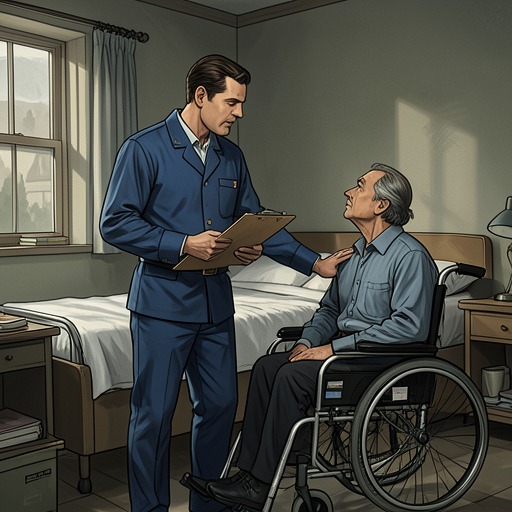
Dan makes the cramped room serviceable. He installs a safe space heater for the cold months and uses two fans to draw air through the open windows in summer; the third-floor room has no air-conditioning and can become hot. Among the discarded items he finds there, he keeps an old school blackboard. The same object serves his work and his private life: he uses it to track the patients and their room numbers, updating the names as the hospice population changes. By spring 2004, his residence and duties have become inseparable. He believes he has found his calling, and the hospice feels like home.
The Hospice as a Place of Passing
At Helen Rivington House, Dan’s shining lets him recognize when residents are near death and meet them as people rather than merely as patients. When he enters Charlie Hayes’s room, the ninety-one-year-old is so thin and pale that Dan has to wait to confirm that he is breathing. Azzie is curled beside him. Charlie admits that he is frightened—not of hell, but of the possibility that death means nothingness. Dan takes his hand rather than bothering to take a pulse, and Charlie’s life comes to him through vivid memories of family, work, food, music, and ordinary pleasures. The hospice room becomes the place where Dan can witness that whole life and reassure Charlie that people do not simply end.
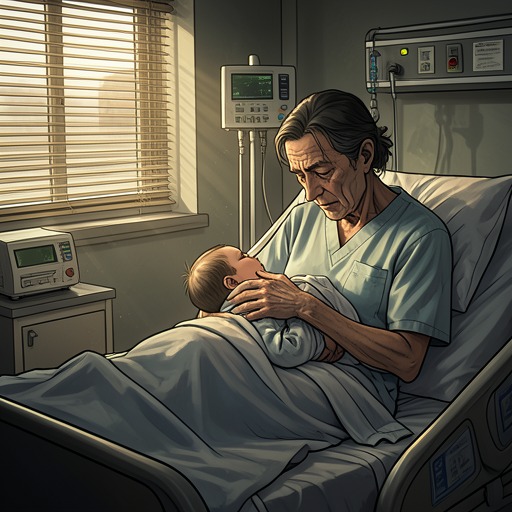
Other bedside scenes extend the same work of attentive presence. Eleanor Ouellette, at 102 the hospice’s oldest resident in fall 2013, lives with multiple serious illnesses and is nevertheless alert and spirited when Dan visits. He has a familiar rapport with her, addressing her playfully and sitting on her bed to ask how she feels. Later, in Concetta’s room, he finds her near death, with photographs of Abra surrounding her. Their final exchange is brief; Concetta speaks mostly in Italian, manages to caress Dan’s stubbly cheek, and answers that she is ready. The hospice makes room for these moments without disguising their outcome.
The work continues in the encounter with Fred Carling, an orderly who himself lies dying. Dan promises that Abra can take care of Carling’s dog, Brownie, and recognizes Carling’s plea for help. He stays with him at the border and offers the simplest comfort he can: sleep. Across these scenes, Helen Rivington House gives Dan repeated opportunities to answer fear with touch, listening, reassurance, and company. The rooms receive people at the end of life; in them, Dan’s own history of pain and recovery becomes part of his capacity to care.