Inherited violence
Doctor SleepInherited violence is the family pattern Dan Torrance confronts in himself and explains to Abra Stone: abuse and anger recur across generations, but recognizing that history does not make its repetition inevitable. The idea links events separated by decades, turning family history into both a warning and a question of responsibility.
Family Pattern and Recognition
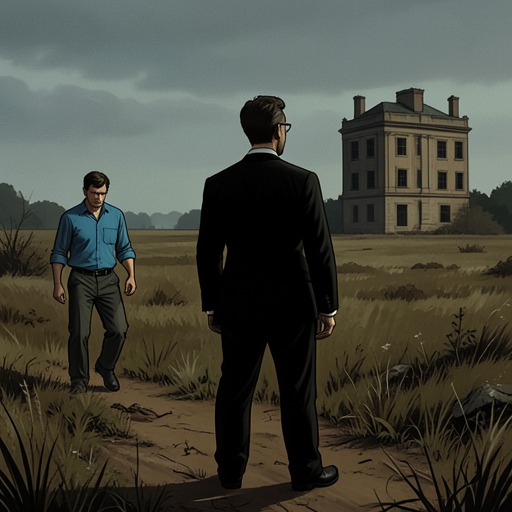
Dan traces the pattern back to his great-grandfather, Don Torrance. Don abused his wife, then concealed what he had done by claiming she had fallen; the children supported his account because they were afraid. Dan sets this remembered history beside what followed: his grandfather broke Dan’s arm and later attacked Dan’s mother at the Overlook Hotel. The different generations and circumstances do not erase the resemblance Dan sees in their violence.
Dan also includes himself in the account. Years later, in a bar in St. Petersburg, he beat a man unconscious with a pool cue after the man laughed at him. The incident led to thirty days in an orange jumpsuit picking up trash along Highway 41. By telling Abra this history, Dan describes the violence as something carried through the family, not as an excuse for it. His account culminates in a distinction he insists on after nearly choking Abra while under Rose the Hat’s influence: he is not his father. Abra responds that his temper suggests they really are related, making kinship at once a source of connection and a reason for concern.
Inherited Impulse and the Possibility of Choice
After hearing Dan’s account, Abra asks why she dreams about killing Rose and wishes she could undo it, even though Rose would have killed them. Dan does not answer with a simple moral judgment. Instead, he asks whether Abra regrets the killing itself or the pleasure she felt in it. The distinction leaves room for her to face not only what she did, but also the unsettling feeling attached to it.
Dan describes the connection between generations as blood calling to blood, while refusing to treat family history as a command. His account of inherited violence is therefore neither an absolution nor a prediction: knowing the pattern explains why anger and violent impulses may feel familiar, but does not erase the need to confront them. He sees Abra as entering a stage of life in which she is fully awake to herself, a difficult passage made more consequential by abilities that can become weapons. Her fear of her own anger is part of that awakening, not proof that she must repeat the family’s past.
Dan wants to comfort Abra physically but does not take her in his arms. The restraint matters: rather than closing the conversation with reassurance, he stays with her question and acknowledges how hard it is to live with powerful impulses. The family history remains real, but recognition creates a space in which inheritance can be examined rather than silently reenacted.
Kinship Discovered Through Evidence
The family connection Dan identifies is not established by physical resemblance alone. After Lucy wonders whether Abra inherited her temper, she points out that Abra looks more like her father than Dan. The clue Dan recalls is a repeated gesture: Abra rubs her mouth as Dan remembers his father doing. That resemblance had once brought Jack Torrance to mind, but Dan had not understood its significance at the time.
Dan explains that the shining cannot, by itself, prove a family relationship: Dick Hallorann had taught him that many people possess it to some degree, and Dan had met others who shone, including Billy Freeman. The ability offers a point of recognition, not a reliable family record. To establish the connection, Dan combines what he knows about the Torrance family with information about Lucy’s mother, Alessandra Anderson.
The circumstances converge on Stovington Prep. Alessandra had student-taught at a Vermont or Massachusetts preparatory school, while Dan’s father had taught English at Stovington Prep in Vermont before losing his job for hurting a student. Dan also knew that his father had been a published writer and that Alessandra had had a brief affair with her supervising teacher, who was a published writer. Concetta confirmed the Vermont setting and the affair, though she did not know the school’s name or the man’s identity. Dan therefore judged that Alessandra’s college transcript might identify her supervisor as John Edward Torrance. The disclosure rests on a convergence of family history and circumstantial details, making the link between Dan and Lucy a discovered relationship rather than an assumption based simply on likeness.
From Inheritance to Practice
Dan’s account does not end with the past: Abra connects it to the anger she feels toward teachers and classmates who mock people for their clothes or athletic ability. Her concern is not only that violence exists in her family, but that anger can flare in ordinary situations and feel difficult to govern. Dan recognizes the difficulty without treating it as proof that she will repeat what came before. He remembers advice from Casey Kingsley and offers it to Abra: go to the dump. The brief, practical response shifts the conversation from tracing a family pattern to facing what she can do when anger rises.
That turn gives the family history its force without making it a prophecy. Dan has described violence across generations, including his own, and acknowledged that Abra’s abilities can make anger more dangerous. Yet he speaks to her as someone capable of confronting her impulses, not as the inevitable next link in a chain. The legacy remains a warning; telling it, and listening when Abra names her own anger, makes it possible to meet the pattern consciously rather than leave it concealed or unexplained.