Jack Torrance
Doctor SleepJack Torrance is Dan Torrance’s father, a gifted but troubled man whose alcoholism and violence shape the central wounds of Dan’s childhood. At the Overlook Hotel, Jack’s attempt to prove his loyalty to the hotel turns against his family: he attacks Wendy and Dan, nearly killing them, and dies in the boiler explosion that destroys the building. Long afterward, Dan remembers him not as a simple monster but as a beloved father whose damage, and whose capacity for tenderness, remain difficult to separate.
Identity and Background
Before the Overlook, Jack taught English in Vermont and wrote fiction. He had published a handful of stories, some in respected magazines including the Atlantic Monthly. His teaching career ended after he hurt a student, and Dan later understood his father’s earlier life as one marked by heavy drinking and a volatile temper. Wendy had said that Jack liked drinking above all else; Dan carried that family history as a warning about the kind of man he might become.
Jack also appears in Dan’s account of how Lucy Stone may be his half-sister. Lucy’s mother, Alessandra Anderson, had been a student teacher in Vermont and had a brief affair with a published writer who supervised her. Dan connected those details to Jack, who taught at Stovington Prep and had published stories. Concetta Reynolds knew enough of the affair to support Dan’s inference, though she had not learned the man’s name. Dan therefore treated Jack’s paternity as a strong conclusion rather than a fact Concetta had explicitly confirmed.
The Overlook and His Death
Jack became the Overlook’s off-season caretaker. During the winter the hotel was closed, its defective boiler built up dangerous steam pressure because a relief valve was not working. Jack died while trying to release that pressure. The hotel burned to the ground in the resulting disaster; Wendy and Dan survived, as did the hotel’s chef, Dick Hallorann. The physical catastrophe closed Jack’s life, but for Dan the Overlook remained inseparable from the terror of his father’s final breakdown.
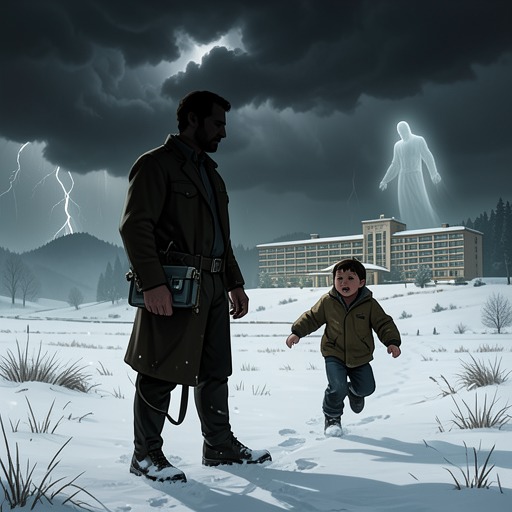
In Dan’s later recollection, Jack believed the hotel might make him its manager and that he could demonstrate his loyalty by giving it his son. During the family’s confinement, Jack was in the basement reading old papers for a book he hoped to write. The child Dan, carrying a passkey, wandered upstairs and confronted the hotel’s uncanny transformations. In a dream years later, the snowbound hotel returns as a place where familiar things become threatening and escape seems impossible. The dream’s child fears that his father is going mad; the adult Dan is reliving the moment when home and danger became impossible to distinguish.
Jack’s violence at the Overlook was real, but Dan and Wendy also understood the hotel as the force that had seized and directed it. Jack’s attack left Wendy seriously impaired and cost Dick his dentures. Dan later described his father as having nearly killed him and his mother there. The distinction between Jack’s actions and the hotel’s influence does not erase the harm; it gives Dan a way to remember that his father was both responsible for what he did and caught in a place that magnified his worst impulses.
Fatherhood, Love, and Violence
Dan’s memories resist a simple division between a loving father and an abusive one. Before the family moved to the Overlook, he waited outside their modest apartment for Jack to return from a job interview, holding a broken balsa glider. The boy expected his father to mend it with tape and glue, then perhaps fly it with him. As an adult, Dan could still picture how much that child loved the frightening man he was waiting for.
That tenderness coexisted with serious harm. Dan remembered that Jack broke his arm when Dan was about four, or perhaps younger. Jack had caught him in his study among his papers and was drunk. When Jack’s temper took hold, he had a habit of rubbing his mouth; Dan later demonstrated the gesture while telling the story. Dan did not remember his father as someone who never loved him. He acknowledged the breaking of his arm and the later attack on Wendy without treating either as proof that love had been absent. In his understanding, affection and danger had occupied the same relationship.
Jack’s drinking also became part of Dan’s early effort to make sense of his own life. As a teenager, Dan struggled with frightening voices and visions. He had promised his mother and himself not to drink as Jack had, but when he began drinking in high school, alcohol seemed to quiet the nightmares. The relief helped make a destructive inheritance feel, at first, like a solution. Dan later recognized that his father’s alcoholism had not merely supplied an example he wanted to avoid; it had helped form the conditions under which Dan became vulnerable to the same escape.
What Dan Carries Forward
Jack’s influence persists in Dan most sharply through anger. During a period of sobriety, Dan encountered a dying man who provoked a violent rage. Dan recognized that some part of him welcomed the anger, and he feared the resemblance to his father. His recovery had helped him manage that impulse, but he understood that it did not remove the family history or guarantee that he would never repeat it. Remembering Jack, Dan could feel sympathy for a man who had hurt him, while also recognizing how little sympathy had protected Jack from the consequences of his own choices.
The resemblance becomes newly visible when Dan notices Abra Stone rubbing her mouth as Jack had done when upset. Lucy had assumed Abra had learned the mannerism from her, but Dan connected it to his father and to the temper he recognized in the child. He later told Abra that anger and violence could run through generations, tracing the pattern beyond Jack to Don Torrance, Jack’s father. Don had abused his wife; family members, frightened by him, concealed what had happened. Jack’s later violence toward Wendy recalled that earlier history, though the men’s circumstances were not identical. Dan presents the resemblance as a warning about repetition, not as proof that anyone is fated to become an ancestor.
At the Roof O’ the World, Rose the Hat’s rage briefly overwhelms Dan during his struggle to protect Abra. In a disoriented moment he mistakes Abra for his enemy and realizes he has his hands around her neck. When the influence passes, he insists that he is not his father. The outburst is not a claim that anger has disappeared: Dan has just confronted the possibility that he could reproduce the violence he has spent his life fearing. Abra’s calm response recognizes both his temper and their kinship, while his decision to send her away acknowledges the immediate danger.
Narrative Significance
Jack is largely present through other people’s memories, especially Dan’s, and those memories repeatedly revise one another. The boy who expects a glider to be repaired is also the child who fears his father in the snowbound hotel; the adult who recalls the assault still admits that he loved Jack. This layered recollection prevents the family history from settling into an easy story of innocence on one side and evil on the other. It preserves the fact of injury while making room for grief and attachment.
The repeated gestures and acts of violence make inheritance concrete: a hand moving toward the mouth, a temper recognized in a child, an ancestor’s abuse echoed in a later generation. Yet Dan’s struggle is not simply to deny resemblance. His sobriety, his recognition of danger, and his intervention when Abra is at risk mark a difference between carrying Jack’s history and surrendering to it. Jack’s decisive significance is therefore both personal and generational: he is the father Dan loved and feared, and the example against which Dan must measure his own choices.